
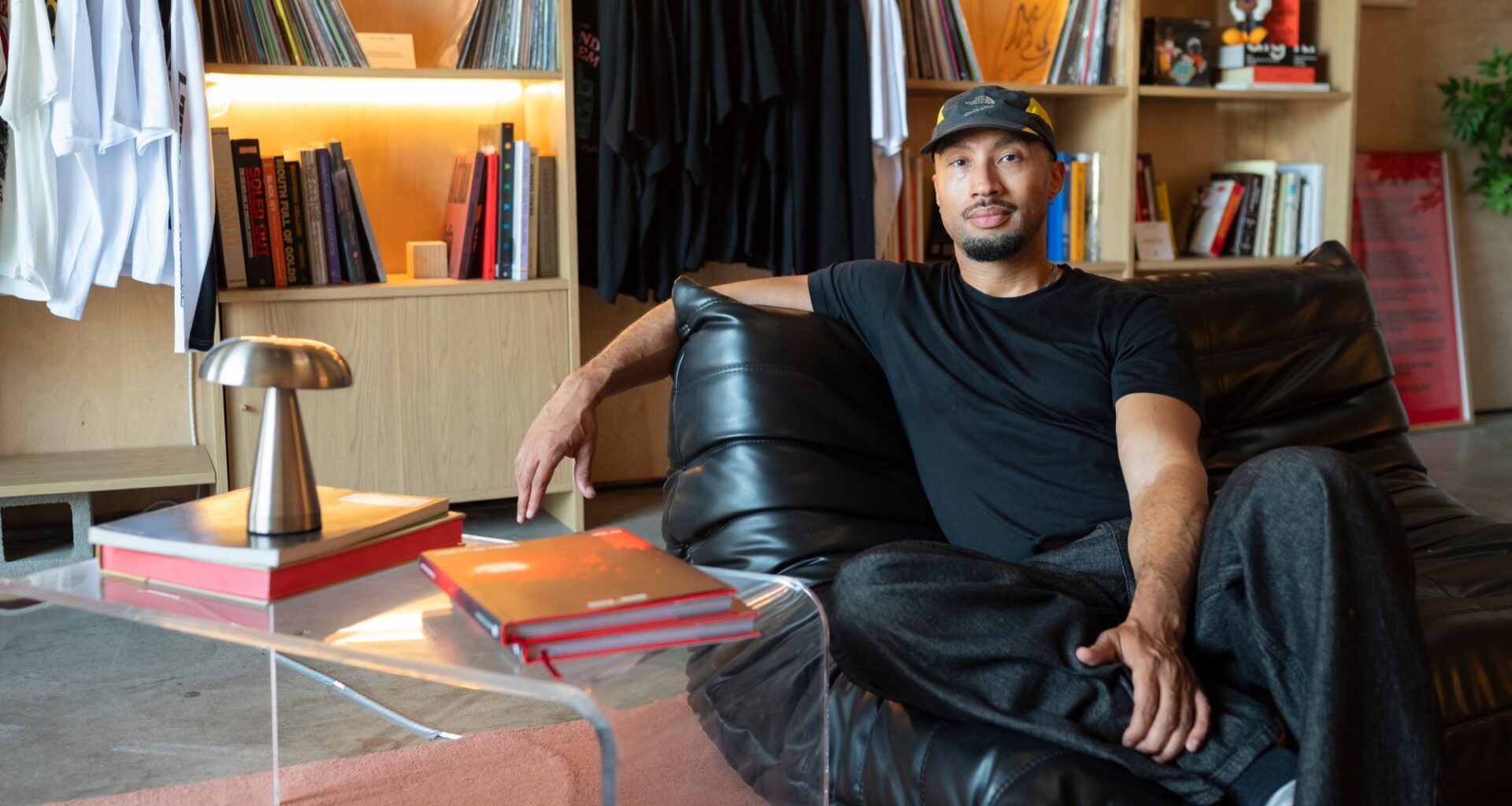
It was hot in the garage space Erwin Hines and his friends had secured in Barrio Logan to fold and ship the T-shirts he had created that people were ordering. To cool off, they would open the garage doors, leading to passersby stopping to read what was on the shirts, and eventually linger to chat.
“Slowly, every weekend, I would just open up the space, even if we weren’t folding shirts, just to be down there and engage in conversation,” he says. ” Not that I was the person who held a bunch of knowledge, but it was more just if people needed space to come and just be present with self. Also, just to express how they’re feeling about what’s going on, then this could be that space.”
What was going on was that it was 2020, George Floyd had been killed, and the response to his death and systemic racism was pervasive. Hines felt compelled to say something, too, so with his full-time background in design and as a creative director, he made a T-shirt with copy printed on it about respecting Black people and Black culture. He didn’t intend to sell it; it was just a way to articulate his feelings. When he posted images of the shirt to his Instagram account, people wanted to buy it and placed orders totaling 5,000 shirts.
“Since I had the full-time job, it gave me that freedom to take all of that money that we made from those first drops and just donate 100% of it to organizations that were doing the groundwork for change. We were donating $10,000 to this organization, $10,000 to this organization,” he says.
As he was reading books, watching films, and refining his own understanding of systems and ideas of collective liberation, folks in the neighborhood kept coming by the garage space in Barrio Logan, so Hines built it into what is now Future Is Color, a collective focused on creative and cultural design that also serves as a creative space, lounge, shop, listening room, and gathering place. That last one is the foundation that has built popular programming that includes their Studio Sessions series, which includes recurring live music gatherings; larger warehouse gatherings; a smaller and more intimate listening room space; and open studio times providing public access to the studio for conversation, work, or rest. There are also community conversations and jazz nights, encouraging folks to meet in person to deepen connection with each other.
Hines, 40, is the founder of Future Is Color, with a background as a creative director working with brands that include Google, Beats by Dre, and Foot Locker. He lives in Linda Vista with his wife, Janelle, and their son, Grey. He took some to talk about growing up as a creative kid in Cleveland, Ohio, how his family nurtured a knowledge of Black history and caring for the community, and how that all animates his desire to bring people closer to one another with greater empathy and compassion.
Q: Tell us about Future Is Color.
A: Future is Color started in 2020 as a response to everything happening in the world, the murder of George Floyd, and being a Black man growing up in America. It was a time in which I had to confront all of those experiences, and everything that my parents and grandparents had told me about what it is to be in America and the tension that exists within America. Obviously, I was taught all of those things, and my grandparents and parents did a really good job of exposing me to Black history, but during that time I never really had to confront what racism really meant. So, with the murder of George Floyd and how much media it got, and the fact that everybody was confronting it and there was the protests, it really caused me to sit with all of those feelings and all of those experiences.
At that time, I was creative director at an agency that I had been at for 10 years. A lot of what I was bringing to the table, unknowingly, was my Blackness. There was this tension in me already of how much of myself and the culture do we give to organizations when they aren’t necessarily going to invest that energy back into our communities? Then, George Floyd and all of the protests happened, and I went down to protest. It was my first time really going to protest, and I couldn’t get out of the car because all of the police officers were getting out with their batons and I got scared. In sitting with that, my response was to make a T-shirt; that was just how I had learned to express myself, was through the written word and small statements that express my emotions, my feelings. T-shirts were a canvas that I had become accustomed to, so that, as a canvas, just became very familiar for me. I put some words on a T-shirt, posted the T-shirt on Instagram with no intention of selling it; I was just using it as a canvas. People then wanted to buy it because of the messaging on it, which just said “Respect the people, Not just the culture,” and then on the front it said “You can’t love the culture and not support the people.” Then, it had a long chunk of body copy on it that explained what that meant. People wanted to buy it, so I put it on Shopify, and over two days we got 5,000 sales.
A lot of people were raising money during that time, and I had a full-time job, so I didn’t need to do this as a cash grab, or to make money to support myself. When I put it out, I thought maybe I’d make $500 or $700 because no one knew me as a clothing designer. I didn’t have a lot of followers on Instagram at that point, and I was just posting it because I wanted to express myself. When it sold 5,000 units, I stayed as creative director for another year at the agency. I wanted to make sure that we were donating to organizations that were doing work that was really going to transform communities, so I was doing more research, and that just began to expand my understanding of what it means to be on the ground and doing work within communities. Along with that, my experience within the agency space was understanding that the things we create, the images and the symbols that we put out, are all shaping our perception of the world around us, which in turn shapes our perception of ourselves. That shapes how we see ourselves and project ourselves into the future. The weight of what design and creativity are, and their potential, was leading me to make sure that Black folks can have better futures. At that point, that’s really all it was: “Oh, if I can use this to get people to buy a product, then I can probably use this same thing in order to get people to read these messages and dig deeper and learn as I learn.” Kind of go on this journey of deepening knowledge of self with me through these T-shirts and through my skillsets in design and creative direction. That was the foundational start of the artistic practice that is Future Is Color.
What I love about Linda Vista…
I like that it’s peaceful, but also central because we’re right above Fashion Valley Mall, so it provides a nice central location to get downtown, to get to North Park, South Park, Barrio Logan. It also provides a nice respite and space to relax in our neighborhood and community. I can walk with my son and it just feels like a little escape without escaping.
The name Future Is Color actually came from my sister, a teacher in Sandusky, Ohio. I’m originally from Cleveland, and a lot of my knowledge of Black history came from my parents spending time educating us, and us going to the South and learning about our own history through elders and other relatives. I recognized that that gave me a lot of firmness in who I am, and allowed me to carve out my own path because I wasn’t concerned with what society was saying I should be, or all that I could be. So, I worked with my sister to start a program, used some of the money from that first (T-shirt) release, and that program was called Future Is Color. The premise of that was that when you know your own story, you can write your own future. It was working with young kids, and it recreated a curriculum that ran alongside the school that was focused on rooting them in the power of their own story. Some of the money we gave to run this program was also buying laptops, cameras, the things they needed to dive into this curriculum; but the name came from that program because we had to come up with a name.
As I continued to release shirts, I didn’t want to become whatever this Future Is Color thing was going to be. I didn’t want to become a T-shirt brand, or have myself and my whole identity attached to it. So, I borrowed the name and the artistic practice, so I could separate myself from this thing. Over time, that just allowed me to decenter myself within the organization. Now, even when people come to programs or events, they don’t necessarily know it’s Erwin, and other people can actually take on the mantle of Future Is Color. The name was also rooted in this idea that the future should be one that embraces the nuance and the space between the polar opposites, whether that’s identity or whatever. Just being able to embrace the full spectrum of humanity, so that framework also allowed me to explore a lot of different things within those first couple years as I had to stay true to that. I also had to stay true to that foundational piece of these being tools for education, tools for liberation, because that’s what we were doing with the kids. That gave me a nice foundational framework.
Q: Why was it important for you to decenter yourself from the work of Future Is Color?
A: I’m a shy dude. I’ve always been someone who just follows intuition without second guessing it, and that got me to move from Cleveland to California and pursue design, not necessarily wanting to be a creative director, not wanting to be anything within that space, just wanting to be better at design and enjoying that process and continuing that process. I really just define myself as a community member, someone within community. I typically don’t define myself as creative director, or any of those things because they’re so narrow, and they start to frame how people might perceive us and see us. That removes humanity, so I never wanted to be framed in any one particular thing. At that time, I didn’t necessarily know if I had the perspective of, ‘This is going to decenter me and make this completely open to interpretation by anybody, and allow them to take on these principles and these values.’ For me, it was more that something in me was saying, ‘Ah, you don’t want to be defined as just this thing, so make it something outside of yourself.’
Q: How would you say your upbringing has influenced the work you’re currently doing?
A: I grew up in Cleveland, in this big, loving family. They were amazingly nurturing. They didn’t necessarily understand the artistic side because I feel like, in the Midwest, it’s heavy into sports, so they kept trying to get me to play sports, but I never wanted to. Even if I had a skill in something that was sports-related, or athletics-related, it just didn’t feel right. I would always go home and do some sort of art, whether it was customizing shoes and selling custom shoes in school, customizing clothes and taking sewing classes in school. I was just making stuff and I never thought anything of it; it was just a fun hustle. When I wasn’t in class, I got to make clothes and sell them.
My parents owned a development company that built affordable housing in the inner city. They didn’t just do it in a way where they were building homes to get money and then just leave. Every single weekend and every summer, they would wake me up to go to the neighborhoods and care for the homes. My grandparents on one side of the family owned a landscaping company, and then my other grandparents owned an exterminating company. One of the principles was how to maintain these communities over time, and just seeing that began to embed something in me. I didn’t know it at the time because I was like, “I just want to hang out with my friends. I just want to play basketball. Can I just go to summer camp?” It was like, “No, you’re coming to work.” So, it was that practice of how the things we create can ultimately help shape our communities, and that’s the framing I put around it later in life once I started doing design work and that sort of stuff. We did a lot of community service, so if I wasn’t working with my father or my grandparents, we were doing community service through the church or through Jack and Jill. There was just this reinforcement of “if you have, you give.” You give from your excess, back to the community because we have this responsibility. Along with that education, my aunts subscribed to educational books about Black history, so every month, they would give me two books a month and they would be about figures in Black history like George Washington Carver or Lena Horne. I think all of those things combined framed how I would then view the work that I would do.
I actually went to school for architecture and engineering to become an urban planner, with the goal being to take what my parents were doing in using physical space and the urban environment to help reshape communities and build more equitable communities. That was my initial goal, but I never liked math, and never really liked school, in general. It was the thing I thought I had to do because I didn’t know that art was an actual thing that you could do. Even though I was doing art and making clothes, I never thought about actually making anything at scale outside of it just being a hobby. I took some art history classes, and during those classes, I began to learn about art, and the impact of art at scale, and that an individual artist can actually speak to the ills of society and what’s happening in society. Art has a unique ability to reflect society back to itself in a way that society can actually receive it, and hopefully begin to have a conversation with themselves and with other people, that builds empathy. In the same way, I saw a parallel between that and urban planning and construction; you’re shaping how people perceive themselves. After a while, I began to have conversations with my grandparents and realized this is what they were doing, as well. It was about how do you actually build and help community, and that’s how they sustained capital, by giving resources back to the community. It was sort of a symbiotic relationship. Once I started with design as a practice, I went back to school after taking a year off, and was dating somebody who went to Wharton. If she didn’t go to Wharton, I don’t think I ever would have learned about branding as this large thing that can define and redefine how we perceive our worlds. That was that connecting point for me, of how art and business can be ways to actually subvert systems.
Q: One of the platforms within Future Is Color is your Studio Sessions series, which includes live sessions, warehouse sessions, the listening room, and open studio times. Can you talk about the idea of gathering itself as an artistic medium, and how you developed Studio Sessions to accomplish this?
A: With those first 5,000 T-shirt orders, I knew we couldn’t ship this out of my house. We have a cat, some of these shirts were black and would end up having a bunch of cat hair on them, so we had to do something a little bit more professional. My friends/business partners at the time, we got a small warehouse space, a garage in Barrio Logan next to Hayes Burger. We asked if we could just pack the shirts up in that space, so we brought all of the boxes. It’s really hot and there’s no airflow because it’s this little garage, so we’d open the big garage gates and people began to walk past. We’re folding the shirts and they have a bunch of body copy on them, so people would come in, read, and we’d start engaging in conversation.
It was a journey for me, as well. It wasn’t that I was any further along than what I was putting on the shirts, as far as understanding what’s happening in the world and all of that. I would just continue to read and buy more books, watch documentaries, and then I would bring all of that stuff into the studio. My full library was in the studio, so people could come in, hang out, read and have conversations. Slowly, I began to reshape the space to meet that need. We no longer needed the space to ship, so I ended up turning it into more like a living room instead of getting rid of it. Like, how do we keep this and maintain the energy that’s already building here? We got some couches, brought in more of my books, brought in a little Bluetooth speaker, and just began to open it more consistently. As we opened it, more people would come in just to hang out, read, have conversations.
One of those conversations was around having music in the space. At that same time, there was a young kid who we were working with, who’s now identified as Skate Jazz and has rotating band members. He was working with me as a designer, and his girlfriend came in and said, “He’s a much better drummer than he is a designer.” I said that if he could put together a band, we could hold a jazz night in three weeks. We ended up launching the jazz night. During that time, I was also working on a collection with Foot Locker for Black Music Month, and I was doing a lot of research on the universal impact of Black music, and how it creates opportunity and space for healing. It wasn’t just about the sounds of the music, but the culture and the space, the people and the clothing, and all of that stuff that was surrounding it that ended up creating these spaces of liberation that was then imbued into all of our experiences. Because Future Is Color already had that messaging, it was easy to tie that into the music experience. Even the reason we started with jazz is because jazz is a liberative music and framework. Improvisation is learning how to interact with people who might not be like you, or might not hold the same views, but you have to come together and just improvise on how to make something beautiful. That was the framework and foundation for launching Jazz Night. It was this process of continuing to learn what it means to gather, continuing to learn the importance of what it is to gather and to be together. I can run this race of chasing collective liberation on my own as this brand with the T-shirts, but what if the entire mission of the brand became creating space and opportunity for conversation and dialog around collective liberation, with the hope that that creates opportunity for empathy and expansion. If we just have more conversation about it, or bring people together in proximity; that proximity was a piece that I was missing because a T-shirt I can ship and people can wear it, but the proximity is not there. So, it was utilizing these spaces to create opportunity for real proximity, and the music became more of a conduit for people just being together.
Q: You mention that your “work starts from one core belief: the environments we inhabit teach us who we are.” What did yours teach you about who you are?
A: I think my environments taught me that I was expansive, and that I was multidimensional in who I am, and in a state of constant becoming. It rooted me in the knowledge that I can be firm and confident in who I am, while also knowing that I don’t know who I am.
Q: In your writing about place identity and how we bond to the environments we are in, and what those places tell us about who we are, when did you start to rewrite that story for yourself? If there was a way that the environments around you were telling you who you were in a way that maybe you rejected or you didn’t agree with, have there been moments where you started to try and rewrite the story your environment was trying to tell you about yourself?
A: To be honest, I wish I knew. I don’t. I think that’s also why I’m in therapy right now because I’m trying to understand that. I think I’ve been really good at doing these retrospectives, and picking apart and seeing what did what. Early in life, I had a very “I’m gonna do what I’m gonna do” type of attitude. I think that came from my elders and ancestors. And, even though sports was a big thing, was still a diversity of blackness and representation within my family and in Cleveland, so I never saw myself as one thing. I fell into that a little bit in high school where I was like, ‘Yeah, I’ve got to be hip hop. I have to be that,” but that also meant exploring these different dimensions of myself. When I was younger, and I don’t know where this comes from, but I always had this perception that I wanted to do the things that aren’t necessarily defined as Black by society, but for me they felt very Black because of the things in the books that I was reading. Like chess, which I wasn’t good at, at all. Or, skiing.
Q: Your writing references collective liberation and dreams setting us free, so do you feel free? What would you need to experience freedom, liberation? How is your current work paving a way there for you?
A: I feel free. Not in the current system, though. Like, I feel liberated enough and free enough mentally, but not physically because of the existing system that we live in. For me, collective liberation starts with us believing and seeing clearly what the system is, and how the system constricts our very being and our very essence to be one-dimensional, so that it can begin to build profit off of us and we chase particular things that benefit it rather than us. I was drawing something the other day, and I was thinking about capitalism and how extractive power exists on one pole, if this is a circle, and then on the other side, on the other pole, there’s humanity and love. Humanity and love and extractive capitalist systems cannot necessarily coexist. The capitalist system can subsume and take on elements and the picture of the simulation of love, but in that process, it just leaves the husk of love and humanity. For me, it’s being able to see those things clearly, not just from a book, but being able to rewrite them and begin to understand that this is how I can mentally be free and know that I don’t have to exist within that system, know that I can expand who I am and explore the range of who I am and my identity. But, everybody cannot have that freedom without violence. A lot of those things that I was reading over the years, putting it on shirts as I was learning it, it was resonating with me. Over time, I feel like those things became mantras, I began to say them more, and now I’m able to reflect on them and say them in my own words. It feels like the things that I’ve learned thus far have been crystallizing my being, so I can wholeheartedly say that even though I might feel like I have some freedom, I know that, in truth, I can’t be free until everybody’s free. That’s what the collective liberation piece is for me.
Q: What is the best advice you’ve ever received?
A: It’s from my wife, who said to just be honest with yourself about who you are, where you are.
Q: What is one thing people would be surprised to find out about you?
A: That I’m a deep introvert. Like, this isn’t what I naturally want to do at all, but it feels like this responsibility now because of the space and opportunity that it’s created for other people. That also was this reminder that I’m not here to extract anything because this is not a space that I want to become famous in, want to be seen in, want to be known for at all.
Q: Please describe your ideal San Diego weekend.
A: My ideal San Diego weekend would be going to a park with my son and just playing. He’s 2 and I’m just trying to cherish and be present. Some of the best advice I’ve ever gotten is from my 2-year-old and him being a mirror to my current growth.