
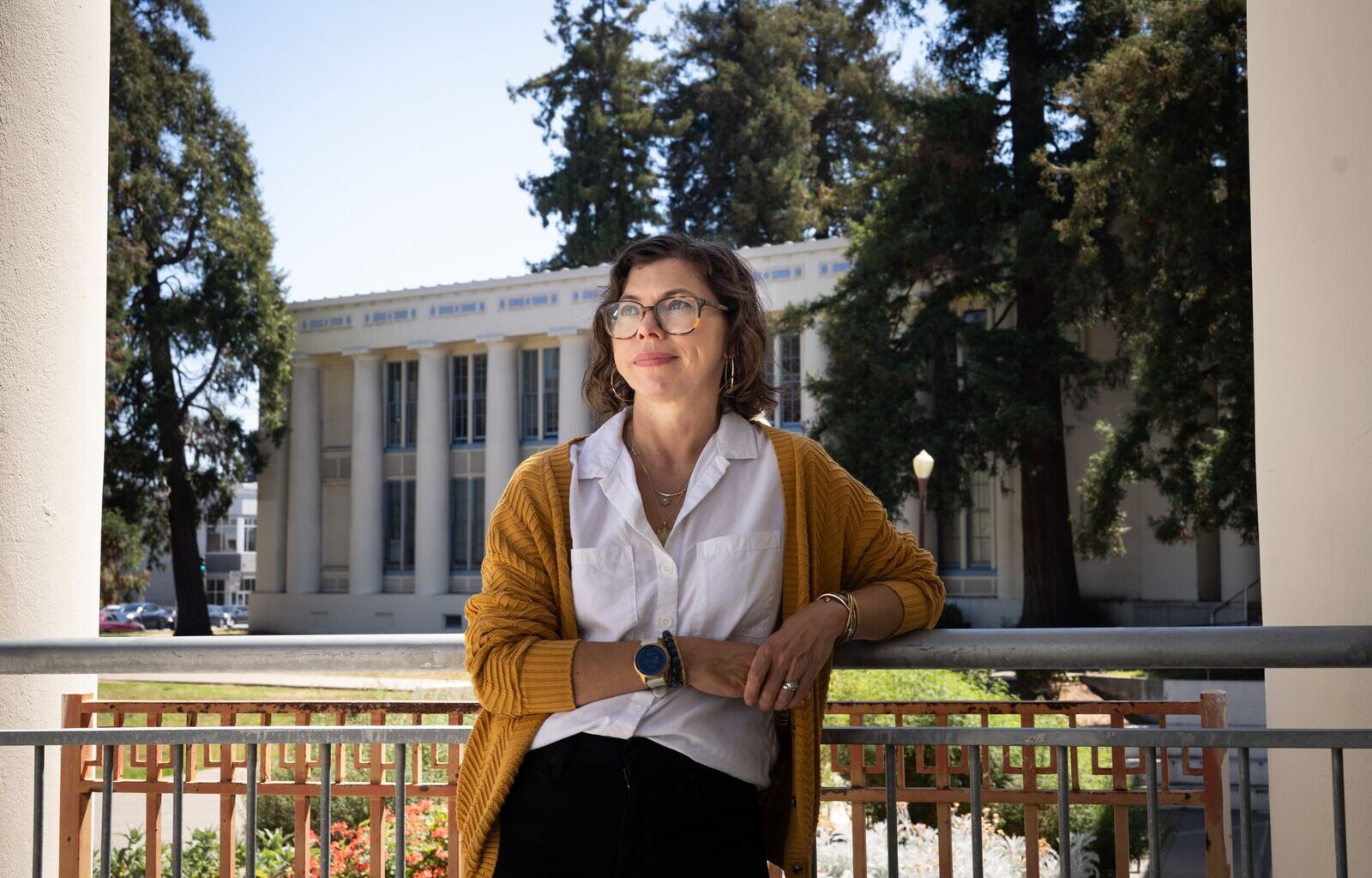
When Rachel Latta was considering a run for the Oakland school board in 2024, she worried about the impact on her family, the increased scrutiny, and the pressures of being in the public eye.
But more than anything else, she feared that her presence wouldn’t make a difference. At the time, the seven-member school board had only one parent with children in Oakland public schools: Sam Davis, who had decided he wasn’t running again.
As a mom of three, whose eldest child entered OUSD 10 years ago, Latta had experienced the many frustrations of Oakland Unified School District: mid-year budget cuts, teacher strikes, school closures, and a weary pessimism about Oakland’s public schools. She wanted to run for office to change all that.
Still, she hesitated. “What if I do all this work to join the school board and all the same things happen: We have a teacher strike every year, we’re closing a bunch of schools, we’re going back into receivership?” she told The Oaklandside. “It was a bit of a leap of faith.”
Oakland Unified has countless parents like her, who dedicate numerous hours every week volunteering at school sites, whether by organizing fundraisers, navigating complex school budgets, solving facilities problems, serving on oversight committees, or beautifying school campuses. Their earned knowledge of the pressures schools face and their personal experiences as parents in the public school system could make them ideal candidates for the school board, which is tasked with passing a balanced budget, evaluating the superintendent, developing board policies, and engaging with the community.
Historically, few of them have made that leap.
Latta ran, and won, replacing Davis as the only current OUSD parent on the board, where she now represents North Oakland’s District 1. Latta said her role, as both a parent and a school board director, has given her particular insight and sway among stakeholders.
Other directors have backgrounds in education and advocacy, or have adult children or children who haven’t started school yet. There are two nonvoting high school students who sit on the board to represent the student perspectives. But the lack of diverse parent perspectives on the board has left some families feeling like there’s a disconnect between the board’s decisions and their repercussions for families.
This fall, OUSD is at a pivotal moment. With the school year set to begin on Monday, the board will be tackling a $30 million gap in the district’s budget, restarting a search for a permanent superintendent, and navigating tough conversations about the district’s footprint, all while maintaining a healthy financial position to avoid receivership. It’s a moment that has prompted a renewed sense of urgency among parents.
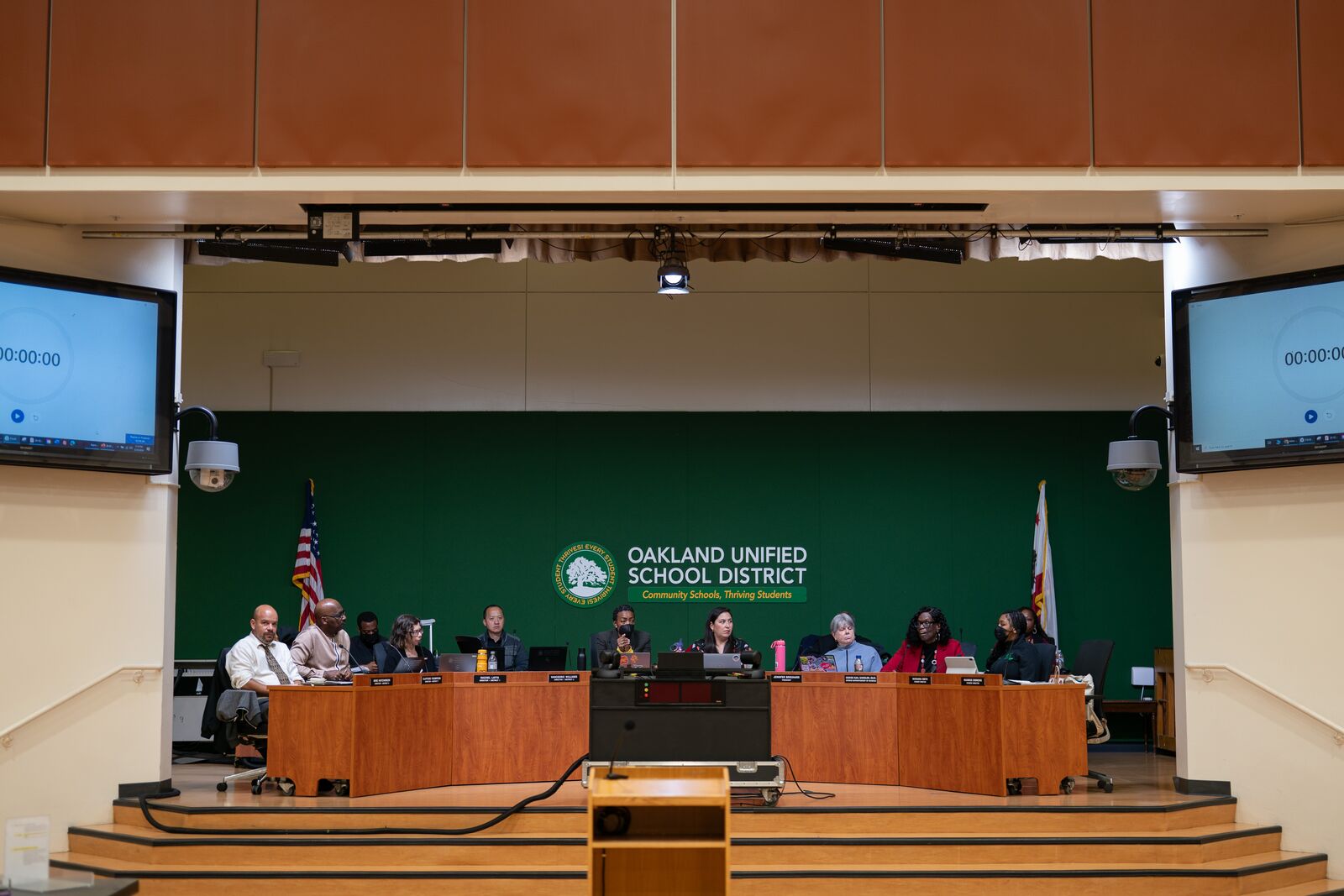 The OUSD school board during a meeting on Feb. 25, 2026. Credit: Jungho Kim for The Oaklandside
Three seats are up for election in November, and three parents have filed candidate papers: In District 2, Arielle Fleisher, who has a child at Crocker Highlands Elementary, will challenge incumbent Jennifer Brouhard, the board president, a former OUSD teacher whose children attended district schools. In District 4, Kathryn Camp, whose child attends Glenview Elementary, will challenge incumbent Mike Hutchinson, an outspoken education advocate and former afterschool teacher. And in District 6, LeAna Powell, whose children attend Burckhalter Elementary, will challenge Valarie Bachelor, a former labor organizer and social justice advocate. (A third candidate in District 6 is educator Alexandra Williams.)
Beyond the board election, there’s a newly formed parent engagement group in OUSD and parents have started a newsletter to dissect school board meetings. This year, parents also formed an independent expenditure committee, Oakland Parents for Quality Education, to support candidates in districts 2 and 6.
It’s beginning to look like a renaissance in parent organizing.
‘The fact that my kids are there changes the conversation’
Latta, whose children are entering ninth grade, sixth grade, and kindergarten this year, does think her presence on the board has had an impact. “As a board member, people do pick up my calls in a way that they wouldn’t when I was just a parent,” she said.
Last fall, when district staff were putting together a plan to solve the budget deficit, she said she called every person she could in the district to encourage a plan that didn’t include taking a loan from the state. The district left receivership in 2025.
“As the only person on the board with kids in the district who lived through receivership, the possibility of going back into receivership felt urgent in a different way,” she told The Oaklandside.
Before her role on the board, Latta was part of Equity Allies for OUSD, a group that raises money from PTAs across OUSD to redistribute to schools with higher poverty levels. She was a parent member of the district’s equitable enrollment committee, which examined ways to diversify schools. During the 2019 teachers strike, she volunteered from District 1 to bring food to the strike schools. Latta also got involved in parent discussions around the potential merger of Peralta and Sankofa elementary schools in 2019, and served as a member of Peralta’s school site council, the body that oversees targeted site-based funding, like Title I funds. When Latta later enrolled her children at Prescott Elementary in West Oakland, she joined the school site council there as well.
When it comes to discussions about school closures, she can weigh in as someone with direct knowledge of how they would impact families. In 2022, the board proposed closing Prescott Elementary and merging West Oakland Middle School, where Latta’s children would likely attend, with Westlake Middle School. The board later rescinded those plans.
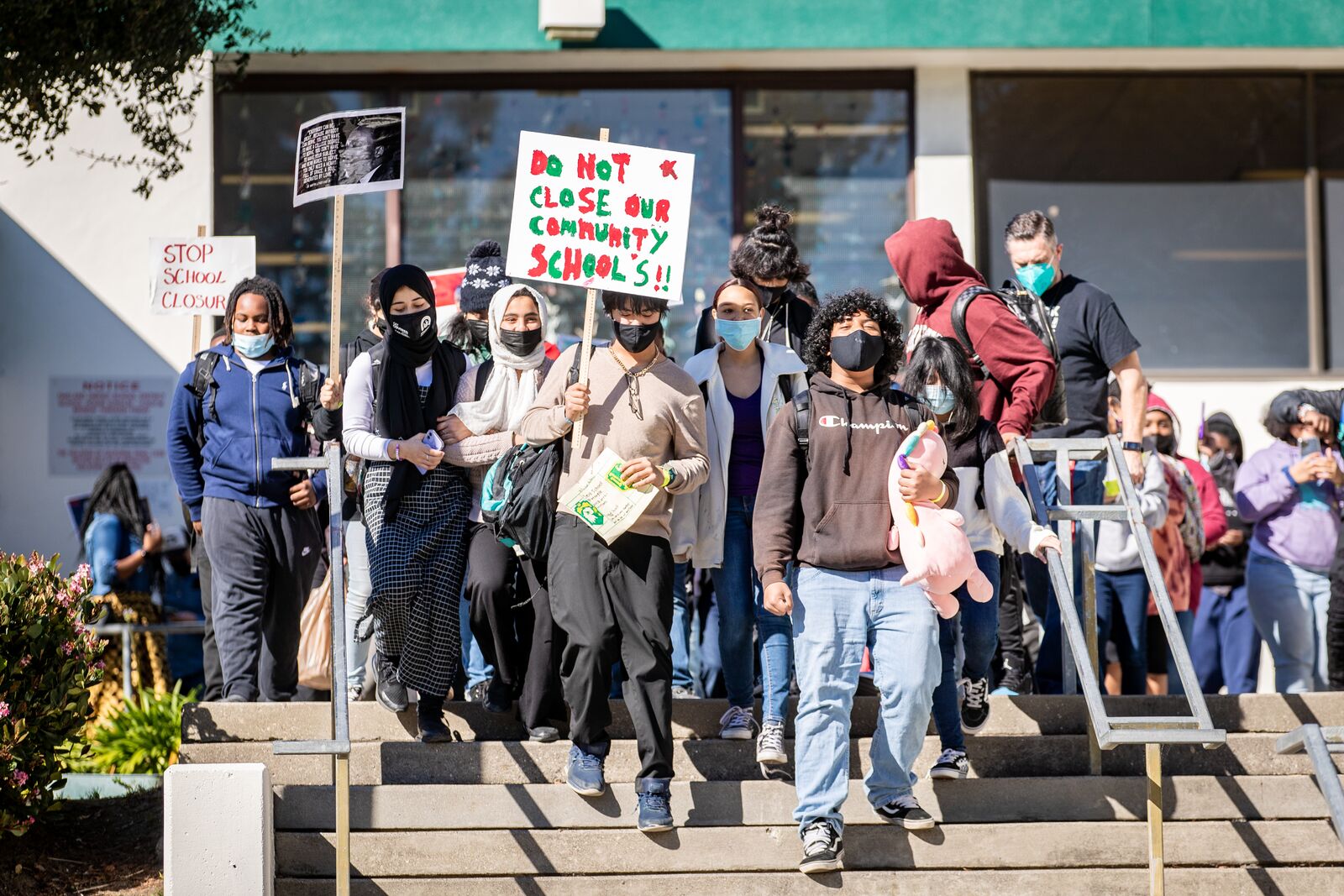 Students at Westlake Middle School walked out of class to protest a plan to merge their school with West Oakland Middle School in 2022. Credit: Amir Aziz/The Oaklandside
“The fact that my kids are there changes the conversation when I have been in meetings with senior leaders in the district,” she said. “It’s harder to talk about closing a school when I can say to you, ‘Let me tell you about these specific kids walking from Seventh to Prescott. If you’re telling them they have to walk another mile and a half across dangerous intersections, how is that better for them?’”
In her two years on the board, Latta has chaired the district’s budget and finance committee, participated in a district task force scrutinizing contract spending, and worked with special education families to sponsor a resolution restricting when and how OUSD closes special education programs.
Last year, the board made a decision that risked abruptly ending afterschool programs, leaving thousands of students and families in a lurch. Natalie Tammen, a parent of rising first and fourth graders at Peralta Elementary, said she finds it hard to believe that decision would ever have been reached if there had been more working parents on the school board.
“I think that was a big, exhausting waste of everybody’s time and energy to even go down that path,” she told The Oaklandside. “Because it was just so clearly not aligned with how parents feel, especially working parents, which is most of us here in Oakland.”
Board leaders said at the time it was not their intent to cut afterschool programs; they were simply trying to shrink OUSD’s contracts with outside agencies. Facing a blowback, that decision was later reversed.
Many parent activists hesitate to run
As the former co-chair of the Peralta Fund, the elementary school’s primary fundraising campaign, and a frequent participant in the school’s parent teacher group, Tammen knows well the ins and outs of school budgets. After last year’s budget cuts eliminated the school’s community school manager and teacher on special assignment, a sort of teachers’ coach, the Peralta community fundraised to reinstate the community school manager position.
But Tammen is uninterested in public office. Representing a city as diverse as Oakland seems impossible, she said. She’d prefer to spend her time working on projects that are already aligned with her views and values, rather than convincing others to go along with her ideas, as elected officials have to do.
Other parents who spoke with The Oaklandside listed similar reasons for not running for the board: not wanting to enter the political fray, not having enough time for a low-paying role, not having the network or the capital to fund a campaign, or not wanting to put their family in the spotlight. When tensions arise in the district, it can put a parent in an awkward position, Latta said.
“I was having parent-teacher conferences this year when we were trying to settle OEA contracts,” she said, which made for some uncomfortable encounters. Her eldest daughter is entering high school this year, so if Latta runs for reelection in 2028, her daughter and her classmates could end up having classroom discussions about school board politics, since youth 16 and over can vote in school board races.
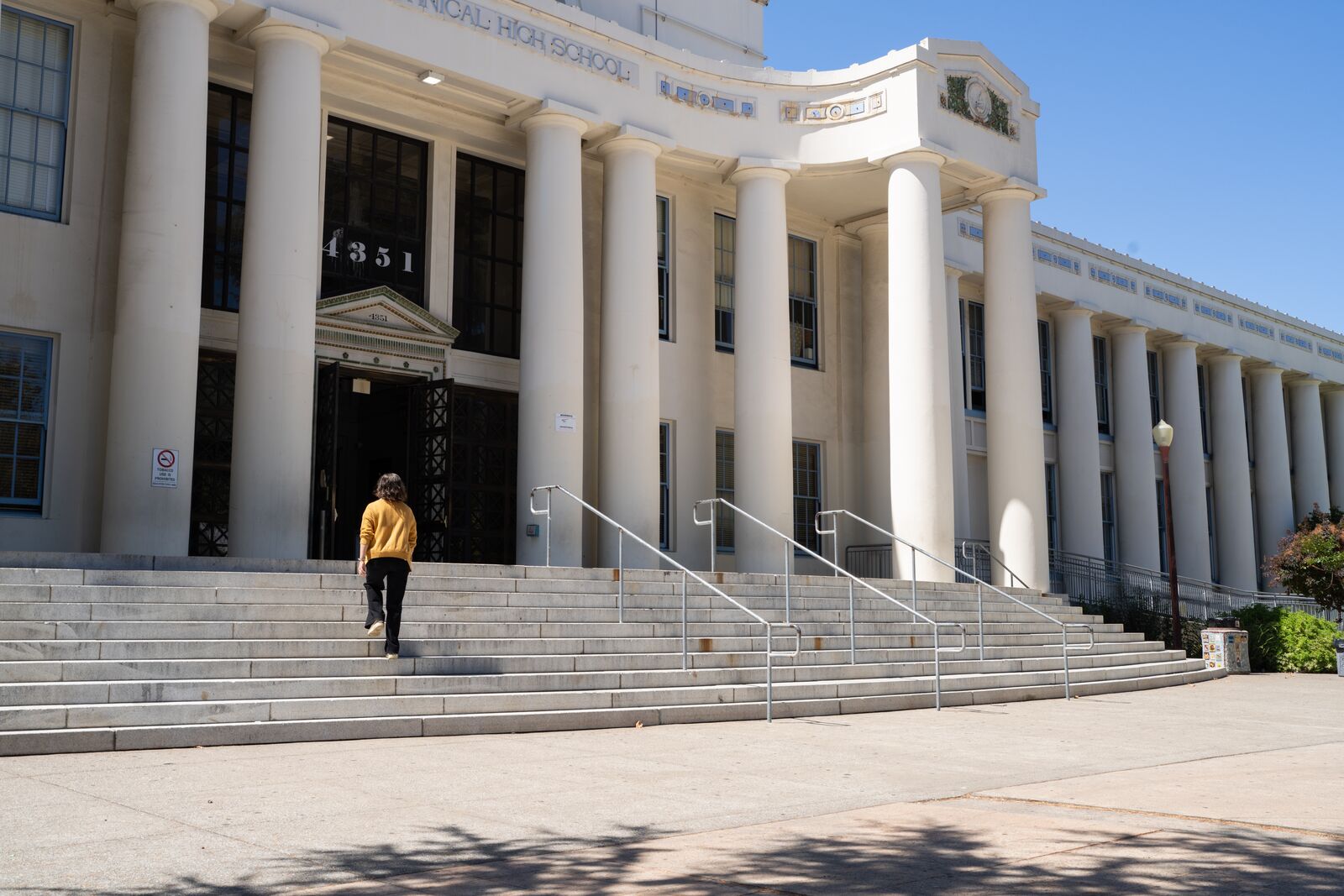 Latta is one of the few parents who has made the leap to the school board after getting involved in various committees and parent groups at her children’s schools. Credit: Sarahbeth Maney for The Oaklandside
Matt Glaser is a delegate for OUSD’s Parent and Student Advisory Committee, or PSAC; chair of Peralta’s school site council; a co-chair of the school’s walk-a-thon; and a representative on OUSD’s community schools task force. Glaser told The Oaklandside he spends 10 to 20 hours a week in various parent volunteer roles.
Frustrated with the lack of clarity from OUSD about district finances and other issues, Glaser started a blog offering his takes on the tensions surrounding public schools in Oakland. The politics of the school board make discussions much harder, he said.
“I feel like I’m doing a lot more right now in my position as a parent who is just trying to talk to everybody than I would be able to do as a school board member who is trying to get elected or re-elected,” he said. “The second you run for school board, it becomes a political enterprise and there are lots of political interests that start to take hold.”
Glaser has helped to set up a new group, the Multi-Stakeholder Engagement Group, to organize parents and families, as well as school staff and community members, to offer input on crucial decisions the district makes.
Tammen thinks the group is a step in the right direction to help parents speak with a more unified voice in the school district, as teachers do through their union, rather than getting directly involved with electoral politics.
“Parents’ perspective feels at the moment very piecemeal — we all have to individually show up and sign up to speak,” Tammen told The Oaklandside. “There isn’t a strong, cohesive, organized voice for parents in OUSD.”
Parents say the board is ‘not welcoming’
For Damani Jackson, parent of a rising second grader at REACH Academy in East Oakland, encouragement from others is what got him more involved.
Since his son entered transitional kindergarten, Jackson has attended as many school meetings and events as he could. He went to coffees with the principal, chaperoned field trips, and took any opportunity to show up and ask questions about school operations. One day, the principal asked him if he’d considered joining the school site council. After his first year as council chair, a PSAC coordinator suggested he join that committee, the elected body of parents and students that advise district leaders on budget priorities, which he did.
A first step in increasing parents’ involvement is reassuring them that their voices and perspectives matter, Jackson said.
“They think that nobody wants to hear what I have to say,” he said. “They need to understand that if you’re part of these committees and councils and boards, your opinion does matter. You can make change.”
Jackson said he hasn’t considered running for the school board, even though he’s always wanted to understand how schools spend their money. As the chair of REACH’s school site council, he works closely with the principal in analyzing budget expenditures for extracurriculars and other resources at the school.
One of the parent candidates running for school board, LeAna Powell, has two children in OUSD, and is known as the former City Council staffer whose ethics complaint prompted Oakland’s investigation into then mayor Sheng Thao. Family and friends have long joked that she should run for mayor since she’s so civically engaged, she said.
At Burckhalter Elementary in District 6, where Powell’s children attend, Powell serves on the parent teacher organization and coordinated parent engagement workshops last year. When multiple parent volunteers suggested she consider running for the school board, she decided to look into it.
As she began attending school board meetings and learning about the district’s budget issues, she was struck by how difficult it can be to decipher board documents and resolutions if you’re not a policy expert, and how uninviting the meetings can be for families.
Going to a school board meeting to give public comment can sometimes mean sitting for hours in stiff chairs in a drafty auditorium, in exchange for a strictly capped one or two minutes at the podium to address the board.
“To go out of your way to participate and to have someone never even look up from their computer to acknowledge you or appreciate you for coming — it’s not welcoming,” Powell said.
Another parent candidate, Arielle Fleisher, running in District 2, is leaning more into her policy expertise as the focus for her candidacy.
“I think being a parent is a really important constituency,” Fleisher told The Oaklandside. “I think what I will bring to the board ultimately is policy. My background is in policy and I think this moment really demands policy leadership.”
Kathryn Camp, a Glenview Elementary School parent running in District 4, was not immediately available for an interview.
Bridging the ‘confidence gap’
The parent knowledge gap is something Families in Action is trying to bridge. Last year the Oakland nonprofit launched a school board boot camp, enlisting 15 community members to learn more about how boards can be more effective. Last fall, the inaugural cohort dove into topics such as a day in the life of a school board member, the critical issues facing OUSD, student academic outcomes, and how a school board drives change. While it’s not a candidate training program, the goal was to demystify the role of the school board and empower families to influence their children’s education, CEO Kimi Kean said.
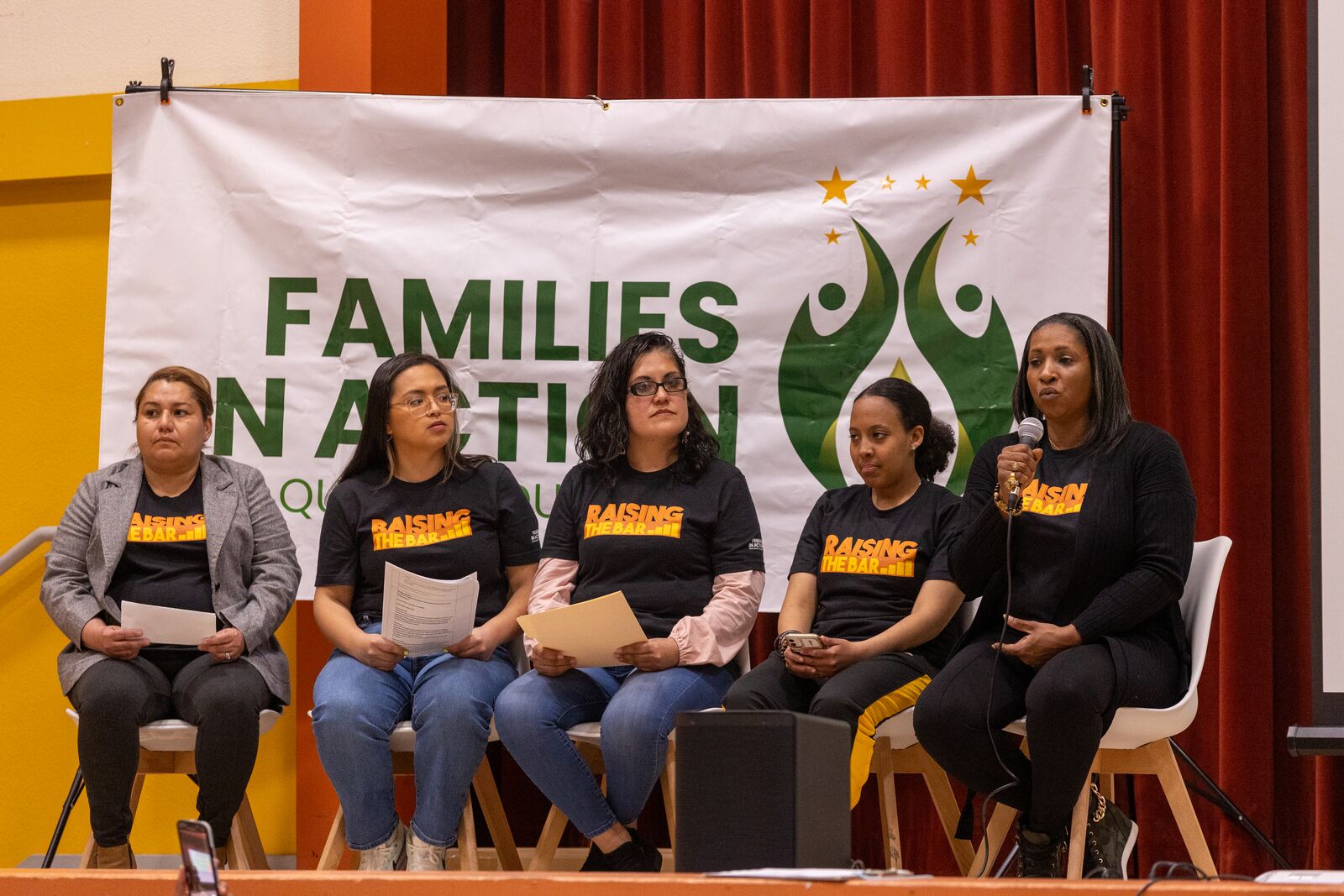 Parent leaders at a 2023 Families in Action event call out educational disparities for Black and Latino students in Oakland. Credit: Amir Aziz/The Oaklandside
“For a lot of families, there’s a confidence gap,” Kean said. “They think, ‘That’s not for me.’ We see parents do really powerful things every day in education and we want them to see themselves in that role.”
When any school board lacks parent perspectives, it can degrade trust and accountability, she said.
Raising pay for school board directors could widen the field for potential candidates, Kean said. This year, the board upped its pay to $3,000 per month, in response to a state law that raised board compensation limits on a scale tied to average daily attendance. Previously, OUSD directors earned around $900 per month. Board members are also eligible for OUSD health insurance.
Hearing other parents or district leaders speak negatively about the district pushed Latta to run for the school board, as she recognized she could do more to help improve the system.
“Ultimately I have always believed that schools are supposed to be for everyone and we all have a responsibility to pour into the system that’s serving our kids,” she said. “I’m committed to doing the work to make it work for our kids.”
Note: This article has been updated to include information about the board incumbents who are up for reelection this year.
“*” indicates required fields