
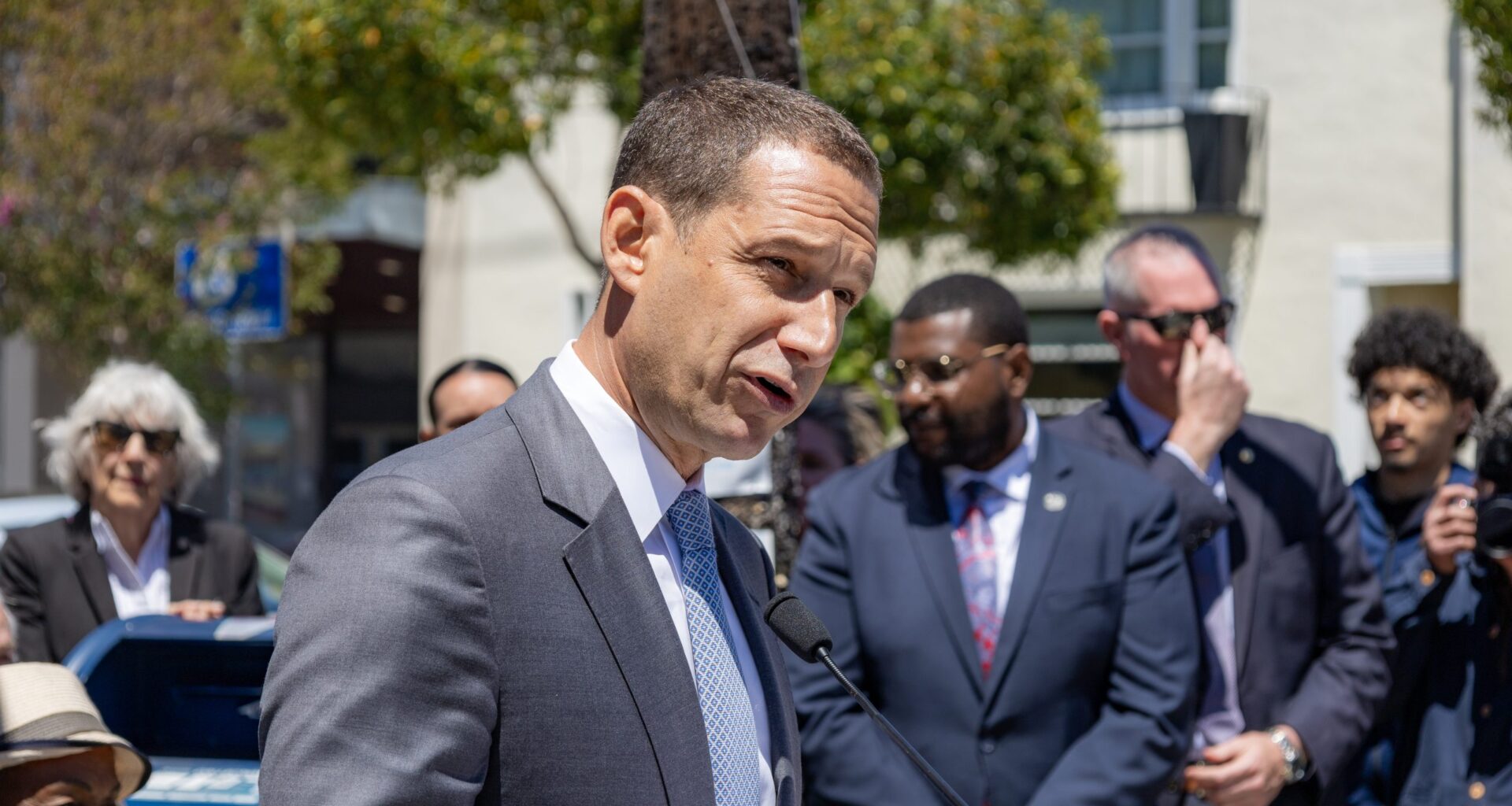
In June, we noted that Mayor Daniel Lurie’s Brunello Cucinelli outerwear did not come equipped with much in the way of coat tails. The question on the eve of June’s primary election was: What about his metaphorical coat tails?
It turns out he had them: Voters gave Lurie everything he could’ve asked for, by gaudy margins to boot. If the mayor chooses to match his literal coattails to his metaphorical ones, he’d film his next Instagram video decked out like Arturo Toscanini.
(Of note: Lurie’s actual jacket of choice at Outside Lands would appear to be this “sherpa-lined” overshirt from Yves Saint Laurent; what goes with Charli XCX better than YSL?).
San Franciscans began reporting happy thoughts on the trajectory of the city to pollsters nanoseconds after Lurie sent London Breed into private life, and continue to do so. San Francisco remains a place with problems to solve, but the right-track wrong-track numbers are the best city politicos have ever seen. Lurie’s appeal is not hard to fathom: He’s an earnest and likable guy promoting “common sense” approaches to problems, and he has vast wealth (and access to others’ vast wealth) with which to spread his earnest and likable messaging.
As such, Lurie’s pitch to voters is also not hard to fathom: It’s the Tom Cruise Help me help you and Sledge Hammer’s Trust me — I know what I’m doing. This is working and, logically, will continue to be deployed until it doesn’t.
We have an election coming in November and, among other contests, Lurie has signature-gathered three charter reform measures onto the ballot to consolidate and centralize mayoral power. These are promoted as “common-sense” reforms but were also boosted by $8.6 million (and counting) from the city’s wealthiest individuals and businesses.
“San Franciscans deserve a City Hall that works for them, not for insiders or special interests,” reads Lurie’s pitch. It is a testament to his unique earnestness and likability that a scion of generational wealth backed by a murderer’s row of millionaires and billionaires spending eye-watering amounts on these measures could seriously make such a statement. But this is working and, logically, will continue to be deployed until it doesn’t.
“Our city charter is so bloated that it slows down basic services, breeds corruption, and wastes taxpayer dollars,” Lurie continued. “San Franciscans elected me to clean up City Hall, and these reforms will strengthen accountability, deliver better results, and end the excuses.”
The campaign for these measures is, unsubtly, called “Clean Up City Hall.” Lurie is telling us that the City Hall he’s overseen for close to two years is still dirty — as well as inefficient, wasteful and even corrupt. Separate and apart from the validity of this pitch, it is not appealing to the positive mindset that propelled him into City Hall and has kept him popular.
Which is why it’s a bit discordant for Lurie to also be putting his imprimatur — and no small degree of money — behind appealing to November voters to tax themselves to shower funds upon Muni and BART. San Franciscans driven to the polls by calls to do away with dirty, disorganized government would not figure to be naturals for the message “please fund our extant transit services, generously.”
But that’s the pitch. And this speaks to the remarkable — and, so far, well-earned — confidence Team Lurie has in voters simply listening to our mayor and checking his desired boxes.
Help me help you.
Trust me — I know what I’m doing.
 Alas: BART has bigger problems than ill-advised carpeting or trains louder than a Metallica concert. Illustration by Neil Ballard
Here’s something funny about November’s so-called Muni and BART measures: The Muni measure would bring in an estimated $160 million yearly for Muni. The five-county “BART” measure would bring in an estimated $170 million yearly for Muni. This is why backers of the “BART” measure would rather you referred to it as the “Regional Transit Measure” — BART only gets around one-third of the money.
That’s something to think about for any San Franciscan considering voting for the local measure and against the regional one because they like Muni but don’t like BART. Calls from San Francisco’s tightfisted closet Republicans to “fix” our transit agencies before funding them do not come from a serious place; you can no more run mass transit on the cheap than you can learn French without learning grammar (on this: Trust me — I know what I’m doing).
Mission Local cannot tell you how to vote. Regardless, it is fundamentally discordant to rile up voters to “clean up” City Hall while also asking them to tax themselves — via a parcel tax for Muni and a sales tax for BART — to bail out transit. It’s not a trivial matter: The consequences of failing to pass either or both of these transit taxes is literally existential.
Lurie’s campaign spokesperson Max Szabo waved off concerns about discordant messaging.
“To avoid devastating service cuts, prevent gridlock traffic and secure our economic recovery, voters are being asked to support transit agencies across the state,” he wrote. Szabo emphasized that 100 percent of the money is going to Muni — the actual buses, trains and cable cars, which voters tell pollsters they like. That’s distinct from the much less popular SFMTA — the overarching transit agency, which includes parking control officers and poindexters who make your block into a Slow Street or eliminate the parking spots in front of shopkeepers’ stores that they like to park in all day while feeding the meter.
“Ultimately, voters love Muni and want to make it stronger.”
Every serious vestige of San Francisco political power will join the mayor in calling for the Muni tax. It only needs a bare majority to win. But the BART … sorry, Regional Transit Measure will be voted on across five counties. To make up for likely poor showings in less transit-friendly corners of the Bay Area, the measure needs to do big numbers in San Francisco and Alameda counties.
Transit advocates are clear that they need to get every vote they can in San Francisco. They are hoping Lurie’s messaging to voters really will help him help BART.
Lurie’s popularity and overflowing war chest bode well for his trio of charter amendments. So does the popular messaging of enabling our popular mayor to do away with bloated, wasteful, redundant vestiges of a byzantine — even sinister — government.
It never hurts to have the rich and powerful spending liberally on your behalf. Meanwhile, organized labor, the only entity with either the resources or the gumption to put up a fight, is monomaniacally focused on getting Connie Chan elected to congress. Labor is also smarting after putting millions into June’s Prop. D “Overpaid CEO Tax” — which voters spurned, at Lurie’s urging. In November, Lurie can march all the way to the capital virtually untouched.
Two of the charter reform measures will likely run unopposed. One would centralize procurement, which is difficult to argue against. Another, weightier measure would allow the mayor to merge or consolidate two dozen city departments and have a more direct hand in hirings and firings. That’s a big deal, but will also probably be conceded even by city entities not thrilled about this.
It’s the third measure, to dramatically curtail the ease of getting items on the ballot, that may draw more than a token fight. It would eliminate provisions allowing the mayor to unilaterally put items on the ballot or a minority of supervisors to do the same — and it would quadruple the number of signatures required for citizens to qualify a measure. At present, the city requires 2 percent of the electorate; the mayor’s measure would hike it to 8 percent (That’d still be lower than most cities in the state — but higher than San Jose’s 5 percent threshold, the percentage recommended by SPUR in a report portending these mayoral charter amendments).
This will be an interesting test of just how convincing our well-liked mayor is: San Francisco’s ballot is uniquely chaotic. But the optics of a billionaire, backed by a cadre of billionaires, diagnosing our city’s problem as too much democracy are so bad as to veer into evil: Mayor Lurie and his allies are spending handily to gather signatures to enact a ballot measure that will make it harder for all but wealthy groups or individuals to gather signatures to enact a ballot measure.
When we get past the anodyne help me help you, Team Lurie’s arguments for limiting ballot access grow shakier. The mayor’s campaign notes that, in 2024, San Franciscans voted on 15 ballot measures — far more than any other Bay Area municipality. That’s true. But if the mayor’s desired reforms were in effect at the time, we’d have still voted on perhaps 12 or 13 measures.
Team Lurie also noted that 44 percent of items on the last 30 years of ballots could’ve been handled legislatively but were sent to voters anyway. That’s true, too. Yet, if Lurie had legislated these three charter reforms thorugh the Board of Supervisors — and a fourth, quarterbacked by Board President Rafael Mandelman — San Franciscans could’ve voted on one measure instead of four.
But, hey, that’s complicated! And it’s not clear that arguments like these will ever be widely made. Certainly not if the discourse doesn’t advance beyond helping our likable and popular mayor help us.