
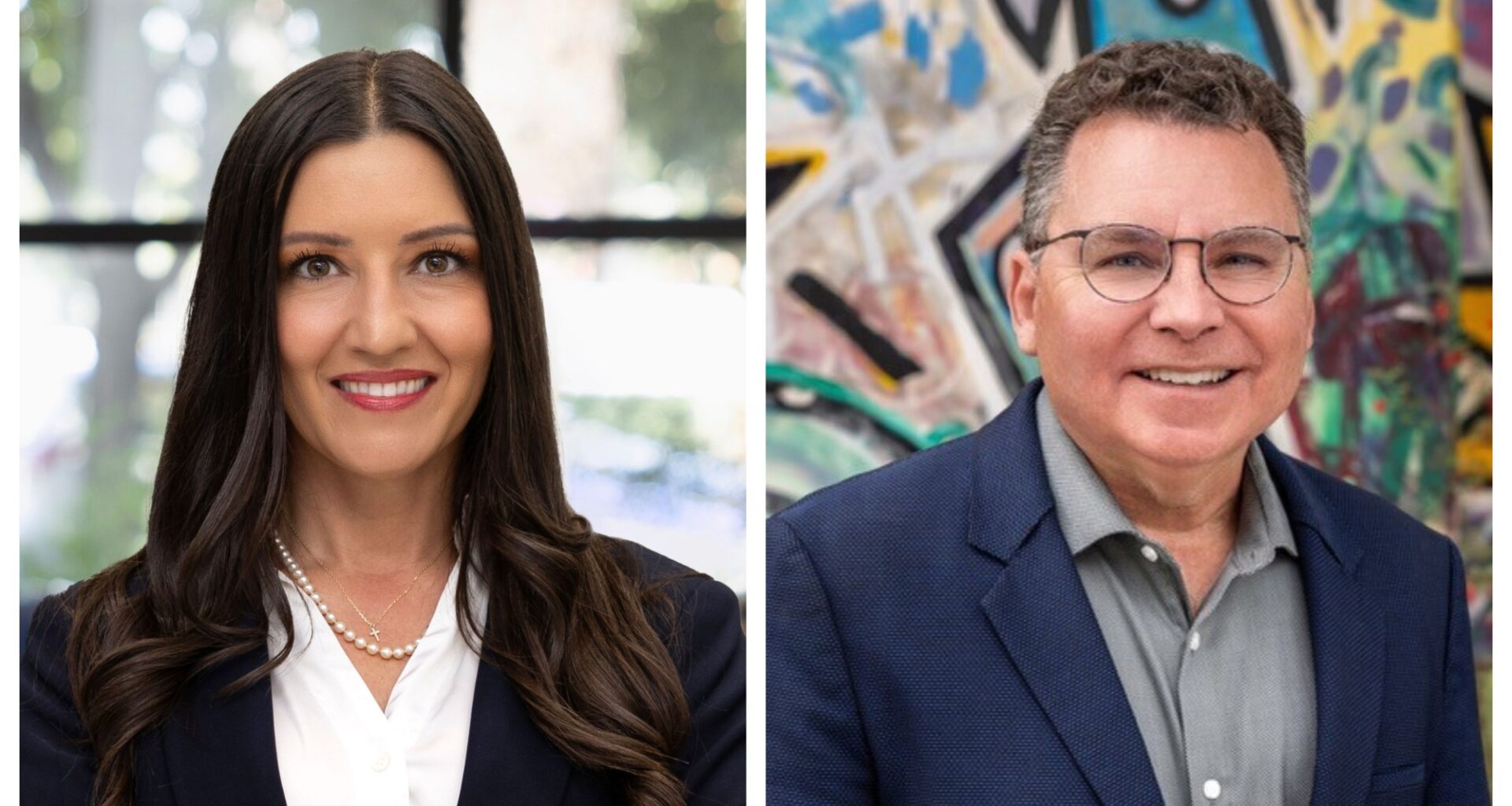
This fall, Californians will vote in just one nonpartisan statewide race. Of all the contests on the ballot, it’s shaping up to be perhaps the most partisan.
In the race for the newly defined job of state superintendent of public instruction, two school board presidents — both children of immigrants, both products of the communities they now lead — offer sharply diverging visions for California schools, informed by very different records. And each leader has arguably molded their district’s reputation in their image.
Richard Barrera, 59, a San Diego County native, leads the board of the San Diego Unified School District, the state’s second-largest district.
First elected in 2008 and by far the board’s longest-serving trustee, he has led policy, hired four superintendents and trained the district’s focus — including on supporting its most vulnerable students, developing community schools and creating workforce housing. Meanwhile, his background in community and union organizing has deepened the district’s own friendliness to labor.
Sonja Shaw was first elected to the board of Chino Valley Unified School District in 2022 as conservative parents swept onto school boards nationwide in the midst of the COVID-19 pandemic.
The 44-year-old, a Chino Valley graduate herself, has said she always wanted to be a mom, and her impulse to run for school board stemmed from her focus on her family. Her tenure on it underscores that focus — in four years, she has emerged as a chief proponent of the self-described parents’ rights movement.
In debates and interviews, Shaw always circles back to parents, Barrera to educators. Barrera focuses on supporting the most vulnerable students, including English learners; Shaw stresses prohibiting transgender girls from playing girls’ sports and using girls’ facilities.
Barrera is running as a continuity candidate, Shaw as a change of direction. Barrera works as an adviser to current state Superintendent Tony Thurmond, who has endorsed him; Shaw drew headlines for ejecting Thurmond from a board meeting.
By the end of June, the Barrera campaign had pulled in more than $400,000, recent disclosures show. He also benefits from more than $5 million in outside spending, mostly from the California Teachers Association, the state’s largest teachers union and a key endorser in the primary.
Shaw’s campaign raised about $465,000 in the same period. But she drew far less independent spending — just $10,000 for a slate mailer from a committee associated with Reform California, the conservative group led by San Diego-area Assemblymember Carl DeMaio.
Neither candidate is running for the kind of job they were originally seeking.
A new law by two San Diego lawmakers, at the urging of Gov. Gavin Newsom, rewrote the superintendent job, reducing its power and handing most of its responsibilities to a commissioner appointed by the governor.
Both candidates disapprove of how the changes were made. But for all they disagree on, both say that even if they had known how the job would change, they still would have run for it.
‘They needed the schools to deliver’
Barrera has served on the San Diego Unified Board of Trustees for nearly two decades, but it wasn’t the first elected office he sought.
Raised in El Cajon, Barrera graduated from UC San Diego, then completed a master’s of public policy at Harvard. Through a professor there, he became involved in community organizing and soon got to work on an effort in Little Rock, Ark. — “my first real job,” he called it.
Barrera brought that experience back to San Diego, where he spent decades as a labor and community organizer, working with home care and hospital workers, and ultimately being elected secretary-treasurer of the San Diego and Imperial Counties Labor Council, a powerful umbrella group for local unions.
And in 2006, he made his introduction to electoral politics when he ran for county supervisor against incumbent Republican Ron Roberts. His campaign focused on social services and what it meant to be poor in San Diego. An ethics pledge he asked Roberts to sign was declined. He lost the race.
Two years later, he ran for a seat on the board of San Diego Unified — the district from which his own children would graduate — with a similar focus on communities’ values and needs.
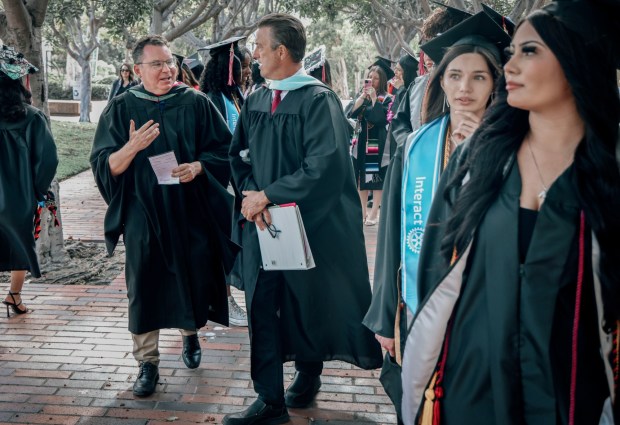 Richard Barrera, the San Diego Unified school board president, speaks with Principal Mitch Booze at the East Village High School graduation ceremony at City College on Friday, June 5, 2026 in downtown San Diego. (Sandy Huffaker for The San Diego Union-Tribune)
In a recent interview, he said that because the incumbent opposed bilingual education, he felt those values weren’t being represented.
“The people that I worked with cared about the quality of their schools,” he said. “If they were willing to work two or three jobs to make a sacrifice, they needed the schools to deliver for their kids.”
It ultimately wasn’t much of a race. The incumbent would fail to make the ballot, leaving Barrera unopposed. “I absolutely got lucky,” he recalled.
News reports at the time framed that election as the one that established the San Diego Unified school board as a particularly union-friendly board — a reputation it holds to this day.
‘Building more consensus’
When Barrera first joined the board at the end of 2008, it was still reeling from the recession. He recalls that at his first full board meeting, the superintendent proposed $50 million in mid-year cuts — a challenge that would last his entire first term.
Barrera also felt the district had emphasized math and reading test scores above all else, eliminating anything it considered a distraction. In his view, it had done a “hatchet job” on arts and music and “all but abandoned career technical education.”
That took a toll on public trust, he said. And it raised questions about the real value of education: “Is it a broad and challenging curriculum that actually students felt connected to that was relevant and meaningful — or was it drilling down improvements for a standardized test?”
To address its challenges, Barrera says, the school board brought back some electives, had employees take furlough days and built up support for parent engagement.
But everything in those first few years was a fight, he recalls — with the board often split 3-2, and huge battles over deficits and whether to rebuild schools with union labor.
“I should have worked harder at building more consensus around what we were trying to achieve,” he said.
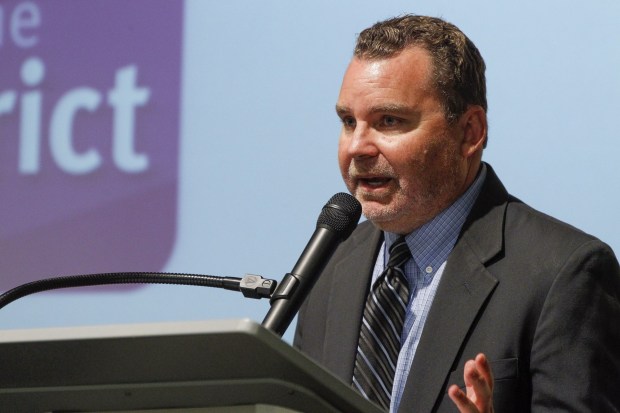 San Diego Unified board president Richard Barrera speaks during the State of the District address at Sherman Elementary School in San Diego in 2017. (Hayne Palmour IV / San Diego Union-Tribune)
Today, consensus is far easier to come by.
In a district where 60% of students are socioeconomically disadvantaged, Barrera and other San Diego Unified leaders have embraced equity as a guiding principle in public education.
Overall, the district has seen academic performance that is stronger than the state average, while sharing a similar demographic profile, data from the California School Dashboard shows.
But all five trustees — “and now the student board members as well,” Barrera says — have agreed to focus most of all on those students considered most likely to fall through the cracks without support, known as spotlight students.
“The definition of the district’s success is not how we do on average overall,” he said. “The bottom 20% of students, who are struggling the most — what kind of progress are they making?”
Another focus is on supporting and celebrating English learners.
Barrera also said there is a broad recognition that “what has the potential to make California great” is the degree to which the state supports newcomers and English learners.
“We don’t act like it’s a deficit for a kid to come to school with a language other than English,” Barrera explained. “That’s actually an advantage — and if we foster bilingualism, we’re going to see kids do better at mastering English.”
A COVID-born candidacy
In just a few years, Shaw has become the face of Chino Valley’s school board, along with its habit of making headlines with anti-LGBTQ+ policies — including removing library books, reporting gender-nonconformity to students’ parents and banning Pride flags in classrooms.
But the board’s conservative reputation didn’t start with her — back in 2000, the district adopted a class on the Bible that raised religious-freedom questions.
Shaw describes the role of parents in public education as a personal one for her.
Her youth in Chino Valley was upended by family strife — her parents’ separation, her mother’s addiction, time in a women’s shelter and in foster care. Shaw recalls stealing food stamps to feed her siblings and staying home from school to care for them.
“I kind of always had that caretaker kind of fighter spirit,” she said.
Her mother died when Shaw was still a child, and she knew that she, too, wanted to be a mother one day — and that when she did, she wanted to spare her children what she’d gone through.
Shaw wanted to be present for her kids. But California’s cost of living being what it is, she also worked odd jobs before settling into work as a fitness instructor.
“I had a desire to make sure other moms were healthy,” she said. “I didn’t have a healthy mom, and I wanted to be a healthy mom.”
The upheaval of the COVID-19 pandemic would mark a turning point for Shaw. Frustrated by remote learning and worried kids were spending too long at computer screens, she joined another parent at a school board meeting. But she felt the board didn’t want to listen to parents and “didn’t care about kids struggling.”
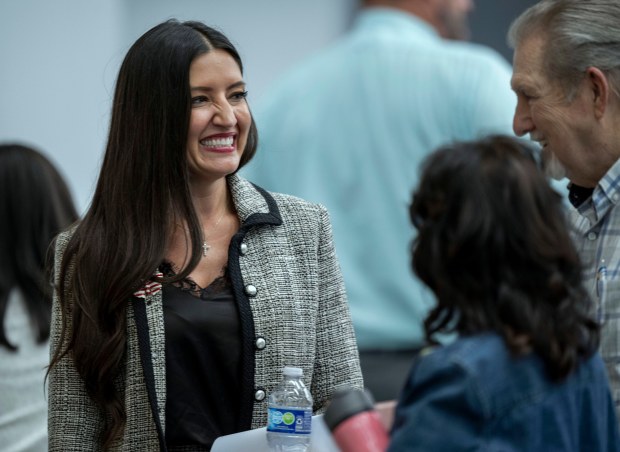 Sonja Shaw, president of the Chino Valley Unified board, talks with guests on Thursday, July 16, after a meeting. (Terry Pierson, The Press-Enterprise/SCNG)
For years, her tumultuous childhood and her father’s immigrant sensibility had ingrained in her an aversion to taking a stand politically, she said — “don’t cause any problems, ruffle any feathers.”
That had changed.
She and other parents began to meet in Sacramento to advocate against legislation they opposed, such as a 2021 law that required schools to stock menstrual products in some boys’ bathrooms as well as girls’. She recalls thinking of elected officials at the time: “You don’t want to give us a seat at the table? We’re going to take the whole darn table.”
Her advocacy drew interest from the Republican Party, and soon she was recruited to run for the Chino Valley Unified school board. At that point, she recalls, “They all declared ‘Shaw 2022.’”
‘Secrets being kept from parents’
Once elected, she aimed to reverse declines in academic performance from before the COVID-19 pandemic — and “to make sure our district went in a direction opposite of what California has been going in,” she said. For her, that meant ensuring community support, getting parents involved and getting “ideologies” out of schools.
“That was a big challenge, watching things be legislated into the curriculum that shouldn’t have been there,” she said. “It wasn’t reading, writing and math, and pathways to success after high school. Parents not being able to have a seat at the table — secrets being kept from parents.”
Chino Valley Unified has a student population about one-quarter the size of San Diego Unified, but a similar share is considered economically disadvantaged. State dashboard data shows strong academic performance, which Shaw attributes to support for teachers and success in challenging students.
She said she’s tired of hearing about the success of states like Alabama and Mississippi in improving academic outcomes, and about university students needing remedial math.
“It’s not rocket science. It’s actually just focusing back on those things, and putting the money and the dedication and the time towards reading, writing, math and training our good teachers — making it attractive again, so we can get newer teachers to come in,” she said.
She said she also wants to make sure kids love civics, and although she sits on a commission dedicated to career and technical education, she also wants to make sure students have a viable pathway to four-year college.
“We have the blueprint. I have the tools that we used here in Chino, and those are the same things that I want to take to the state,” she said.
Her district, she points out, was acknowledged by researchers at a Stanford-affiliated think tank for its recovery from pandemic disruptions. It also ensures that teachers are well-paid and that it’s “getting teachers trained, retaining the newer teachers and living within our means,” she said.
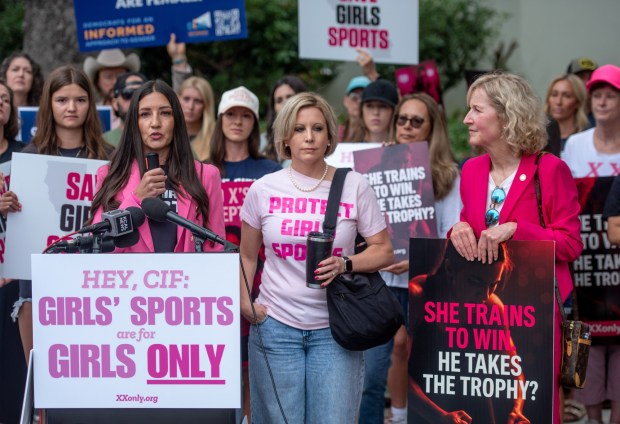 Sonja Shaw, the Chino Valley Unified board president, urges the California Interscholastic Federation to ban transgender girls from playing in girls’ sports at a press conference in Costa Mesa on Friday, June 20, 2025. (Jeff Antenore, Contributing Photographer)
But the district has become better known in recent years for its anti-LGBTQ+ efforts, and its battles with state education leaders over them.
Shaw and her board drew notoriety, and litigation, after enacting a policy to require schools to inform parents of possible changes to a student’s gender presentation; they famously kicked Thurmond out of a meeting on the issue. More recently, she and her board have vocally opposed transgender girls’ participation in girls’ sports.
The boss’s boss
School board trustees have a limited number of roles, but a big one is hiring a superintendent. Looking back on his four hires, Barrera has some regrets about how he helped lead that process — especially in the case of Cindy Marten.
Marten was still an elementary school principal in Barrera’s subdistrict when she was plucked from relative obscurity to lead the district, with hardly any community engagement.
Just hours after getting the previous superintendent’s resignation, the San Diego Unified board met in closed session, then announced Marten’s hire — raising questions about whether the move complied with state public meetings law.
“When it becomes clear that the board unanimously knows who we want to hire, it just wouldn’t be honest to go out to the community as if we hadn’t made that decision,” Barrera said at the time.
But the result was a host of public questions and suspicions, and today, Barrera assesses the situation differently.
“The process to hire her was kind of the opposite of what I think a good process is,” he said.
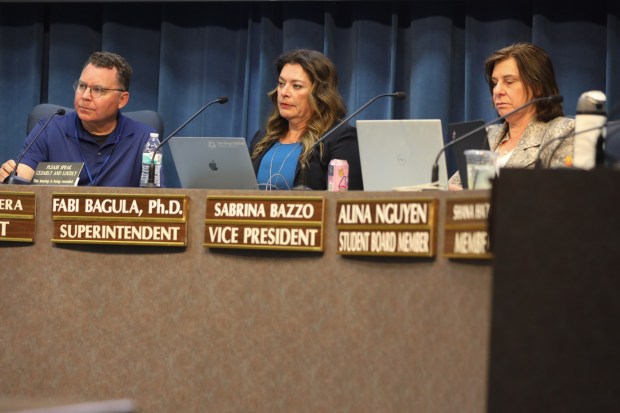 Board members Richard Barrera and Sabrina Bazzo, along with Superintendent Fabi Bagula, listen to people speak at the San Diego Unified School District headquarters on Tuesday, March 3, 2026. (Kristian Carreon / The San Diego Union-Tribune)
Marten served eight years as San Diego Unified superintendent, until she was named to a job in the Biden administration as deputy secretary of education. After she left San Diego Unified, the board hired Lamont Jackson as superintendent in 2022. Two years later, it fired him, after investigating him for sexual harassment allegations.
That investigation began after Barrera learned of the allegations from one of Jackson’s accusers at a breakfast. He told district lawyers, and the board hired an outside law firm to investigate.
Years earlier, the district — and Barrera — had also been aware of an anonymous 2021 complaint that Jackson might be having an inappropriate relationship with a principal. But Barrera later said the anonymous nature of such a report made it difficult to investigate properly.
Today, the school board president rejects the idea that a lack of institutional processes or safeguards might have led to the situation with Jackson.
“I think it was the failure of an individual,” said Barrera, adding that the board acted quickly to investigate and then to fire him based on that probe’s findings.
In Chino Valley, Shaw hasn’t been involved in the hiring of a superintendent.
But she does recall that before she was elected, she hadn’t known a school board is a superintendent’s boss. Once she realized that, she says, she thought to herself of district leadership: “You guys are all done, you’re gone — just wait till we get in.’”
It didn’t turn out that way. Today, she says, she feels the superintendent is moving Chino Valley in the right direction, and she considers herself his protector.