
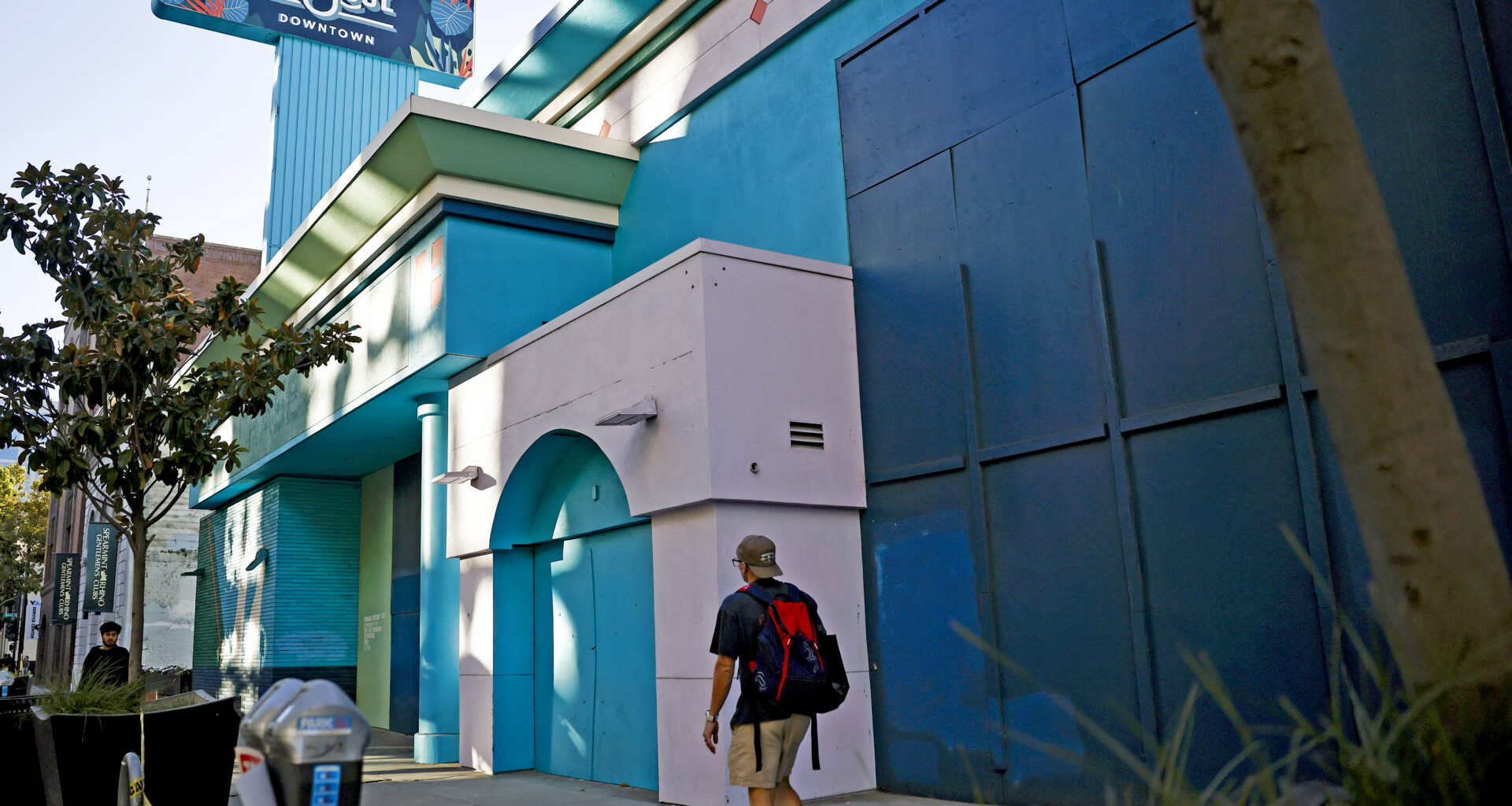
SAN JOSE — World Cup watch parties and other major sporting events brought large crowds and rare bursts of energy to downtown San Jose this summer. But a new national ranking underscores the challenge facing city leaders once those events end: turning occasional spectacles into everyday street life.
To be sure, record crowds packed downtown for World Cup watch parties and other major sporting events this year.
Still, downtown San Jose ranked 29th among 34 U.S. downtowns in a survey measuring residents’ perceptions of vibrancy, according to the Gensler Research Institute, which produces data and knowledge about workplace trends, human behavior and design innovation.
Only 61% of respondents rated downtown San Jose highly, leaving the urban core of the Bay Area’s largest city stuck in the bottom five for the U.S. — tied with Indianapolis and ahead of only Baltimore, Salt Lake City, Portland and St. Louis.
The average for the 34 U.S. cities included in the survey was 70.6%.
Gensler’s report surveyed a combined 35,000 anonymous residents in 75 cities worldwide during the latter months of 2025. Respondents were required to live within the boundaries of the city surveyed. Some cities were excluded if not enough residents responded.
Now that the crowds and watch parties have faded into a steadily receding past, long-term challenges remain for the downtown to retain its footing.
One ominous sign has already emerged. Sushi Confidential revealed it would close its San Pedro Square restaurant and instead concentrate on locations outside of downtown.
“When it comes to finding things to do in San Jose, you can go to Santana Row, you can go to Valley Fair, or you can go home,” said Mark Ritchie, president of Ritchie Commercial, a San Jose-based real estate firm.
As the city pushes to bring more residents and workers downtown, visible challenges remain.
“There are a lot of empty storefronts in downtown San Jose,” said David Taxin, partner and co-founder of Meacham Oppenheimer, a commercial real estate firm.
Nearly one-third of downtown San Jose office spaces remain vacant, according to commercial real estate firm Cushman & Wakefield as measured during the first six months of 2026. Fewer office workers means fewer customers for shops and restaurants.
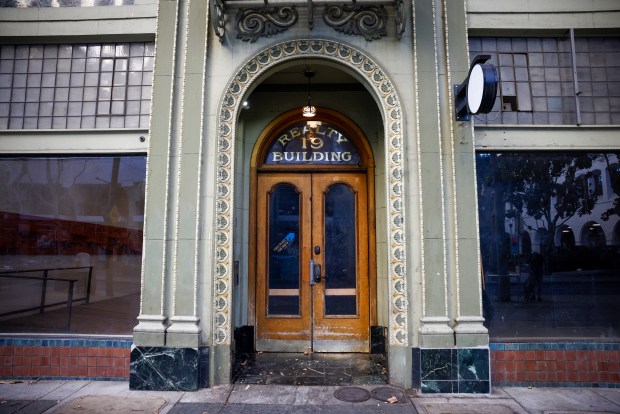 The doors to the vacant Realty Building North Second Street between East Santa Clara Street and St. John Street in downtown San Jose, Calif., on Thursday, July 23, 2026. (Nhat V. Meyer/Bay Area News Group)
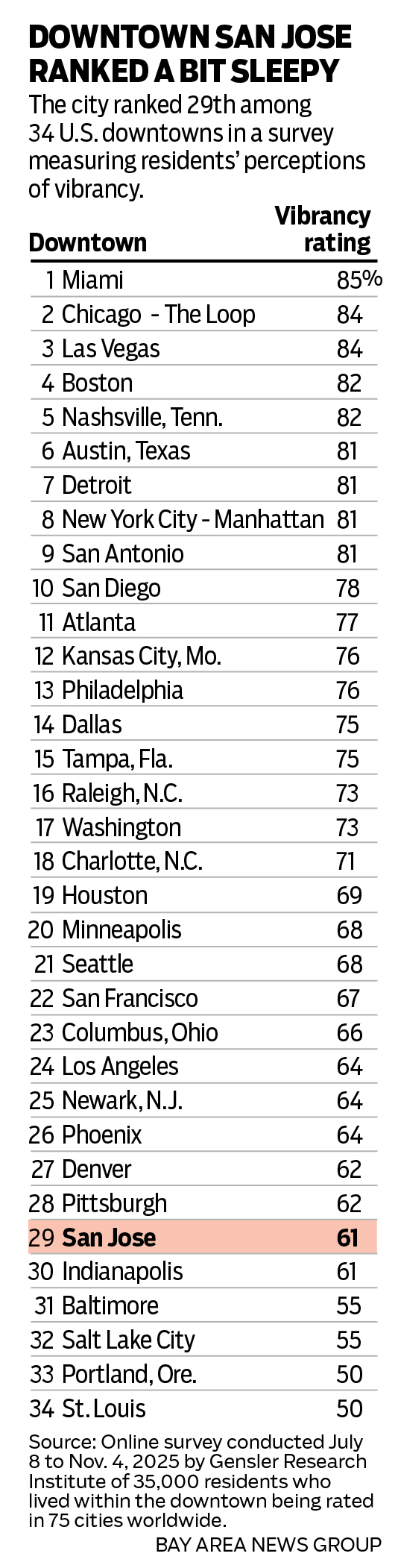 Gensler asked respondents whether they thought their respective downtown districts were vibrant. The rankings resulted from the percentage of respondents who rated them as “good” or “excellent.”
The five most vibrant downtowns surveyed were Miami, Chicago (The Loop), Las Vegas, Boston and Nashville.
“Downtown has shifted from an office economy toward an experience economy centered on restaurants, entertainment, sports, arts, housing and events,” said Bob Staedler, principal executive with Silicon Valley Synergy, a land-use consultancy.
San Jose Mayor Matt Mahan and other city leaders are betting that entertainment, events and other experiences can help transform downtown, as it looks to rebound in the post-COVID era.
“Turning downtown into Silicon Valley’s true urban center is a multi-generational effort, but we’ve made real strides in recent years,” Mahan said. “San Jose has been recognized as having one of the fastest post-pandemic downtown recoveries in the country. We’re building on that momentum by growing our experience economy and committed to attracting the housing investment and anchor employers that make downtowns exceptional places to live, work and play.”
Downtown San Jose is now experiencing 96% of the visits to the city’s urban core that occurred in 2019, the final year before state and local government agencies imposed wide-ranging business shutdowns to fight a global pandemic, according to the report.
That’s the third-highest activity level in the 66 downtown districts in North America the researchers studied, trailing only the 103% activity level for Las Vegas and the 97% mark posted in downtown El Paso, Texas, according to University of Toronto academics.
Downtown San Jose’s layout divides its busiest districts, making its activity feel scattered. High-energy spots are typically confined to disconnected islands such as San Pedro Square, the SoFA district, and small hubs near First and Santa Clara streets and Second and Santa Clara streets.
Stretches of vacant storefronts and empty commercial properties create barriers between the lively areas.
 The abandoned Greyhound bus station at 60 South Almaden Avenue in downtown San Jose, Calif., on Thursday, July 23, 2026. (Nhat V. Meyer/Bay Area News Group)
San Jose’s downtown also has been affected by the development of large shopping malls in suburban sections of the city.
Valley Fair Mall, Eastridge Mall and Town & County, which itself was torn down in 1999 to make way for Santana Row, all emerged miles from downtown.
Many merchants, including department stores, left downtown, leading to a retail desert, as noted in a 2013 report by SPUR, a public policy nonprofit.
“Over the course of about 15 years, retailers led an exodus from which downtown San Jose has never recovered,” SPUR stated in its report.
All of downtown San Jose’s major department stores closed or moved to the new suburban malls, SPUR stated.
“Santana Row and Valley Fair took a lot of the thunder away from downtown San Jose,” Taxin said. “There’s very little retail shopping downtown.”
City officials attempted to revive downtown retail by creating a two-story, open-air mall on South First Street next to the Paseo de San Antonio.
“The construction of the Pavilion shopping and entertainment center in 1989 was the most notable attempt to inject life into downtown shopping,” SPUR wrote in its report.
Having never attracted an anchor tenant, the Pavilion failed. After opening in 1989, its final retail tenants, including a movie theater and San Jose Live, exited in 1998.
“In addition to the mall’s design flaws, downtown simply had too few workers, tourists, or high-income shoppers to make the Pavilion a success,” SPUR wrote in its report.
Since roughly 2000, the former mall’s 121,200-square-foot upper floor has operated as a data center, hidden behind blocks of empty ground-floor storefronts. Efforts are underway to attract merchants to those spaces, an effort among many to entice more shops and restaurants to move downtown.
The San Jose Downtown Association says activating ground floors, filling vacancies and creating daytime, evening and weekend programs and activities can provide some answers. The association, though, demands that city and business leaders raise standards and expectations for safety, walkability, reliable lighting and other metrics.
“That’s the connective tissue and how we prevent the vanishing effect and turn what these events proved is possible into a habit,” said Brian Kurtz, chief executive officer of the San Jose Downtown Association.
Bottom line: The trifecta of mega events seems unlikely to be replicated any time soon. Next steps will include efforts to create some sort of carryover.
“Will the near future be like 2026? No, but we have a good foundation to build on,” said David Mulvehill, who co-owns or owns downtown establishments such as O’Flaherty’s Irish Pub, Five Points cocktail lounge and The Pressroom restaurant and bar.
Some local observers warn the post-coronavirus office worker exodus has done more than reduce the number of customers for downtown merchants. The absence of daytime workers has also constricted the hours when establishments are active.
“Vibrancy has never really taken off downtown,” said Taxin, who works out of an office in the heart of downtown next to San Pedro Square. “Downtown San Jose is mainly bars and nightclubs. But until 10 at night, there’s nothing happening.”