
By SUSAN JONES
The final draft of the updated Campus Master Plan debuted this week, and it has many of the ideas that have been discussed for months — more student housing, increased accessibility, and improved public spaces and gateways into the Oakland campus.
What it doesn’t have are specific timelines or priorities for what project should come first.
“It’s an aspirational vision,” said Gina Bleck, vice chancellor for planning, design and construction. “It’s not a roadmap of projects all laid out with timelines or anything, especially given the the fiscal reality across higher ed.”
She said they are hopeful “that potential donors will become excited about some of the projects … and will want to put their name on things.”
Bleck and her team outlined the plan at a preview event on Nov. 5 and spoke to the University Times about it earlier in the week. They’ll present it to the Board of Trustees in December. Any specific projects would be presented to the board at a later date for approval. The plan was developed with architectural firm Sasaki.
Some projects do seem to have more momentum than others.
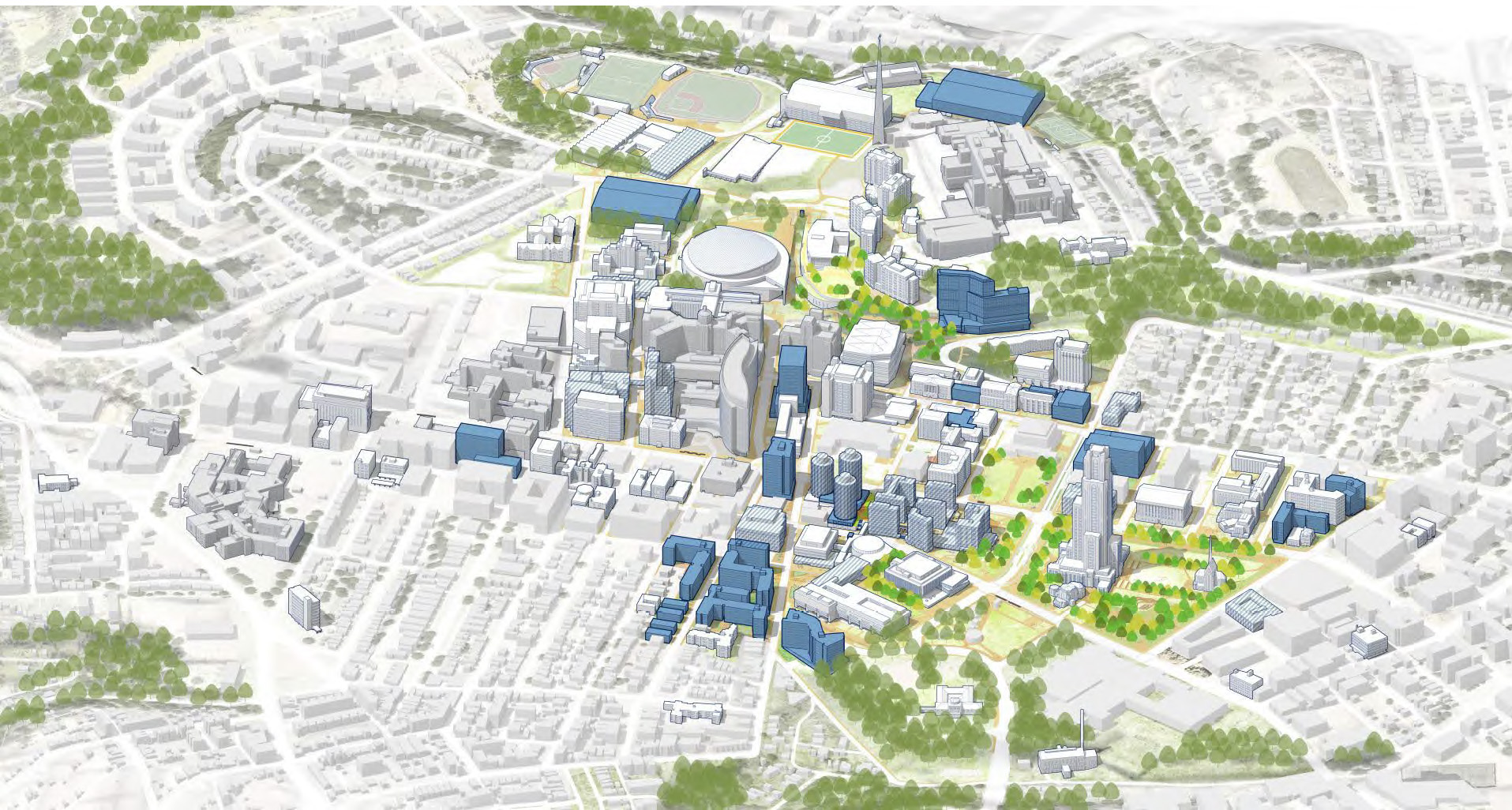
Student housing: Carolyn Verga, assistant vice chancellor for campus planning, said that housing is definitely a priority. The plan includes several possible projects, including a fourth Litchfield Tower, replacing Bouquet Gardens with taller, more densely populated buildings and converting the upper floors of the William Pitt Union into housing.
The idea gaining the most momentum is a 400-bed residence hall that would wrap around the Music Building on Fifth Avenue, where there’s now a parking lot.
“I think why that’s gaining some momentum is it’s probably the easiest site to work with because it’s a parking lot,” Verga said. “We don’t have to tear anything down. We don’t have a lot of enabling projects associated with it, and that’s a building we might be able to get up sooner than some of the other ideas that we have.”
Cathedral lawn: The plan calls for several changes on the Cathedral of Learning lawn, which could be done in pieces instead of all at once, Bleck said.
One would make the area between the Cathedral and Heinz Chapel more accessible, by removing the steps on that side of the Cathedral and making a larger plaza. “Currently, you have to go all the way out to Fifth if you want to get from the Cathedral in a wheelchair to the chapel,” Verga said.
The lawn between the two buildings would remain, which was something students were adamant about in their input.
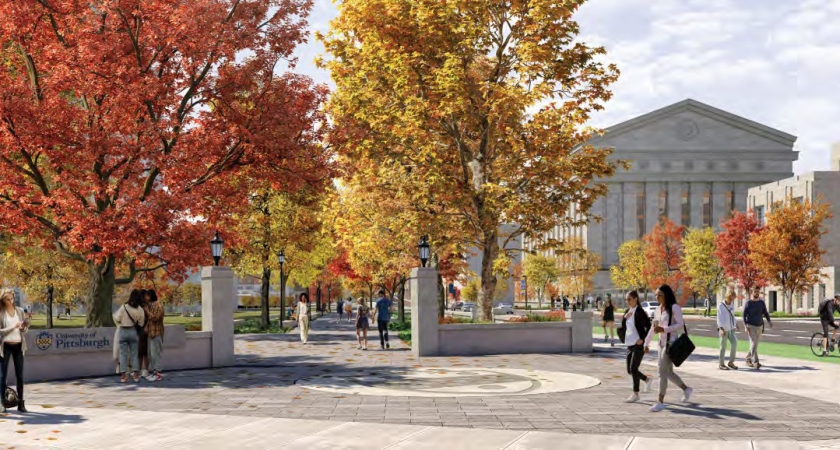
Other changes include a new gateway entrance at the corner of Bellefield and Fifth avenues and an outdoor theater area for performances or movie nights closer to the Forbes Avenue side of the lawn.
PAA conversion: The Pittsburgh Athletic Association, which Pitt acquired in spring 2024, is envisioned as a new student union. This would eventually allow the current union to be converted to housing.
Bleck noted that the upper floors of the William Pitt Union are not a good match for the student activities that are housed there.
“The possibility of being in the PAA and the iconic building with large volume spaces, that’s exciting to Student Affairs and to others about our dedication to the students,” she said. “… I think it’s a win on both sides, both the PAA renovation side, and what it could do for student clubs and other things, and also that students want to live near Schenley Quad and the other residence halls there.”
Right now, the plan would keep the first floor ballroom and other spaces in the William Pitt Union.
Historic preservation
The PAA renovation is indicative of the new plan’s “appreciation for the historic buildings that the University has on campus and acknowledging their significance and the need to renovate them for current and future use and needs,” Bleck said.
Other projects that include this look at preservation include:
The 20th Century Club at Bigelow Boulevard and O’Hara Street is envisioned as new alumni or welcome center. It also could house people from Pitt’s Philanthropic & Alumni Engagement who are now in leased space. And it could be used for Board of Trustees meetings, which take up student spaces during the quarterly gatherings.
The O’Hara Student Center and Gardner Steel building would be maintained and joined by a glass connector that would include class space and an elevator to make the buildings more accessible.
Allen Hall and the Old Engineering Building would be renovated inside but maintained outside. “We want to keep the 1920s buildings, but then improve how you use them,” Bleck said. A new building is proposed in the parking lot next to the SRCC building, which would include modern lab space for researchers.
Other projects
In addition to building more housing, there are a few other new buildings and renovations proposed.
One Bigelow: This project dates back to the original Campus Master Plan. It would be in the parking lot next to the Oaklander hotel and would potentially house the School of Computing and Information and Pitt Business.
Parking at Fitzgerald Field House site: The idea is to replace the field house with a parking garage that would have an indoor running track on the top. Any new buildings, like a proposed upper campus residence hall, also would have parking.
Crabtree Hall: This building would get a full renovation with additional floors for more classroom space.
Trees Hall: A section of the building would be converted for the men’s and women’s basketball team to use for practice.
Sports Dome: This structure is at year 10 of a 15- to 20-year lifespan, Verga said. The idea is to convert it into a simple recreational building, and add on a facility for the Pitt Band to use for rehearsals and storage.
Public realm
One of the overarching goals of the plan is to “connect the fabric of campus with the neighborhood of Oakland and the city of Pittsburgh and make places for student engagement or study and hangout space,” Bleck said.
One idea is to open up the Litchfield Towers plaza by removing the area where Panther Central is now. There would be ramps leading down to Fifth Avenue and on the other side more active student collaboration spaces on the Posvar walkway.
The areas along Bouquet Street from Fifth Avenue up to O’Hara and then back down on Thackeray Avenue also would be developed to be more pedestrian friendly.
Susan Jones is editor of the University Times. Reach her at suejones@pitt.edu or 724-244-4042.
Have a story idea or news to share? Share it with the University Times.
Follow the University Times on Twitter and Facebook.