
Like many students still in their teens, Isshin Shiraishi arrived at UC Berkeley in 2023 with no clear plan for his education or life after graduation. Certainly, though, he had no intention to choose a military life. After growing up in the Bay Area, he wasn’t even aware that such a life existed.
Today, remarkably, Cadet Shiraishi is beginning a term as cadet commander of the Army ROTC Golden Bears Battalion. No, he says — his choice was not conventional. But after his initial hesitation, Shiraishi has embraced the challenge and camaraderie of this life, even if friends and fellow students don’t always understand.
“It’s not like I threw away my social life,” said Shiraishi, now a senior. “On the weekends, I still go out with my friends. But I’ve gained a lot more discipline, a lot of leadership experience. There’s been an unspoken awareness that I’m going a different route than my peers. Not that I’m not trying to compare or anything — it’s just different.”
ROTC — the Reserve Officer Training Corps — has a deep history on the Berkeley campus. This year, the Naval ROTC is celebrating its 100th anniversary. Berkeley hosted the first Air ROTC. The decades have brought heroic contributions in World War I and World War II, along with the sometimes violent turmoil that surrounded the corps during the Vietnam War era.
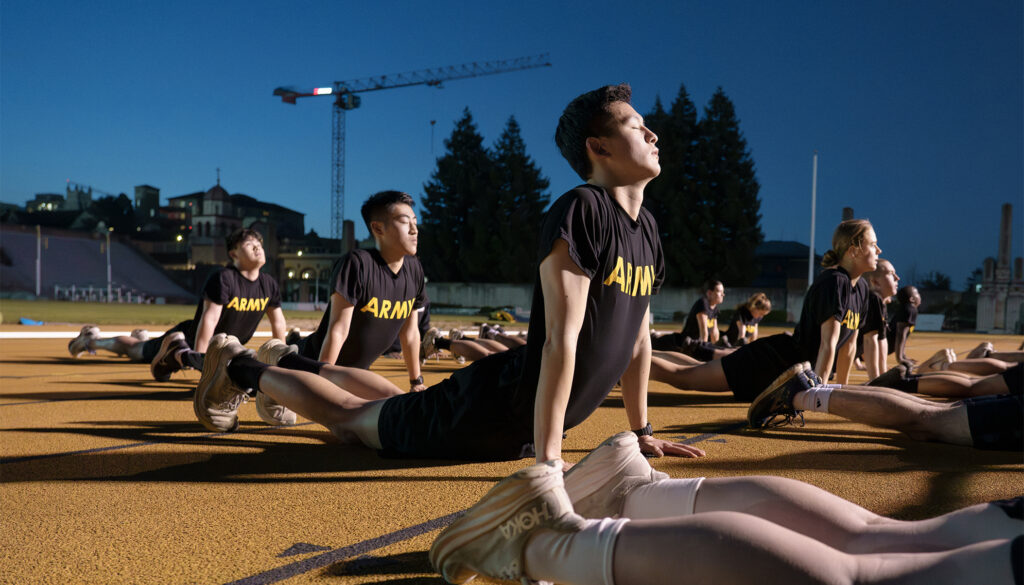 ROTC Cadet Isshin Shiraishi (foreground) was drawn to the intellectual and physical challenge of military training, and to the camaraderie established with fellow cadets.
Photo by Sophia Bella Cutino
ROTC’s place on campus is more peaceful now, and Shiraishi and nearly 200 other ROTC cadets and naval midshipmen are carrying forward traditions that have evolved for more than 150 years, since the University of California’s founding. While time has passed and the nation has changed, ROTC students are much the same as they have been across decades — and much the same as other undergrads who will return to campus in a few days.
“They’re all just college kids,” said Lt. Col. Aaron Elliott, a Berkeley faculty member and the top Army ROTC officer on campus. “Like a lot of students, they’re struggling in their first year being away from home. They’re just as worried about their grades. They’re just as stressed about relationships. They’re the exact same in all those different ways.”
But in a campus community that prizes student service and positive impact across a range of disciplines, there’s a critical difference.
“If you have a degree from Cal, especially a STEM degree, as many cadets and midshipmen do, you’re certainly foregoing lots of earning potential in the private sector if you pursue a military career,” said history professor Mark Brilliant, chair of Berkeley’s Military Officer Education Committee. “That’s sacrifice for the sake of service. Much more than that, though, is the willingness to pay the ultimate price for one’s country. To me, that’s the epitome of service.”
A history of innovation and impact
It doesn’t fit modern stereotypes, but Berkeley has an illustrious place in U.S. military history. When Shiraishi and his comrades do training runs through the Berkeley Hills up to the Big C, or when they take Mil Sci 3, “Intro to the Profession of Arms,” they’re working on a foundation of campus military culture that dates to the middle of the 19th century.
The Navy ROTC at Berkeley was one of the nation’s original six units established by the U.S. Navy in 1926. The program’s first commanding officer was Captain Chester W. Nimitz, a Berkeley professor of naval science. Nimitz would later serve as commander of Allied forces in the Pacific during World War II.
Owing to Berkeley’s excellence in engineering, the nation’s first Air ROTC was formed on campus in the early 1920s, a forerunner of today’s Air Force ROTC. It supplied officers to the U.S. Army Air Corps, founded in 1926.
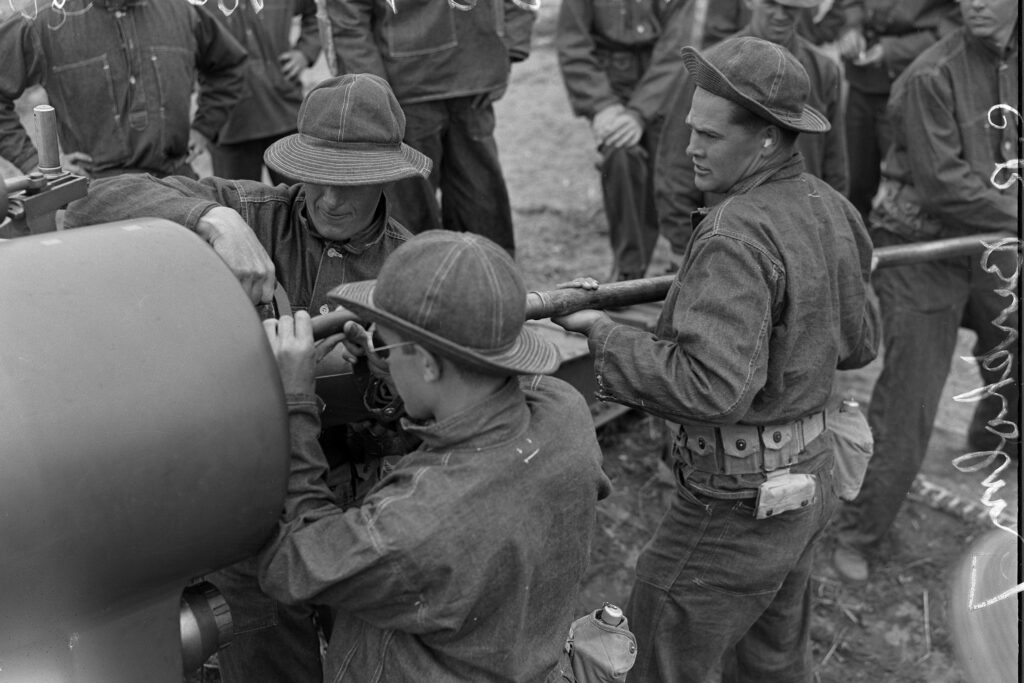 With World War II on the horizon, three UC Berkeley ROTC cadets trained in cannon operation during 1938 exercises at Fort Funston, a U.S. Army base in San Francisco.
Photo by Joe De Narie, Fang family San Francisco Examiner Photograph Archive Negative Files. © The Regents of the University of California, The Bancroft Library
In fact, military training was central to the campus culture from the founding of the University of California at Berkeley in 1868. Under a federal law, government-held lands were provided to state colleges and universities at no cost — if the schools offered training in military tactics. State law that established the University of California set military training as a requirement for male students.
With World War I raging in Europe, the U.S. Army ROTC program sprang from the passage of the National Defense Act of 1916, and marked the first time that military training on campuses was brought under a single federal program. Berkeley hosted one of the nation’s first five campus Army units.
Nimitz was just one of the major military innovators who emerged from the Berkeley milieu. General James H. “Jimmy” Doolittle was a celebrated World War II aviation pioneer. Major General William F. Dean was a prominent Army leader during World War II and the Korean War; he would later win the U.S. Medal of Honor. General Frederick C. Weyand served as Army chief of staff during the Vietnam War. And four-star General Ellen Pawlikowski led the Air Force Materiel Command from 2015 to 2018, managing 80,000 people and $60 billion in programs.
‘It was a foreign world’
Shiraishi knew none of this history when he arrived at Berkeley. His parents had immigrated from Japan when he was 2 years old, and he grew up in San Jose. He describes his family life as turbulent. He played some sports, but not seriously; he played video games and hung out with friends. He liked to draw and paint.
His feelings about the military were neither positive nor negative, he said. It simply was not on his radar.
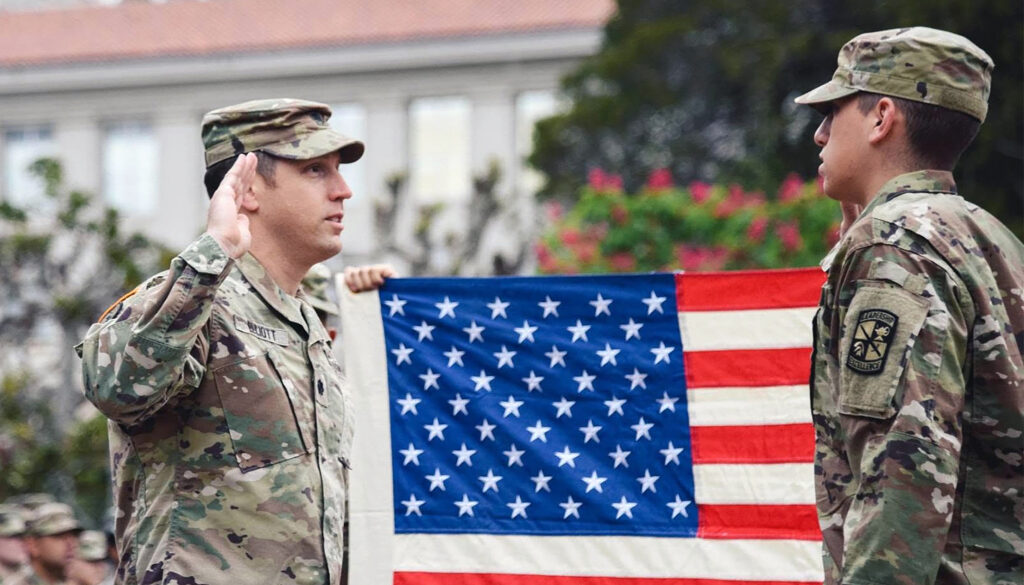 U.S. Army Lt. Col. Aaron Elliott (left) at the swearing-in ceremony for a cadet who is formally contracting with the ROTC Golden Bears Battalion. Elliott is the supervising officer of the battalion.
Photo courtesy of Lt. Col. Aaron Elliott, U.S. Army
“I didn’t think that I would be joining the military in any way, shape or form at any point in my life,” Shiraishi said. “Not that I was against it — I just didn’t grow up with any military personnel around me. It was a foreign world. … It was not part of the culture, especially in California.”
Shiraishi recalls walking by an ROTC recruiting table on Sproul Plaza in his early days on campus. His friend was interested and stopped, but Shiraishi felt no immediate attraction.
Perhaps it was his nature to be fiercely independent. He recalls himself as a young man with a chip on his shoulder — “arrogant,” in his own words. He wanted to leave his youth behind. When he explored student activities such as a consulting club or a finance club, it all seemed superficial.
Challenge, sacrifice and change
Shiraishi didn’t completely forget the ROTC option, though. One day he was walking to class at the Golden Bear Center on University Avenue, and he passed a Marine recruiting station. Spontaneously, he went in and asked about ROTC.
Sometimes Berkeley students have a low interest in the military because it’s such a foreign concept in the Bay Area and California.”
ROTC Cadet Isshin Shiraishi
One thing led to another, and by the beginning of his sophomore year, he had made a serious connection with the Army ROTC battalion and its leaders. Then the very shape of his days began a dramatic change.
On Tuesdays, Wednesdays and Fridays, one-hour physical training sessions started at 06:00. On Thursdays at 06:00, there was a three-hour tactical training lab, followed by two 90-minute military sciences classes: MS1-Leadership Laboratory, and MS2-Intro to the Army & Critical Thinking.
That was on top of the classes needed for his major in legal studies.
“I built a lot of discipline in my sophomore year, definitely,” Shiraishi said. “I would go to bed at midnight at the latest because staying up late would start affecting my day. I’d wake up at five and go to physical training and class, then do all my work and then go to bed. It became a cycle, a very structured cycle that I think most college kids wouldn’t experience.”
But Shiraishi didn’t mind getting up before dawn. He liked the physical and intellectual challenge, and the hands-on training. He liked the camaraderie with his fellow cadets and their superiors, even when it was built through the shared suffering of an early morning run through a biting winter rain.
The question that everyone asks
Everyone wants to know: What’s it like to be ROTC at Berkeley, with its long history of social protest and counterculture movements?
The curiosity is understandable. Berkeley’s history in military innovation and training is not well known, but the campus is famous as a center of pacifism and anti-war activism.
The stereotype is dated, but there’s truth in it, too. A detailed report in the archives of the Free Speech Movement, prepared by 1960s-era Berkeley students, details the long opposition to mandatory ROTC training for male students.
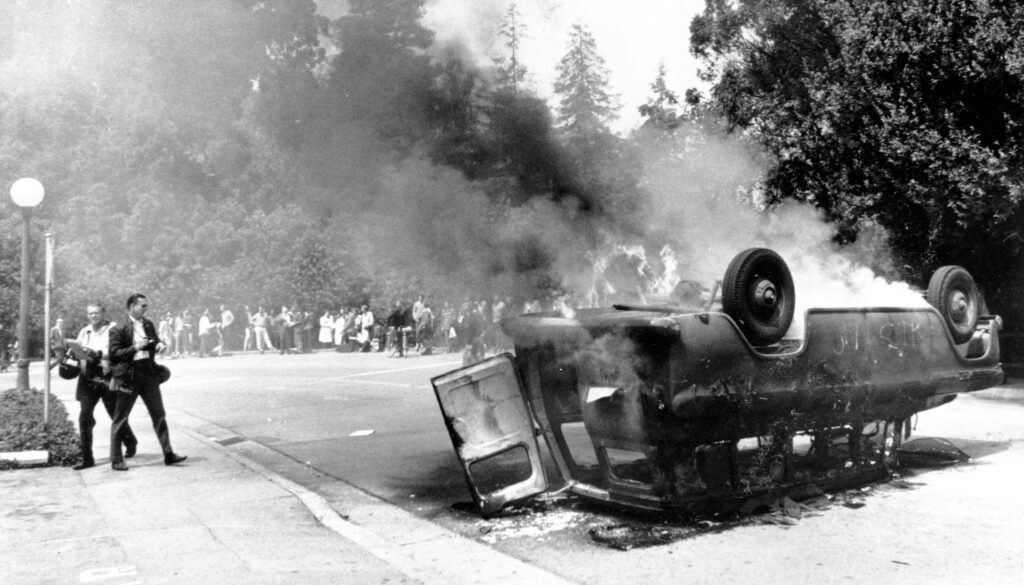 At the height of nationwide unrest over the Vietnam War in 1970, the UC Berkeley campus erupted in violence on May 4. Protesters turned over an ROTC van and set it on fire, and tried to torch ROTC headquarters.
Associated Press
As early as the mid-1930s, the report says, some 3,000 mothers petitioned the Board of Regents for an end to mandatory ROTC. Student referendums in the period showed strong opposition to the requirement. By the mid-1950s, campus opposition was accelerating. A sustained campaign featuring research, political organizing and peaceful protest achieved its goal in 1962, when the Regents formally voted to end the requirements.
Within a few years, the political and cultural movement that opposed the Vietnam War and embraced pacifism was surging at Berkeley and on many U.S. campuses. ROTC quarters became a target for anti-war forces. There were protests. Cadets were sometimes harassed. There were incidents of violence.
In late April 1970, a new round of protests exploded on U.S. campuses after President Richard Nixon announced that the Vietnam War would expand into Cambodia. On May 4, National Guard troops on the campus of Kent State University in Ohio opened fire on protesters, killing four of them.
At Berkeley, students walked out of classes. Protesters fought police in the street. Someone set fire to the campus ROTC headquarters.
While that conflict eventually eased, ROTC remained a target. In 1980, students protesting the university’s collaboration with the military and nuclear weapons research demanded that ROTC be shut down. In February 1985, an arson fire destroyed Callaghan Hall, where Navy ROTC was quartered. That came just after President Ronald Reagan was inaugurated to his second term, and just before the inaugural Chester W. Nimitz Memorial Lecture, now an annual Berkeley event.
Echoes of a long-ago time
Today, Berkeley is largely peaceful, and hostility against ROTC is almost unheard of.
Elliott, a career Army officer, has served two stints as the faculty leader of the ROTC, from 2017 to 2019 and from 2024 until now. He knows that the stereotypes persist.
“Colleagues in the Army often ask me, ‘Is it safe to wear your uniform on campus?’” he recalled. “I tell them, ‘Yes — I’ve never been egged. I’ve never been tomatoed.’ I’ve had very little negative interaction with any student.”
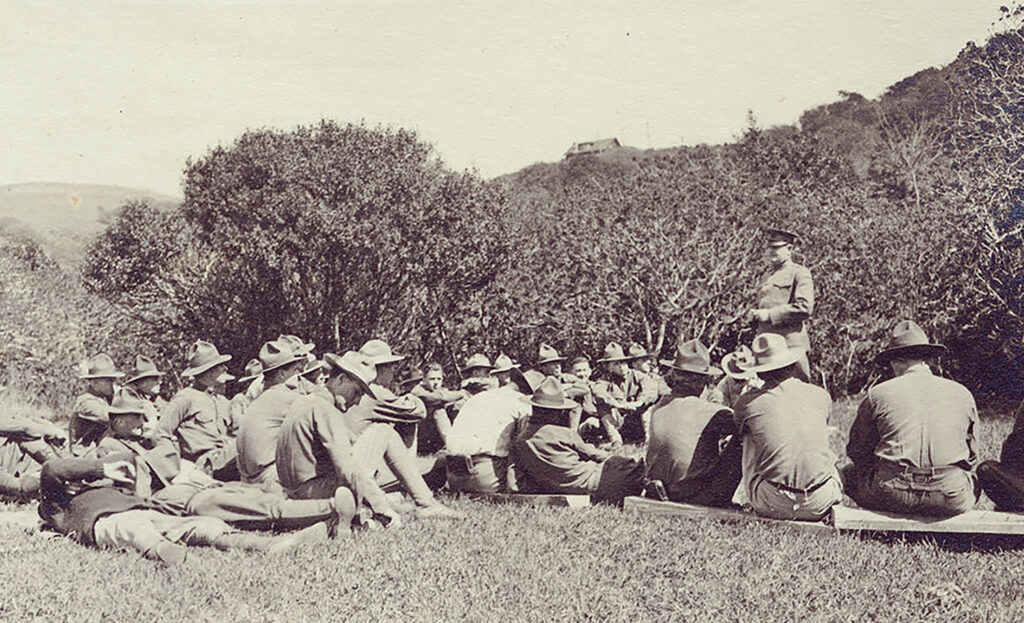 An ROTC officer, identified in Bancroft Library photo archives only as Captain Burke, speaks with a group of university cadets in February 1917. Berkeley’s history of military training and innovation dates to the founding of the university in 1868.
Fritz-Metcalf Photographs collection, The Bancroft Library, University of California, Berkeley
In generations past, faculty might also have opposed the ROTC’s presence on campus. But today that would be shortsighted, said Brilliant, the historian who’s now in his fourth year on the Military Officer Education Committee.
“It’s always struck me as eminently sensible — in fact, highly desirable — that if we’re going to have a military, then the officer corps should be trained at places besides the military academies,” Brilliant said. “It just seems invaluable to have officers who have the kind of perspective that is cultivated at UC Berkeley.”
After three years moving among undergraduates, both in and out of ROTC, Shiraishi has a slightly different perspective. The student body definitely remains liberal, he said, and sometimes he chafes at political pressure. Occasionally when he’s in uniform, he added, someone will try to stare him down.
But, he said, those are rare exceptions.
“Obviously walking around in uniform on any part of the campus, in any capacity, would raise eyebrows,” he explained.
“Sometimes Berkeley students have a low interest in the military because it’s such a foreign concept in the Bay Area and California,” he said. “It’s not that it’s a bad idea — it’s just so foreign. They aren’t curious about it. They’ll say, ‘Oh, cool,’ and go on about their day.”
Shiraishi has grown accustomed to such reactions, and he’s not troubled by them. “People are entitled to their own opinions and political views,” he said. “That’s what we’re here to protect.”
Making the ultimate commitment
Now entering his senior year, Shiraishi said he has evolved from the headstrong freshman who came to campus a few years ago. Even as he pursues a major in legal studies, he’s taken military science classes in training management and war-fighting functions, Army doctrine and team development. This summer, he spent 31 days in intensive training at Fort Knox, Kentucky.
Across every year, leadership is the persistent theme in ROTC classes and labs.
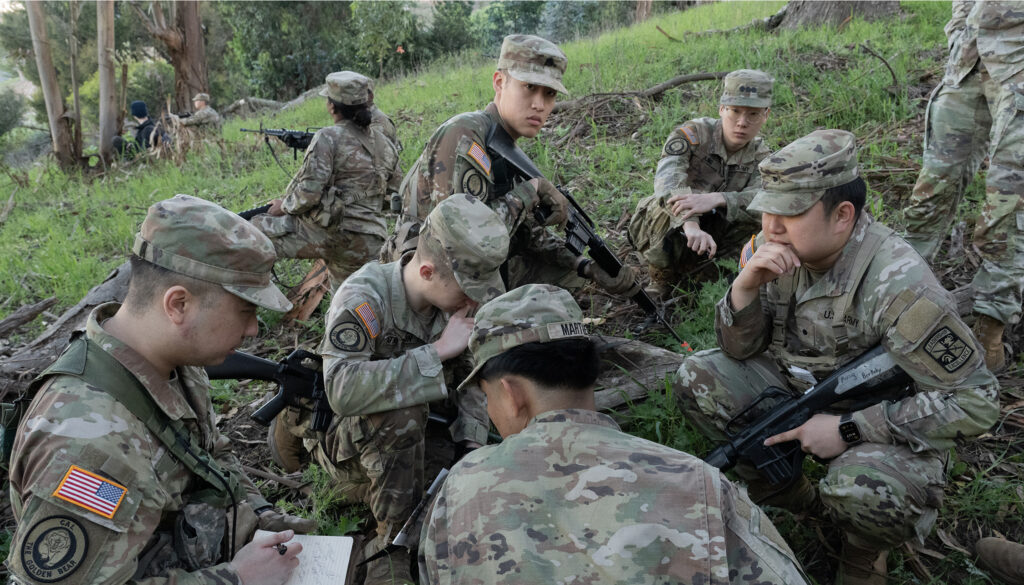
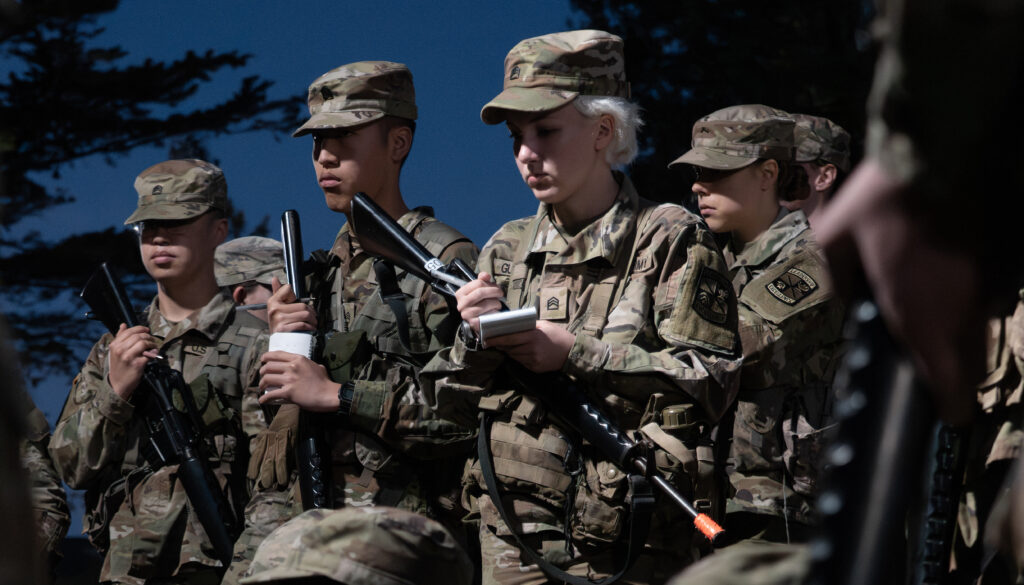 Isshin Shiraisha, second from left, stands with other Army ROTC cadets as they listen to an early morning briefing on how to carry out an attack movement.
Photo by Sophia Bella Cutino
Today, he’s more level, more able to see all sides. He credits his superiors with seeing his potential for leadership, and experience for honing his skills.
His high grades and performance scores, the respect he’s earned among his ROTC peers — Elliott said these were important factors when Shiraishi was named the cadet battalion commander for the fall semester.
“We’ve seen him step up and be a strong, confident, competent leader,” the supervising officer explained. “He was one of the top students who could come forward and take a broader leadership role.”
But, Elliott said, the appointment also reflects something more: not just Shiraishi’s skill today, but his potential for further growth.
Even as the new cadet commander plans for the upcoming semester, he’s thinking ahead to graduation next spring, and his formal commissioning as a second lieutenant with the U.S. Army. They’ll ask him to choose a specialty — maybe intelligence, he said, maybe logistics. Then weeks or months of additional training before his first official assignment.
He doesn’t know how long he’ll stay in. Someday he’d like to get an MBA or go to law school. His contract runs three years, and he’ll see where that leads.
But the world is volatile right now, and events beyond his control might shape his future. That happened to Elliott a generation ago. Soon after he graduated from West Point, terrorists struck on Sept. 11, 2001. By 2003, he was flying a Blackhawk helicopter in the war zones of Afghanistan.
In Shiraishi’s view, military training confers a world-awareness on ROTC cadets and midshipmen that’s distinct from most other students.
“We’re definitely aware that things can happen,” he said. “I can’t speak for others, but I want to emphasize this: As long as I put on this uniform, and as long as I’ve decided that I’ll go this path, whatever happens, in one way or another I’ll serve and defend this country.”