
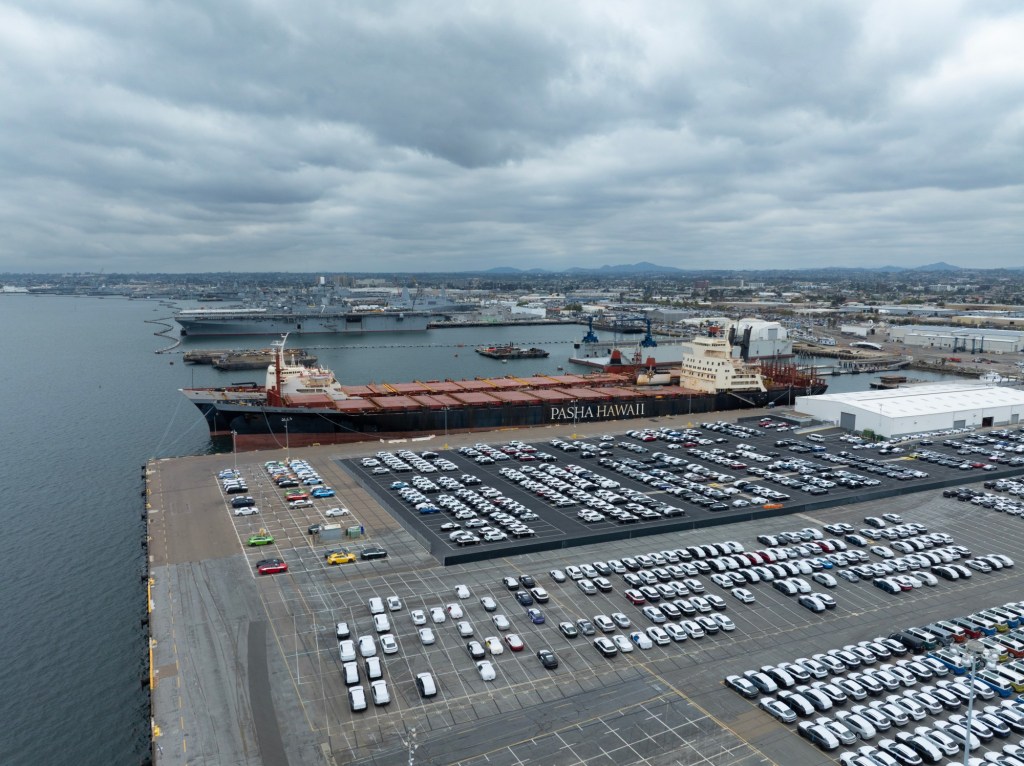
President Donald Trump’s tariffs have yet to stop imports at the Port of San Diego.
Total cargo volume at the port from January through August was 1.5 million metric tons, up 1% from the same time last year. The port is a major importer of motor vehicles, fertilizer, seasonal fruits, oil and gas equipment and jet fuel.
Early concerns of a collapse in shipping in American ports appear to have been overstated, or at least premature. It isn’t just San Diego seeing a moderate increase: The nearby Port of Los Angeles saw import volume increase 3.3% annually as of June, said a recent report from Cushman & Wakefield Research, and volume was up 9.6% at the Port of Long Beach.
Year-over-year data doesn’t tell the whole story, the report said, noting a choppy year with mini-surges to get ahead of tariffs, followed by slowdowns, and then often followed by another one-month increase. Also hard to quantify: What imports would have been without the president’s historic tariff push.
Michael LaFleur, chief operations officer at the Port of San Diego, said part of the reason for less impact locally, or even large ups and downs, is a diverse mix of imports that limited the potential damage.
“Our lines of business are not tied to some of the countries most impacted by tariffs, like China,” he said. “We have reliable partners, and our cargo volume has remained steady.”
LaFleur said it is possible there will be more tariff impact down the road. Some experts have still predicted businesses that stockpiled goods before tariffs hit will begin slowing imports or increasing the cost of goods for consumers.
Tariffs have had, at least, an indirect impact on imports into San Diego. Foreign industries have attempted to get around Trump tariffs before they hit, or when there was a pause.
For example, in February the Port of San Diego had one of its biggest months in years — as Trump continued to say big tariffs were coming but mostly held off until April — with 246,414 metric tons, an increase of 26% from 2024 and 29% from 2023.
Automobile importers, also likely trying to get ahead of tariffs, actually increased the number of vehicles coming into San Diego this year. As of August, there have been 230,982 automobiles imported into the main hub at National City, compared to 192,242 at the same time in 2024.
“I think everybody probably thought the same thing: ‘I need to get my product over there and have my product sitting in the the U.S. before the tariffs come down,’” said Ray Major, a San Diego economist. “So, you ship what you can.”
China has manufacturing surplus it needs to offload, Major said, so it’s not like it could cut out the U.S. market altogether. He said other nations have similar surplus issues. One in 10 foreign cars that enter the U.S. come through National City, from factories in South Korea, Japan, Mexico and elsewhere.
“You have to sell them somewhere. Germany can’t consume all the Mercedes and BMW’s that they build,” he said. “You do it and deal with tariffs on the back-end.”
The Port of San Diego might have seen imports moderately increase from January through August in comparison to last year but things could still shake out differently by the end of 2025. At the end of 2024, the port had imported 2,391,618 metric tons, down 2.3% from 2023.
The tariff situation continues to be as hard to pin down for foreign governments as it has for everyone stateside. The Trump administration was in the hot seat on Wednesday at a Supreme Court hearing arguing the legality of tariffs. The main argument of plaintiffs was that the U.S. Constitution gives authority to raise revenue via tariffs and taxes to Congress, not the president. The court has yet to issue its decision.
Imports by Port of San Diego
Cars: Honda, Acura, Audi, Volkswagen, Maserati, Mitsubishi, Hyundai, Kia, Isuzu, Fiat, Alfa Romeo, Toyota, Porsche, Lotus, Lamborghini and Bentley.
Break bulk: Machinery, oil and gas equipment, project cargo, ship engines, steel products, wind/energy components, transformers and generators, yachts.
Containers: Mostly refrigerated cargo including bananas, seasonal fruits, perishables and seafood. All Dole bananas sold in the western U.S. – from California to Colorado – come through the Port of San Diego.
Dry bulk: Bauxite, fertilizer, soda ash and sugar products.
Liquid Bulk: Jet fuel, petroleum products.
Source: Port of San Diego