
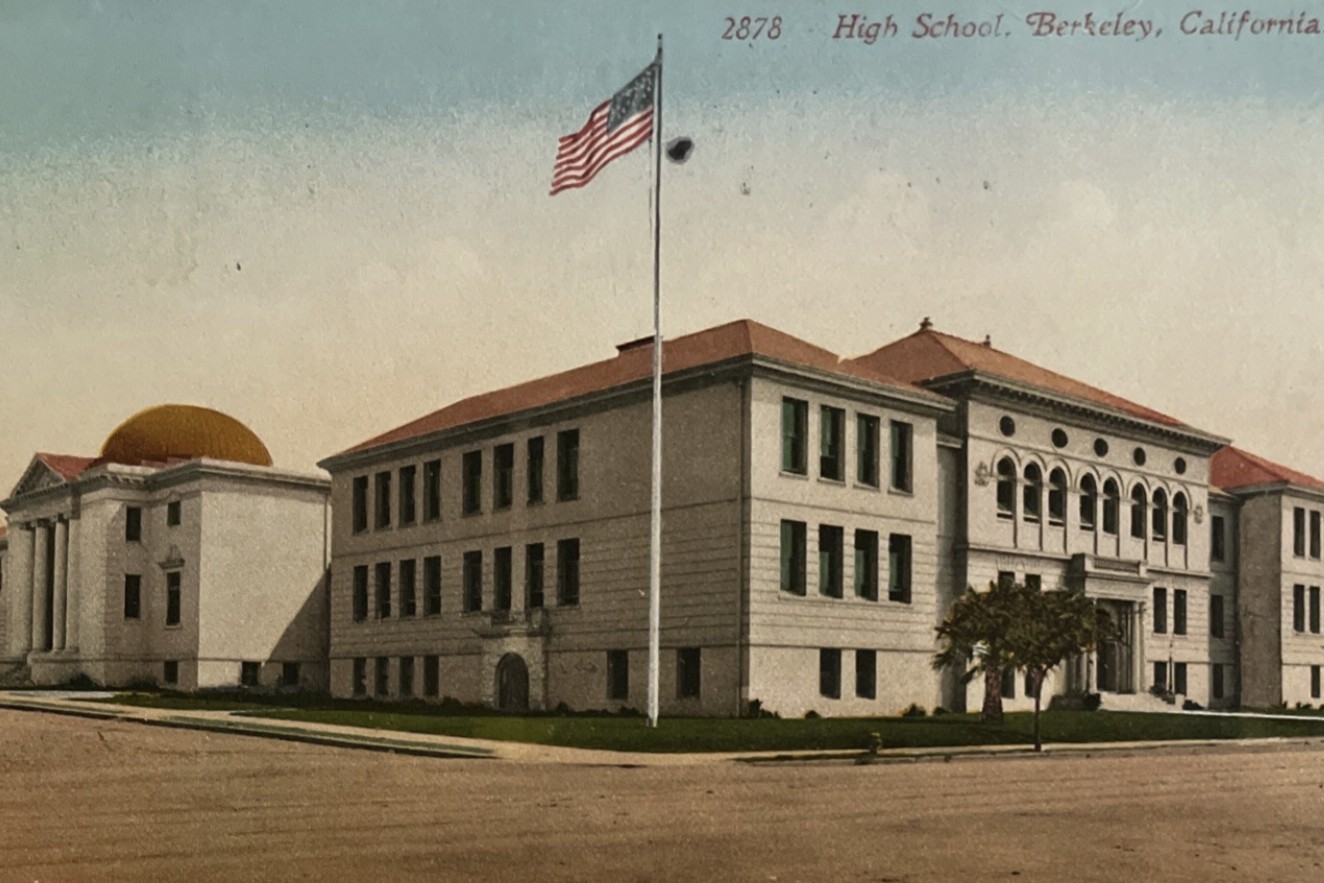
A postcard depicts Berkeley High School circa 1920. A 1926 survey of Berkeley schools recommended spending $3.5 million on facilities projects. (Steven Finacom for Bay Area News Group)
A century ago on Aug. 13, 1926, the Berkeley Daily Gazette was full of news of “a comprehensive survey of the physical needs of the Berkeley public schools.” Stanford University Professor J.B. Sears had prepared the survey and presented it to the Berkeley school board, recommending a $3.5 million bond issue go on the city’s election ballot by November 1927.
Among his other proposals were building a new northeast Berkeley junior high school in five or six years, “enlarging existing school buildings rather than erecting new elementary schoolhouses” and consolidation of some elementary schools with low enrollments.
He said “the senior high school will be too large soon and the city must build a new high school or shift part of the load to some other school. A six-year high school could be established at the Garfield Union High School, (but) there is no justification for two separate high schools. From the Berkeley point of view, Albany should become a part of the Berkeley high system.”
The Gazette reported on Aug. 16, 1926, that 12,719 children were enrolled in Berkeley public schools, up more than 500 from the previous year and “breaking all records for school attendance.”
UC buildings: The UC system was promoting its own facilities rebuilding program in 1926, with a bond measure on that year’s Nov. 2 state ballot.
It would finance buildings at the new UCLA campus as well as remove “obsolete and temporary wooden buildings” from the Berkeley campus, creating new modern facilities for several academic departments. Looking ahead, the bond would pass and result in the construction of several UC Berkeley buildings, including the Life Sciences Building.
Tennis great: Berkeley’s tennis champion and Cal student Helen Wills suffered setbacks in summer 1926 and had to withdraw from the U.S. championships to return from the East Coast to Berkeley. The Gazette headlined that her father had “ordered” her to come back to Berkeley for medical reasons. Earlier in the year she had an emergency appendectomy. She would stay out of competition until March 1927.
Divinity school: The Church Divinity School of the Pacific, which trained Episcopal seminarians, announced on Aug. 6, 1926, that it would move from San Francisco to new Berkeley facilities north of the UC campus. The paper reported that the move was “in order that their students may have the advantage of classes at the University of California and at the Pacific School of Religion.”
Waterfront park: After decades of reading through the Berkeley Daily Gazette, I’ve often thought that some form of everything that happens in Berkeley today also happened in the past. Here’s another example: Readers probably know that the East Bay Regional Park District is in the process of acquiring the old Golden Gate Fields property to use as a permanent public park.
A century ago on Aug. 5, 1926, Berkeleyans were discussing much the same idea. City Councilmember Walter Mark told the West Berkeley Commercial Association that creating a city park would be good at Fleming’s Point (where Golden Gate Fields would later be built).
He “said that Fleming’s Point was the logical place for a municipal park and swimming resort because of many natural advantages, including the clearest water anywhere along the Berkeley waterfront, shallow water for wading with a gentle slope down into deeper water for swimming, and a sheltered inlet, remarkably adapted for conversion into a gigantic swimming pool.”
If Mark’s idea had been pursued a century ago, Berkeley would now have a beautiful century-old park plus a beach on the edge of San Francisco Bay to match the park at the Berkeley Marina.
Bay Area native and Berkeley community historian Steven Finacom holds this column’s copyright.