
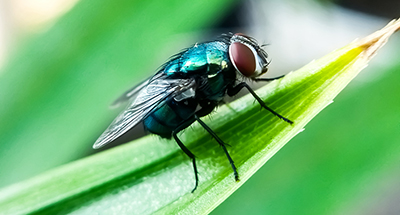
Cochliomyia hominivorax, the New World screwworm fly, causes injury or death to livestock and wildlife by laying eggs in open wounds or natural body openings. Once the larvae hatch, they feed on healthy tissue. Credit: iStock/Lidya Elfa Sari
The geographical expansion of the pest has been facilitated not only by the fly’s natural ability to travel miles looking for hosts, but also the movement of livestock, pets and birds and other wildlife.
“We knew in 2023 that New World screwworm was going to move northward, but I wasn’t expecting it to move as fast as it has,” said Beatty. “Although the source of the infections in the U.S. is still under investigation, the fact that it’s in the U.S. is 100% clear.
“Once it entered Texas, we quickly saw an increase in detections,” he continued. “It’s in a place where it used to live, so it’s not surprising it’s taking a hold again.”
Fighting back
In the 1950s, the New World screwworm was eliminated from the United States using one of the most successful biological control campaigns ever attempted. Called the sterile insect technique, the approach used the mass release of radiation-sterilized insects into the wild to cause reproductive failure and population collapse.
Officials today are drawing on a similar strategy. Led by the U.S. Department of Agriculture (USDA), the latest eradication effort has reintroduced the technique, combined with pesticides and animal movement quarantines. U.S. Environmental Protection Agency approval is also being sought for a genetically modified all-male strain, which is now in field testing. Researchers at UC San Diego are also developing next-generation genetic technologies that could strengthen future screwworm control and eradication efforts. (See related story, “Flesh-eating Screwworms Have Returned. Which New Technologies Could Stop Them?“)
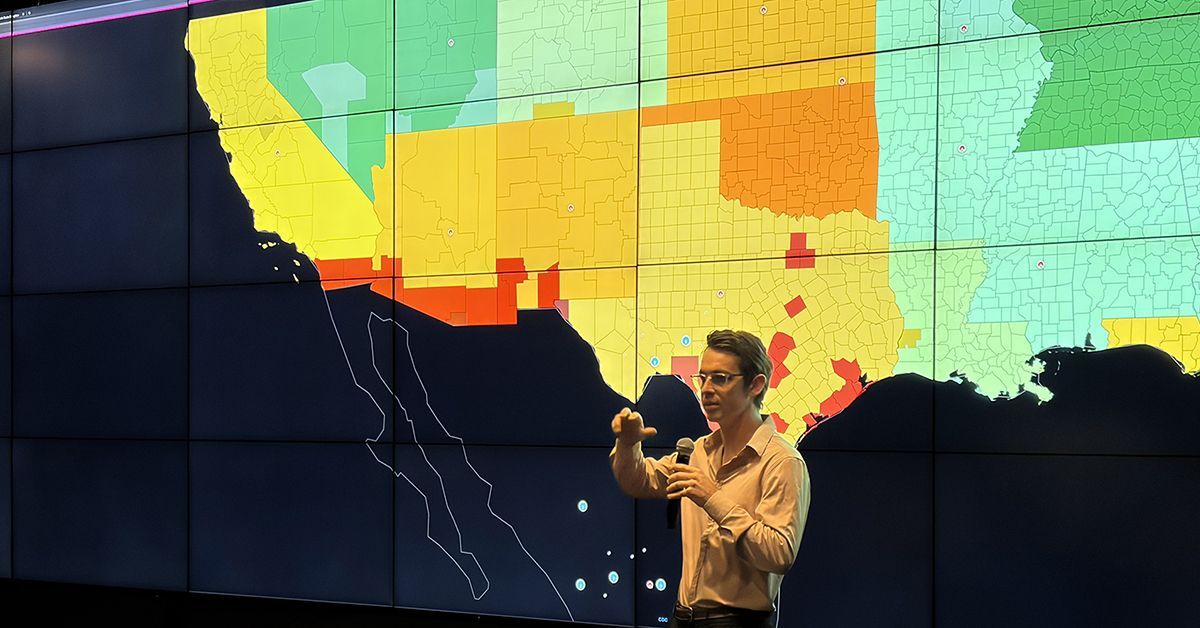
“We are working closely with the California Department of Food and Agriculture to connect local veterinarians with screwworm resources for surveillance in our region,” said Emily Trumbull, DVM, veterinarian and lead for the Epidemiology Unit’s One Health Program. “The flies can affect any warm-blooded animal, so working together with veterinarians serving livestock, pets and wildlife is critical for identifying suspect cases and preventing cases in people. The dashboard takes into account environmental factors that can help us understand how the risk to our local region is changing before the fly arrives. That’s why the dashboard is valuable.”
A New Model for Public Health Response
The screwworm dashboard is the latest project from Resilient Shield, a UC San Diego initiative and U.S. Centers for Disease Control (CDC)-funded center led by Aronoff-Spencer and co-PIs. As one of 13 core facilities in the CDC’s new Insight Net, a national outbreak and disease modeling network, Resilient Shield is helping pioneer a new approach to building public health tools — one driven by the needs of public health professionals.
“In public health, we always know our most urgent priorities, but too often we don’t have the immediate resources or in-house technical solutions to achieve them,” said Shah. “The screwworm is a perfect example. It is a critical threat, but it is an issue our academic partners might never have prioritized without our direct ticket. This partnership solves our immediate problem while providing shareable, open reference designs that demonstrate exactly how public health, academia, and industry can successfully work together.”
Instead of researchers guessing what agencies need, organizations facing real-world threats can submit tickets to Resilient Shield for the solutions they require. In addition to San Diego County, Resilient Shield’s partners range from the California Department of Public Health to the Navajo Nation and the broader Insight Net.
This multidisciplinary model allows for rapid, cross-institutional mobilization. The center’s very first ticket was a flu tracking request also issued by Shah; the response was co-led by Resilient Shield co-PI Ruy Ribeiro at Los Alamos National Laboratory. For the current screwworm threat, the response was a direct collaboration between Aronoff-Spencer and mathematical epidemiologist Natasha Martin, DPhil, professor medicine and vice chief in the Division of Infectious Diseases and Global Public Health at UC San Diego School of Medicine.
To answer those requests, Resilient Shield has engineered a modular, scalable resource hub. Working alongside technology partners like Google and MITRE, the center integrates broad data systems, cross-referencing human disease, livestock, environmental and weather data, national health records, and social listening. When a ticket comes in, the team can rapidly assemble the required tools from the open hub. This allows the team to deploy whatever is needed, whether that requires public-facing web and social media, secure compute, robust simulation engines, or AI agent builders.
“Our central innovation is the true convergence of partner priorities with scalable engineering,” said Aronoff-Spencer. “We do not build in a vacuum. Our infrastructure is built directly on the priorities dictated by our partners. In addition, because our platform is built on an open, modular architecture, every solution we develop strengthens the system and makes it more adaptable for the next public health challenge.”
Learn more by visiting the Resilient Shield, County of San Diego Public Health Services or USDA Stop Screwworm Hub websites.
Read more news about: School of Medicine,