
It’s a little unsettling when the person you’re interviewing shows up for the Zoom call wearing a shirt that reads “sarcastic comment loading” — in all caps, no less.
Better make sure those interview questions are properly researched and up to snuff — or else there could be some real zingers flying in from the interviewee.
Yet, Claude McKnight is nothing but kind and courteous as we chat about his legendary gospel a cappella outfit Take 6, which performs four nights — Aug. 13-16 — at SFJAZZ Center in San Francisco.
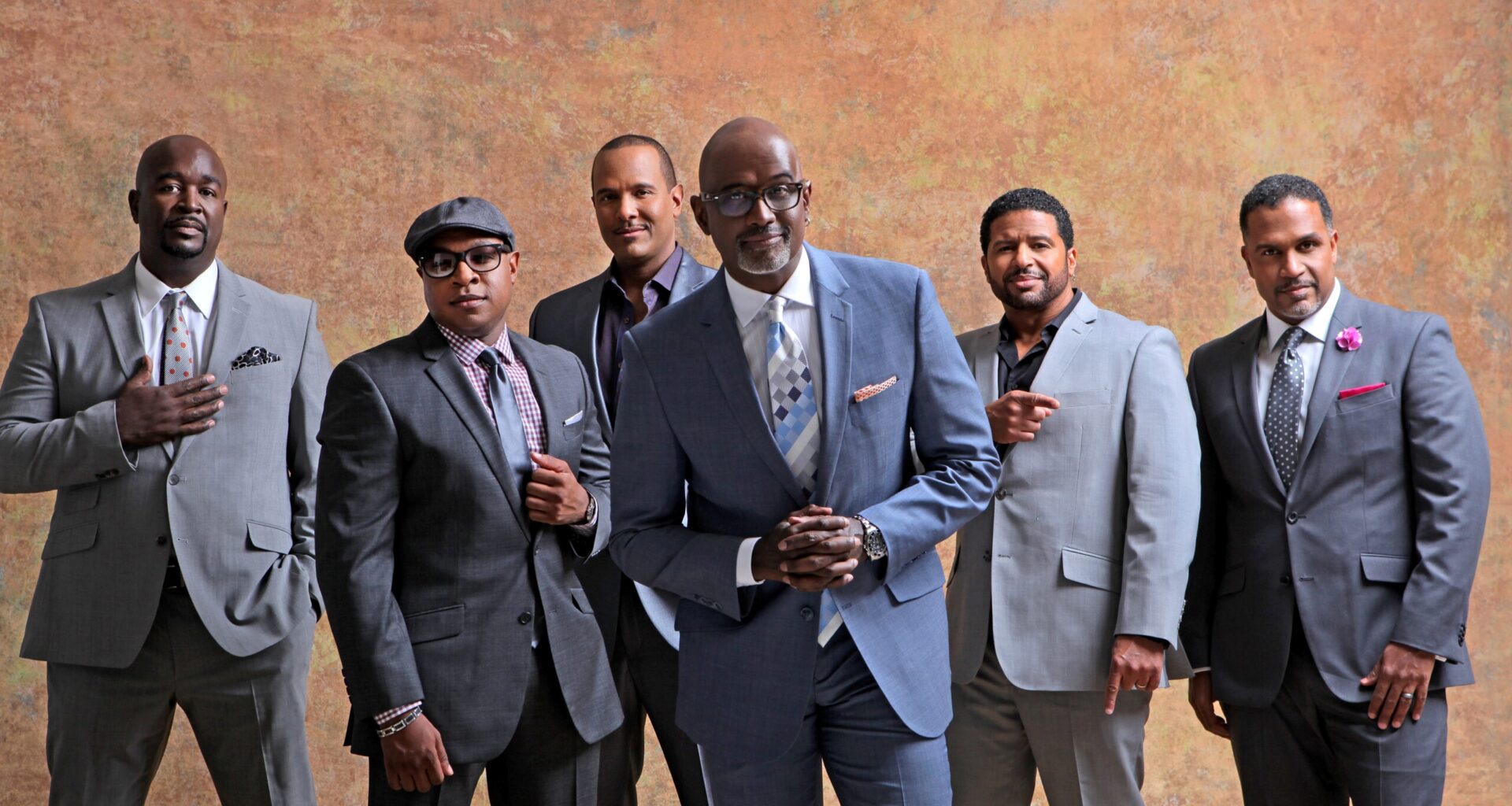
And there’s certainly a lot to talk about when it comes to this vocal troupe, which formed in 1980 and went on to become nothing short of an a cappella gospel sensation with the release of its Grammy-winning eponymous debut in 1988. The group — which currently consists of McKnight, Alvin Chea, Khristian Dentley, Joey Kibble, Mark Kibble and David Thomas — has continued to release popular albums and delight crowds through the decades.
Showtimes for this Gospel Hall of Fame act are 7:30 p.m. Aug. 13-15 and 7 p.m. Aug. 16. Tickets are $40-$130, sfjazz.org.
Here is my interview with the Take 6 founder, who is the older brother of R&B artist Brian McKnight.
Q: Hey, Claude, good to talk with you. Let’s start off way back at the beginning. What were some of your early experiences with music that helped form the entertainer, performer and vocalist that you would later become? I’m talking about those sort of foundational moments that still register with you today.
A: For me, it was all about family. I grew up in a very musical family and my grandfather led a church choir in Buffalo, New York. So from the time I was 5 or 6 years old, I would go to those choir rehearsals with my mom and start learning the parts. It was just something natural to do — because the family sang.
Q: Makes sense. That’s what you were used to.
A: It wasn’t until — and my brothers tell this story as well — we started going to school that we realized that all families and all people weren’t that way.
We just thought that singing and being able to hear harmonies and everything was just something natural that you did.
Because we got it so early, I think that translated very easily for me going on to playing instruments and then singing and starting a group like Take 6.
Q: Did you always know that you wanted to devote your life to singing for the Lord?
A: I never had any aspirations to be a singer professionally at all. That was not on my radar. I loved to sing, but it was mostly kind of background stuff and singing in choirs and things of that nature because I grew up very shy.
I also grew up playing the trombone, so I played in jazz bands and orchestras and things like that. So that’s where I thought my vocation was going to be — probably playing an instrument somewhere.
Q: But somewhere along the line that all changed.
A: It wasn’t until I got to Oakwood College — now Oakwood University in Huntsville, Alabama — which is a Christian school, that I started this group. We were singing pretty much old Negro spirituals and spiritual music in general.
And we just happened to get this record deal after doing one showcase.
All of a sudden, I was personally thrust into a position of, “Oh, wait a minute, this is what I’m going to be doing now.”
And it just happens to be singing for the Lord. But I grew up in the church, so it wasn’t a stretch. It was just I had no idea that I was going to be a singer as my vocation.
Q: What were your initial aspirations for the group?
A: When we started out, it was just a hobby. And if you do some research on Oakwood University, you will find that it has a very long and rich heritage of a cappella groups. When I got there as a freshman, I found three other freshmen guys who were like, “Yeah, I can sing.” So, we just started singing as a quartet.
One was my roommate and we found two other guys. It was very easy at that time to find a number of people who just wanted to be a part of a group. So, for me, that initial putting together of the group was just as a hobby.
Q: Pretty cool little hobby.
A: It was something to do when we weren’t in class and when we weren’t doing homework. We would rehearse and we would learn songs.
It’s kind of like barbershop at the time. It wasn’t until we went through a lot of different guys that we realized, “Wait a minute, this might be something that could be a professional endeavor.”
It was years later, after coming upon the bottom three guys in the group — a new bass, a new baritone and a new second tenor — that we were like, “Man, this could be something.”
And then the infamous showcase happened and we had a record deal.
Q: Is the story about Mark (Kibble) actually hearing you guys in the bathroom — and that being what led him to joining the band — actually true?
A: It’s absolutely true. You may or may not know this, but you sound really great in a bathroom. And the larger the bathroom, the more echo you get and reverberation. So, we used to rehearse in this large bathroom and Mark came into that bathroom and heard what we were doing — the original quartet — added the fifth part on the spot and started arranging for this group as a quintet. So, yeah, that is a very true story.
Q: That’s funny. OK, let’s talk about that “infamous showcase,” as you say. Because you went from being a college group to major label recording act really quick.
A: It was quick and not quick at the same time. The quick part is that it was just one showcase and, all of a sudden, we literally were recording 20 days later for Warner Bros. Records in Nashville.
But we had had years of being a group together, as I mentioned, just rehearsing and getting ready — so it’s kind of like that 10,000 hours that you hear about. We did all of the rehearsing and everything for that one moment.
Q: How did the showcase come about?
A: The showcase came together because we approached someone in Nashville — who had known all of us as we were kids and who, later on, became our manager — and asked her if she could set up a showcase for us.
We went to a Christian bookstore. She invited about 200 people in Nashville and about five or six people showed up, and we were really disappointed.
But because we were prepared, we sang.
Q: And apparently one of those five or six people who showed up had some pretty great connections in the music industry.
A: The legendary story is a gentleman named Jim Ed Norman, who was the vice president of Warner Bros. at the time, came to that showcase uninvited. He had walked over from his office thinking that we may have been a group that he had heard about from a writer friend of his.
He walks in, hears us, and after the showcase introduces himself and says, “Hey, I have no clue what we would do with this music because Warner Bros. Nashville is the country music division. But we would love to sign you.”
And the rest is pretty much history.
Q: Those early years, after scoring the record deal, must have been pretty breathtaking. What was it like to achieve so much success with your very first album?
A: It was crazy because so much happened so quickly that we had no real time to slow down and to really see what was going on, you know, because everything was moving ahead.
We went to the Grammys for that first album and won two of the three that we were nominated for. We were recording with all these other artists, everybody from Quincy Jones to Stevie (Wonder). So we never had a chance to slow down, to take in the laurels or to even understand what was happening.
And that’s a great thing. You want to have that kind of inertia built up to where you’re just moving, moving, moving.
Q: What do you think it was about that first album that made such an impact?
A: That’s a great question. We’re asked that all the time, so it gives me an opportunity to think about it.
For one thing, I think it was divinely inspired for that album to come out at that time. If you think about it, in the late ‘80s, there was so much technology going on. You had the hair bands in rock. You had R&B, which was being married to a lot of the instrumentation and everything.
Tracy Chapman also came out at the same time. And so here was this acoustic folk singer who won all the awards, and here’s this a cappella gospel jazz group. I think it was a welcome, kind of breath of fresh air to everything else that was going on musically. And I think (the album) came out at the exact right time that it was supposed to.
Q: At the time, did you really understand the magnitude of being nominated for Best New Artist? Because you’re not just competing against people in your own field, but top talents from all kinds of music.
A: That’s the one we lost. But it’s my favorite nomination because that speaks to the newness and the fact that it can only be that one time that you can be nominated for Best New Artist.
I don’t think we understood the magnitude at the time, but over the years I’m like, “Man, that’s the one that got away, but that’s the one I’m most proud of.”
Q: Grammys are only one of the award shows where Take 6 has found success. The band has also won a number of Dove Awards. Talk to me about what the Doves mean to you. Do they mean as much as — or perhaps even more than — the Grammys since they represent the nonsecular side of the music industry?
A: I don’t think I’ve ever been asked that question. I guess the Doves could be considered the Christian Grammys.
The Doves were very cool because initially, not only the industry, but the public, didn’t know where to place us.
We just did music that we liked. We did concerts in secular settings and in sacred settings and in Black settings and in White settings, and young settings and old settings.
We didn’t know and radio didn’t know, and the record company didn’t know (where to categorize us) — so to get awards in various places actually felt good. It felt like we were justified.
Q: I just was looking at list of the legends Take 6 has performed with over the years, which ranges from Ray Charles to Whitney Houston to Kenny Rogers. Do you ever take time to just reflect on those names, pause and just go, well, wow?
A: So every once in a while, we do. It is good, every once in a while, to reminisce on those things. So many of those artists were people that we grew up listening to. And so many of them aren’t here anymore.
It’s pretty amazing, in 35-plus years of doing this professionally, that we’ve been able to touch — and be touched by — so many artists who are memorable.
Q: We’ve been talking a lot about the past, but the Take 6 story is one that is very much still being written. How satisfying is it to you that you’ve continued to have hit records over the years?
A: It’s very satisfying. You want other people to like what it is you do. So, to continue being relevant in that sense is great because that also helps to stoke your creativity. And it keeps a much more lighthearted mood within the group. To be able to continue to come together and know that people enjoy what you do — that’s a great feeling, day in, day out.
Q: Why do you think gospel music impacts not just believers in the message, but all different kinds of people?
A: I guess it’s various reasons. And it’s interesting the way you phrase that question, because you’re right — there are people who are impacted who are believers and there are people who are impacted who may not be believers.
I think that we’re all trying to believe in something.
Now, I always come from the spiritual nature of things, meaning that I think there’s always a reason why people are there. And I think that the Lord knows before any of us what everybody needs and His Spirit is always going to be present if you allow it to be.
Q: Amen to that, Claude.
A: For Take 6 specifically, we always — before every show — have a worship service and we pray and we try to rid ourselves of anything that can be in the way of somebody getting that experience.
I think that’s why, for Take 6, we continue being impactful.
And I think that’s why, a lot of times, gospel music — in and of itself — continues to be impactful for people.
Q: So one of the first things I noticed when you logged on to the interview was your shirt that reads “sarcastic comment loading.” So, now that you’ve had like 25 minutes or so, has the sarcastic comment loaded? Do you have one for me?
A: That’s funny. People who know me know that sarcasm is one of my superpowers, and it can also be a supervillain power. So, I have to keep that in check. And one of the ways to keep that in check is to make sure I’m prayed up. Sarcasm is an interesting thing because it can be viewed by some people as funny and other people as hurtful. So sarcasm, I think if you’re going to use it, needs to be with enough restraint that you stay on the funny side.
Q: We’ve been going through a series at my church on wisdom. We’ve been looking at Solomon and other scripture. And it seems that so much of wisdom, at least Biblically speaking, keeps coming back to watching what you say.
A: Absolutely. Imagine what you might say to somebody that might impact them for the rest of their moment, day and life. And it may have been a flippant comment and what you intended to do was to draw them in, but what you’ve now done is push them away. So, the wisdom part of it is so important.
Q: After doing this for so long, what wisdom would you impart to a young person who is looking to make a career in Christian/gospel music?
A: I would say continue daily to examine your heart. And that’s not just for Christian music, but for anything you do — examine your heart. Because if you are genuine in who it is you are in your heart, then you will be able to continue to have the passion for what it is you say you want to do.
Because it will tell on you if you’re not.