
View the full episode transcript.
San Francisco’s Beaver Street is just two blocks long. It climbs from Castro Street up a steep hill toward Corona Heights, a few blocks from the Castro Theater.
Tucked into the curve of this tiny street is a narrow park, and inside it, a 60-foot slab of rock that towers over a public playground. The rock is streaked with diagonal bands of red and tan that make it look almost like a slice of bacon — with a surface unlike any rock Bay Curious listener Ravi Bhoraskar had seen.
Bhoraskar first stumbled across the Beaver Street rock wall during a weekend outing with his daughters, to the Randall Museum of Science in Corona Heights Park.
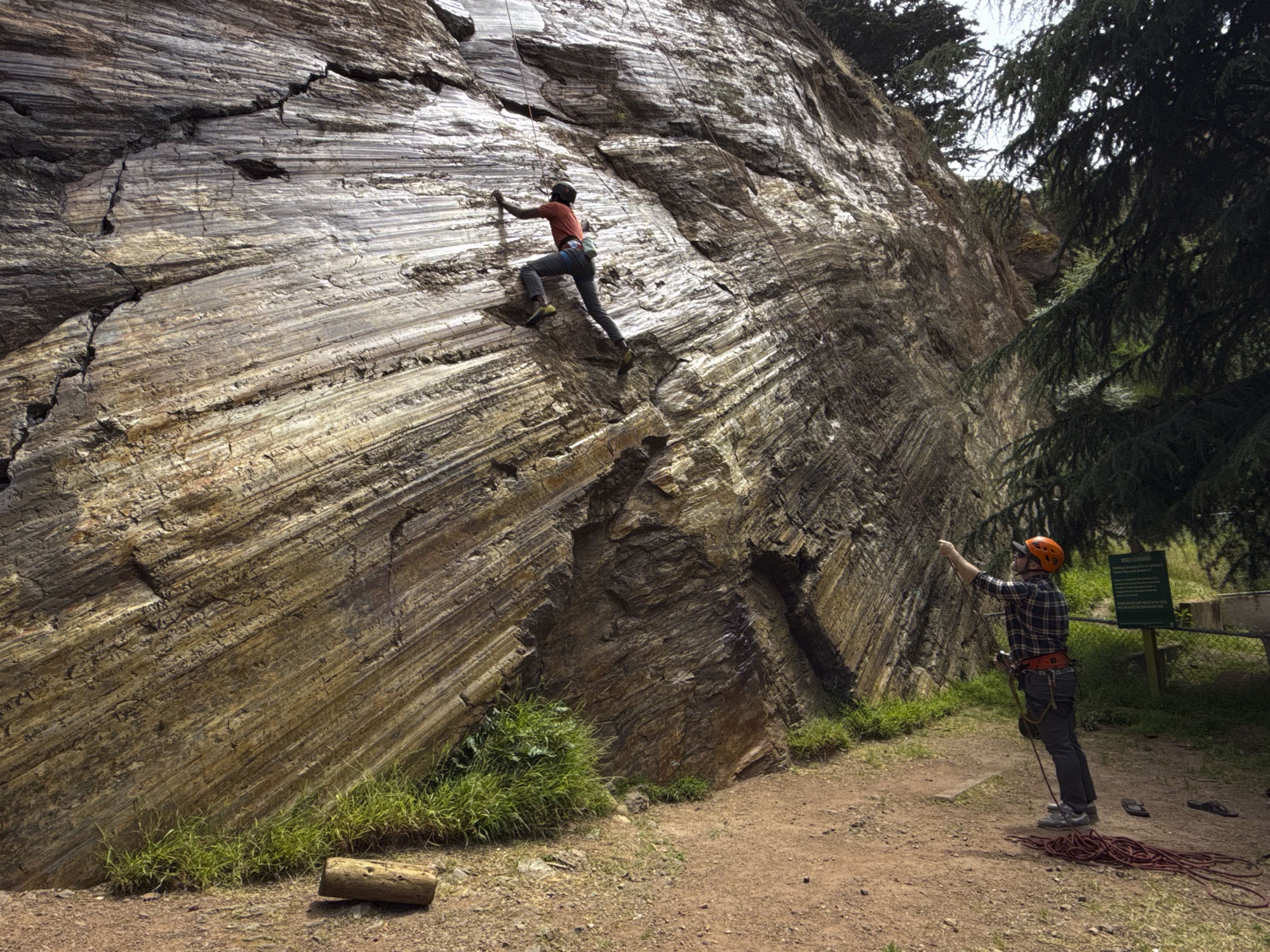 Max Stewart belays Ravi Bhoraskar as he climbs the Beaver Street wall in San Francisco’s Corona Heights Park.
He described it as a “shiny, almost slippery-looking surface” with a few sparse holes “that you can potentially use to climb on.”
The secluded crag felt like a revelation. He recently started rock climbing, and climbs weekly at his neighborhood gym in the Mission.
“I was excited to learn that there is at least one [outdoor] climbing spot within the city, easily reachable by bus,” Bhoraskar said.
A visible record of Bay Area geology
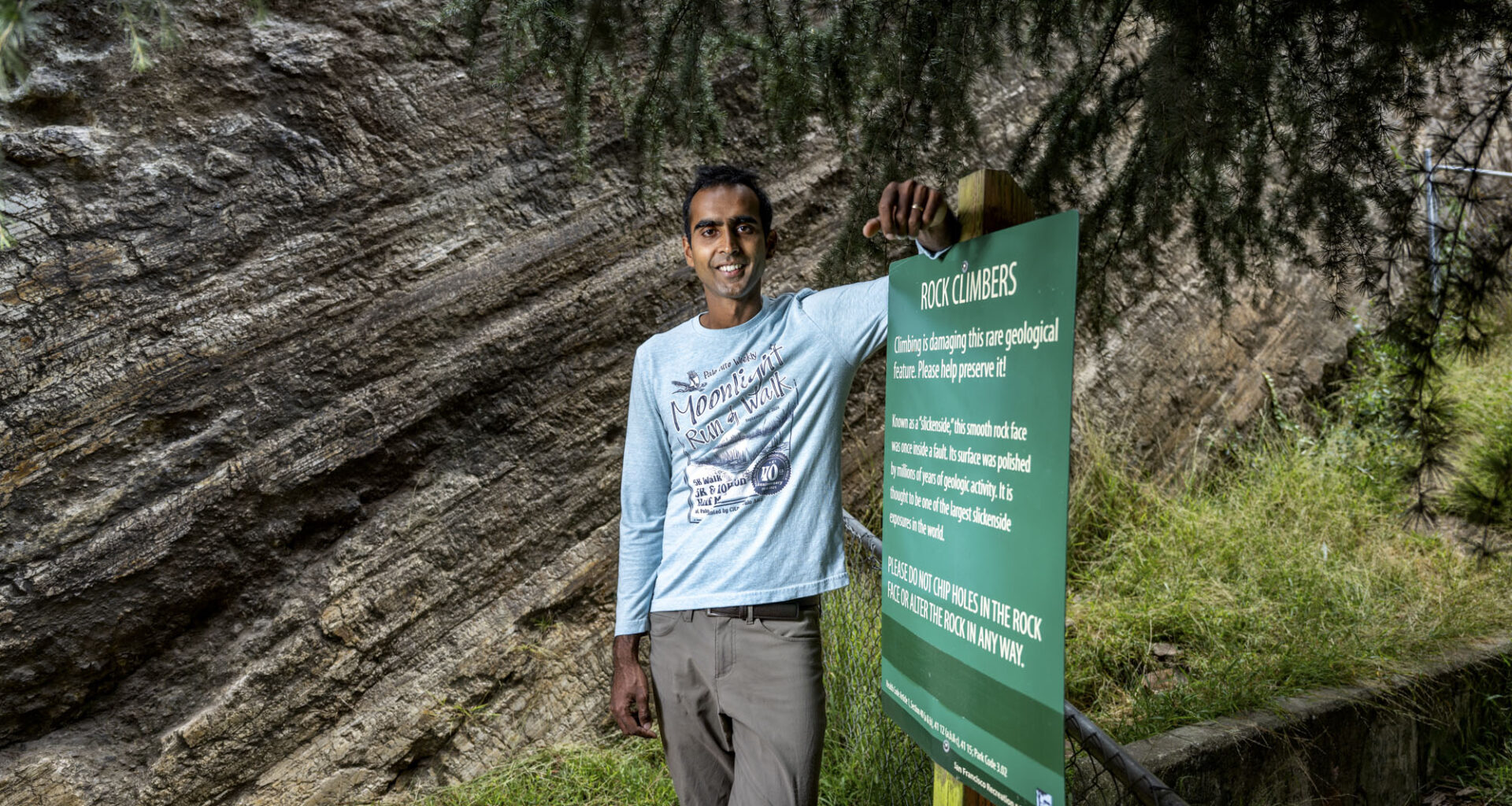
Bhoraskar’s first clue to the origins of the Beaver Street rock came from a sign posted at its base. Known as a “slickenside,” the sign explained: “This smooth rock face was once inside a fault. Its surface was polished by millions of years of geological activity.”
Slickenside is a type of rock that forms along fault lines, like the San Andreas Fault that slashes diagonally across San Francisco. When two rocks on either side of the fault rub against each other, the friction between them can generate heat and super-fine particles of dust.
That dust acts like a lubricant, polishing the rock surface until it becomes glassy and smooth, just like the rock on Beaver Street. The colorful stripes on a slickenside formation even record the direction the rocks were moving, allowing geologists to track the movement of different faults across time.
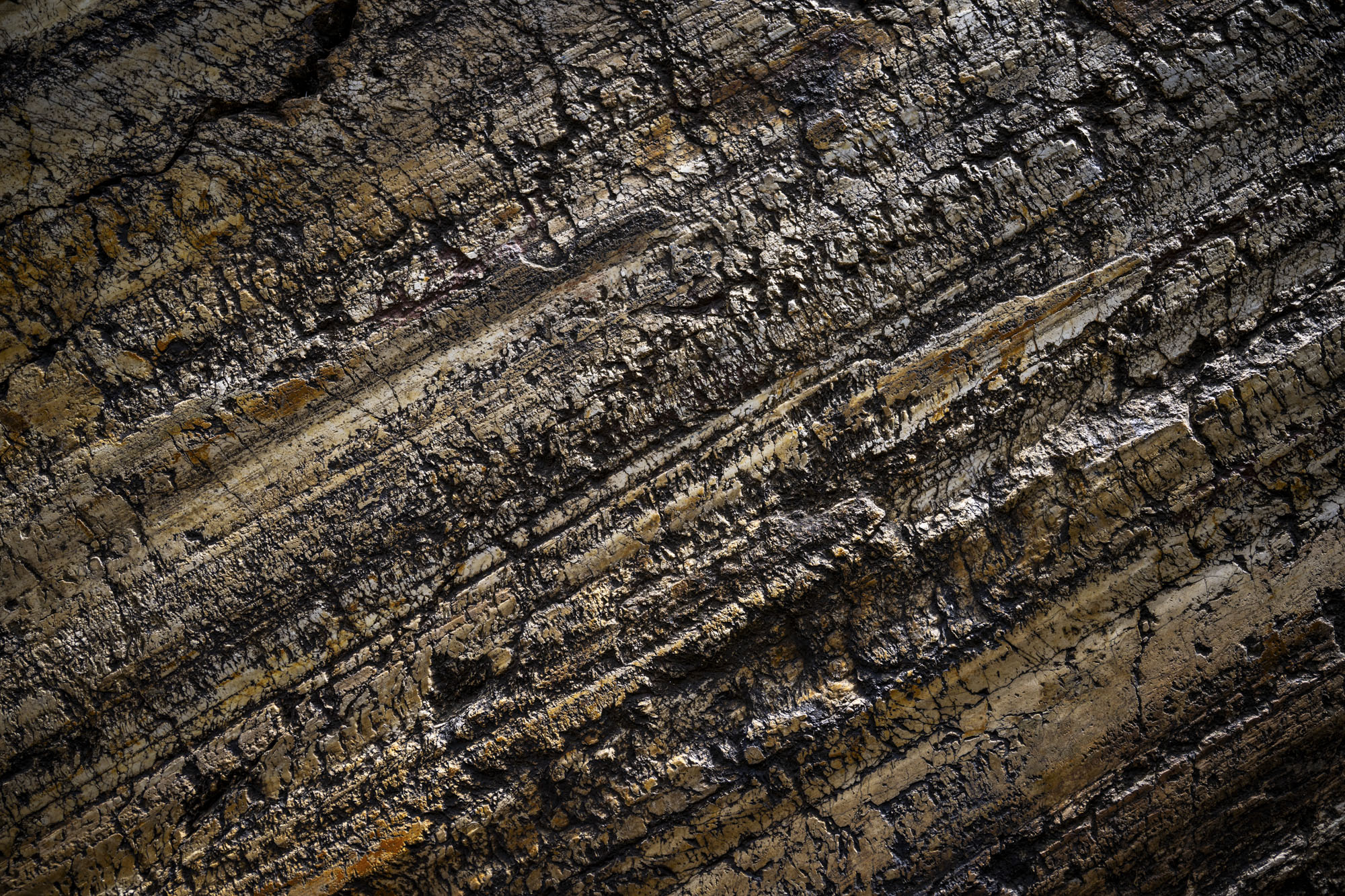 The Beaver Street Wall in Corona Heights Park in San Francisco on Aug. 10, 2026. The rock wall is open to climbing and is primarily used for top-rope climbing.
According to the City of San Francisco’s posted signage, the rock wall on Beaver Street is thought to be one of the largest exposed slickenside formations in the world.
This sign also serves as a reminder of a small municipal battle over access to the rock. In 2014, the city instituted a permitting process for climbers hoping to scale the slick stone wall.
San Francisco climbers protested and eventually persuaded the city to drop the permits — on the condition that local climbing groups and the signage at Beaver Street emphasized a “leave no trace” policy.
How a Berkeley park changed climbing history
The rock on Beaver Street is one of a handful of outdoor climbing areas in San Francisco proper, but across the bay in the Berkeley Hills sits another city park where climbers have pushed the sport forward for nearly a century.
Indian Rock Park encompasses a collection of volcanic boulders in the hills overlooking the UC Berkeley campus. Long a place of significance to Ohlone people, these boulders have also played an outsized role in the Bay Area’s climbing history. John Sherman remembers getting introduced to the sport here in the 1970s, when he was a student at El Cerrito High.
“Well, it’s kind of a funny story,” Sherman said. “Some friends and I scored some beer. Of course, we weren’t of legal drinking age, so we were really excited, and we wanted to find some place where we’d be semi-hidden to drink it.”
“We took a real beating back in those days,” Sherman explained of his early bouldering experiments at Indian Rock. “There weren’t that many people, like myself, who were daft enough to go through that and keep beating themselves up.”
Sherman is now a climbing legend within the Bay Area and beyond.
He was the first person to scale and document hundreds of new routes in a now-esteemed bouldering area in Texas, called Hueco Tanks, and he helped to invent the “crash pads” that boulderers use to cushion their falls today.
But his most recognizable contribution to the Bay Area’s climbing culture is one that Sherman doesn’t like to talk about.
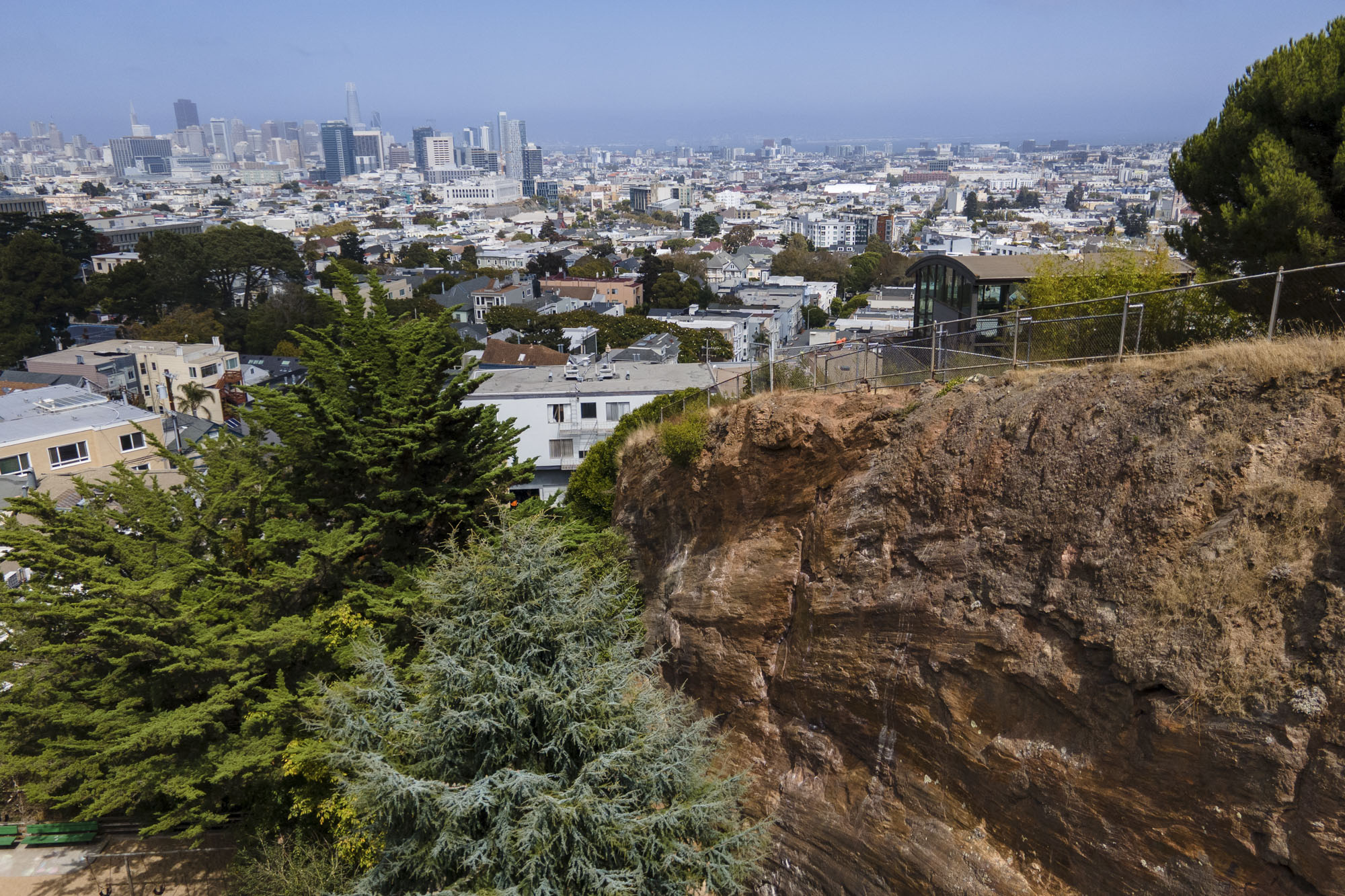 A view of the skyline from the Beaver Street Wall in Corona Heights Park in San Francisco on Aug. 10, 2026. The rock wall is open to climbing and is primarily used for top-rope climbing.
He invented a system to grade the difficulty of bouldering climbs, dubbed the “V grading system” — as in, the Vermin grading system. This is a system now widely used by climbing gyms, which rates the easiest climbs at V0 and goes up numerically (V1, V2, V3 and so on) as the difficulty increases.
Sherman said he dislikes how fixated other climbers have become with his grading system.
“I just think of climbing grades as the excrement of the climbing experience,” he said. He described the “nutrition” of the climbing experience as being all the things that make climbing worthwhile: the camaraderie, the “kinesthetic flow of the movement” and a communion with nature.
“And then what happens afterwards?” he said. “Out pops a V grade.”
A safer way to fall
Sherman prefers to think of himself as part of a long lineage of Bay Area climbers who have sharpened their skills on the urban rock faces available to them.
At Indian Rock, for example, a group of Berkeley law students and mountaineers were preparing for ascents in Yosemite Valley as early as the 1930s.
Mountain climbing at the time was extraordinarily dangerous. The gear was heavy and awkward, and the safety equipment didn’t really work. Climbers used ropes made of hemp — stiff, dry, and prone to snapping if pulled too quickly. Most people assumed a fall on a climbing route was fatal.
“The rope’s gonna break, and that’s it, you know?” Sherman said.
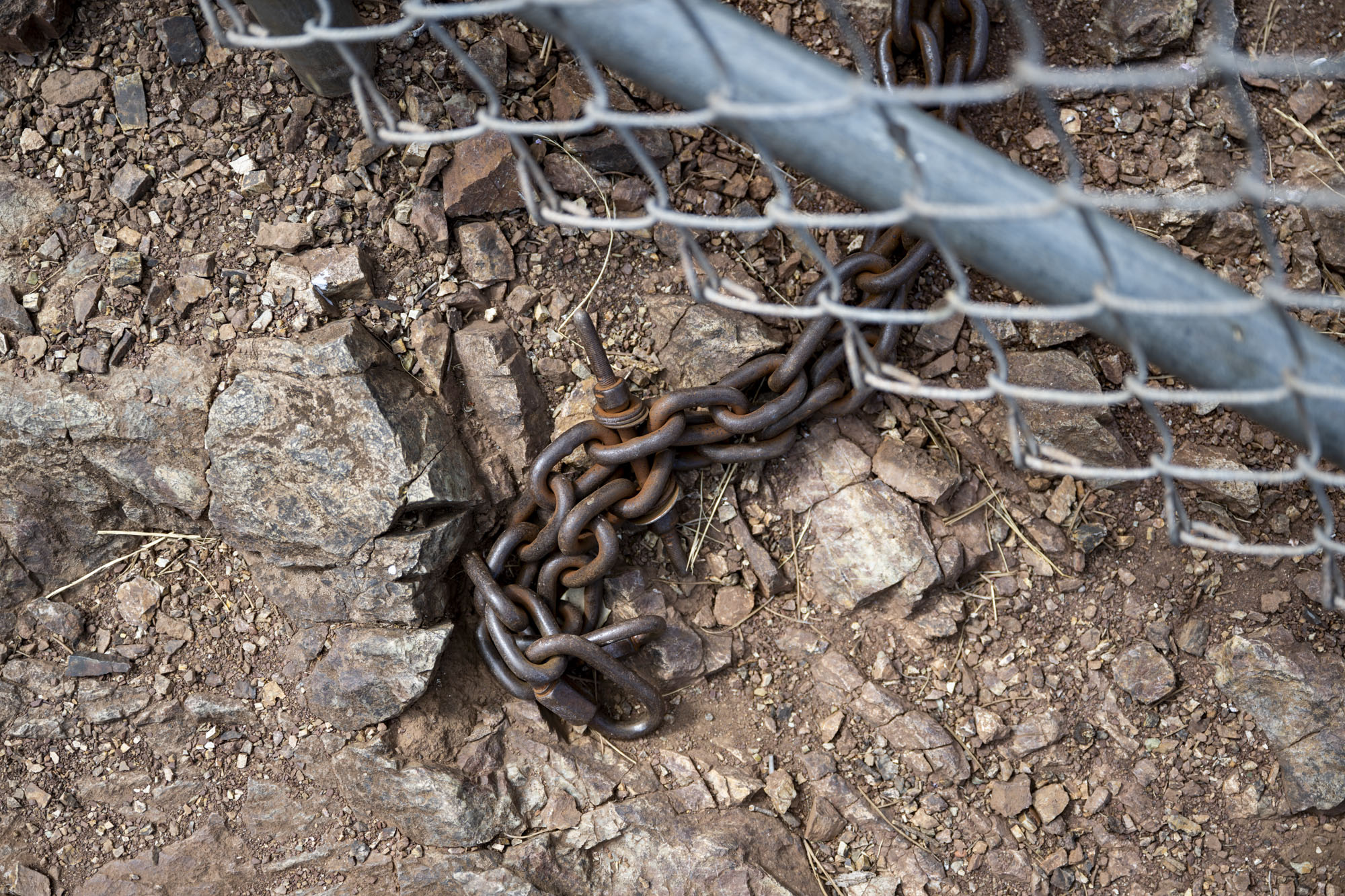 An anchor chain at the top of the Beaver Street Wall in Corona Heights Park in San Francisco on Aug. 10, 2026. The rock wall is open to climbing and is primarily used for top-rope climbing.
But the Berkeley students climbing at Indian Rock developed a counterintuitive idea to change that.
The solution was all in how climbers handled the rope. If a belayer let the rope run through their hands and slowly absorbed the force of a fall, the rope was far less likely to snap — and could actually catch a falling climber without killing them.
Climbers began practicing these controlled, “slow” rope falls by jumping off the boulders at Indian Rock, and they carried the life-saving technique with them to Yosemite. By the 1940s, nylon was commercially accessible, and climbers began making stronger, more shock-absorbent ropes from it.
“And then all of a sudden things got a lot safer,” Sherman said. “The nylon ropes were less prone to breaking than hemp ropes were.”
Falling was no longer a death sentence, and the sport became more popular as a result. As new tools and techniques made climbing safer, the goals of the sport shifted too.
“Style was more important than difficulty, and you were more respected if you could walk up to a climb and climb it without falling … just figuring it out,” Sherman said.
By the 1960s, climbing was no longer just about the summit — it was about finding a creative way up each rock, and making the act of climbing itself beautiful.
The secret climbs on University of California, Berkeley campus
Climbers still wanted to test themselves on big routes in Yosemite and Joshua Tree, but the Bay Area’s natural geology was limited, and climbing gyms weren’t yet common. So climbers had to look for training grounds in some unexpected places.
Jordan Schultz is the kind of climber who sees potential everywhere — even across the UC Berkeley campus, where he’s cataloged hundreds of “buildering” routes.
“I think I listed, like, 300-plus routes just on campus,” Schultz said. “Pretty much every building is climbable, is what I found out, if you look at it in the right way.”
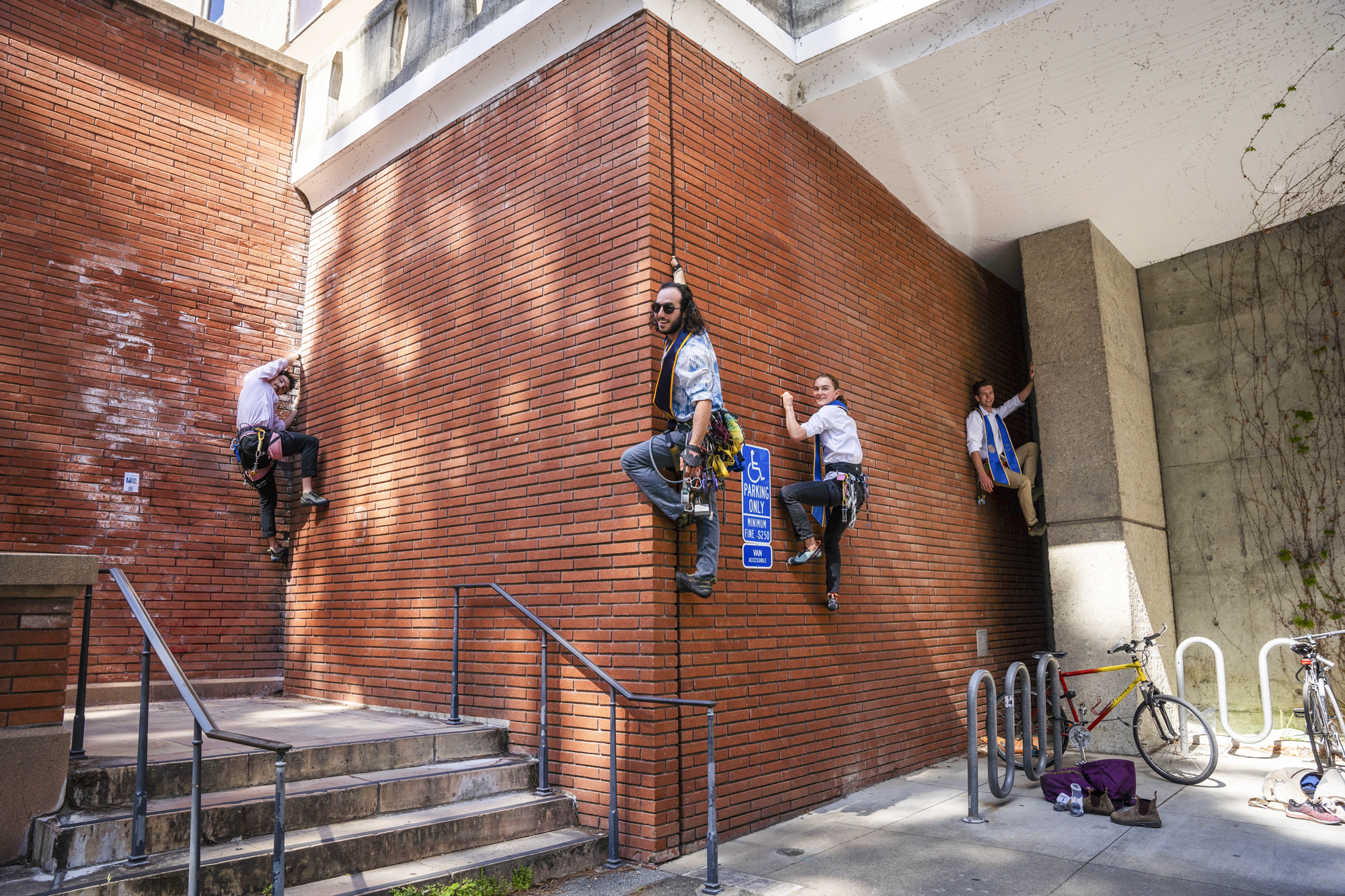 From left to right, climbers Ace Landauer, Jordan Schultz, Tilly Holtz and Colin Wills hang from cracks in the “penny wall,” a spot on the UC Berkeley campus where rock climbers practice crack climbing techniques required for climbs in Yosemite Valley.
Schultz documented these routes — and the history behind them — in his guidebook, Campusing: A Secret History and Buildering Guide to UC Berkeley. One of the university’s most famous unofficial routes is a crack running up the side of a brick building that houses the chemistry department.
“It doesn’t really look like much when you look at it,” Schultz said. “I think that’s the beautiful part about it. You need to open your eyes to it, you know?”
Climbers have used this crack to practice technique since at least the 1960s, Schultz said, because it mirrors the kind of crack climbing common in Yosemite and other parts of the Sierra.
Episode transcript
Olivia Allen-Price: I’m Olivia Allen-Price and you’re listening to Bay Curious.
When I was about six months pregnant with my first child, a friend of a friend passed along a maternity climbing harness … a full body nylon contraption that allows pregnant people to keep rock climbing.
Now, I was not a rock climber at the time, but thought — “hey, why not? A lot of other activities I love, like running, have gotten really hard, but my legs are stronger than ever. Let’s climb!”
Soon I found myself halfway up a wall in Pinnacles National Park … having a blast, but also hearing the voice of my mother inside my head: “Oh, Olivia. You would.”
To be honest, my stint with rock climbing was relatively short, but I was into it long enough to hit up most of the bigger climbing areas in the Bay Area. And I learned you don’t have to drive all the way to Yosemite to feel the thrill of scaling a cliff.
There are a handful of urban climbing areas you might have walked past without a second look.
Bay Curious listener Ravi Bhoraskar [[boh-RAHS-car]] stumbled across one of those hidden rock walls … tucked into the hills of San Francisco.
Ravi Bhoraskar: It looked to me like a residential street. A bunch of cute houses, uh, and, like, a little narrow path in the middle.
Olivia Allen-Price: Beaver Street itself is just two blocks long. It climbs from Castro Street up a steep hill towards Corona Heights. The Castro Theater is just a few blocks away.
And tucked into the curve of Beaver Street is a narrow park.
Ravi Bhoraskar: And as you come in, you get this giant piece of shiny rock, which is the Beaver Street Wall.
Olivia Allen-Price: This big slab of rock towers 60 feet above a kids’ playground. It’s got these diagonal streaks of red and tan rock that honestly make it look almost like a slice of bacon. And it has an unusual texture…
Ravi Bhoraskar: It’s kind of like a shiny, almost slippery-looking surface, with some holes that you can potentially use to climb on.
Olivia Allen-Price: This interested Ravi because he recently got into rock climbing.
Ravi Bhoraskar: Mostly indoors at the climbing gym. I was excited to learn that there is, like, at least one climbing spot right within the city, like, easily reachable by bus.
Olivia Allen-Price: And he wants to know … what is that slippery, striped bacon rock?
Ravi Bhoraskar: How did it end up there, and why does it look so cool?
Olivia Allen-Price: And most importantly…
Ravi Bhoraskar: Like, can I climb it?
Olivia Allen-Price: Today we’re going to get answers for Ravi, of course. But we’ll also explore how Bay Area climbers have used city parks to practice their skills for decades — and ultimately push the sport forward. Turns out there’s a lot of rock climbing history anchored right here in the Bay Area.
KQED producer Francesca Fenzi headed to Beaver Street with Ravi … to check out this unusual rock.
Birds singing, slight traffic sounds
Francesca Fenzi: Ravi and I arrive at Corona Heights Park on a sunny weekend afternoon. We can hear birds singing … and the faint sound of traffic from Market Street carrying up the hill.
There’s a playground, a dense pocket of trees, and then … this glistening rock wall.
Ravi Bhoraskar: It’s not wet, but it looks wet.
Francesca Fenzi: The shiny surface is interrupted by a single jagged crack, which runs about six stories high. And at the base of the rock is a sign … which gives us a clue about how it got here.
Ravi Bhoraskar: Known as a slickenslide, this smooth rock face was once inside a fault. Its surface was polished by millions of years of geological activity.
Francesca Fenzi: It’s Slicken SIDE actually. Try saying that three times fast!
Slickenside forms when two rocks inside a fault rub against each other. Imagine pressing your hands together as hard as you can and then sliding them back and forth.
That friction creates heat — and tiny dust particles which act like a fluid — to polish the rock until it looks glassy and smooth. Just like the wall at Beaver Street. The colorful stripes even show the direction the fault was moving when a Slickenside was formed.
According to the sign, this rock is thought to be one of the largest exposed Slickenside formations in the world.
Ravi Bhoraskar: Capitals, “Please do not chip holes in the rock face or alter the rock in any way.” And then it’s taped over Um, climbing on these rocks is by permit only. To obtain a permit, call some number.
Francesca Fenzi: I looked into getting a permit and it turns out you no longer need one to climb at Beaver Street. So Ravi is going to try to climb it today.
And to make sure we don’t damage the rock, we’ve enlisted some help.
Max Stewart: Hey, how you doing? I’m Max. Hey, Ravi. Ravi, nice to meet you. Nice to meet you.
Francesca Fenzi: Max Stewart owns a guiding company, called SAANO Adventures. And he’s offered to help us set up an anchor and climbing rope on the Beaver Street wall…
Max Stewart: I’d be happy to. Did you bring some shoes?
Ravi Bhoraskar: I brought some shoes.
Max Stewart: Yeah? Okay. Cool.
Francesca Fenzi: Outdoor rocks don’t come with built-in safety equipment like the climbs in a gym, so we’ll need to secure our rope to something sturdy at the top of the rock wall.
Max Stewart: There’s a little staircase here. Yep, there it is.
Francesca Fenzi: Max leads us up and around the back side of the rock, to the top of a windy hill.
I can pick out landmarks like the diagonal slash of Market Street below, the Salesforce tower and the Bay Bridge in the distance.
Directly in front of us is a steep drop off. It looks a lot more intimidating from up here!
Max Stewart: Isn’t that wild? So the playground. we met just right down there. There’s the sign that you were reading.
Francesca Fenzi: Separating us from the edge of the cliff is a chain link fence.
Max Stewart: And then a bunch of heavy duty chains that we’re gonna use.
Francesca Fenzi: These heavy duty chains bolted into the top of the wall are perfect for setting up what’s called a “top rope” climb, where a rope runs from the ground, up to an anchor, and back down to the climber, catching them if they fall.
Max Stewart: Always a little weird!
Francesca Fenzi: Max explains that this is the same setup used by climbing gyms … even if it looks a bit different outside.
Francesca Fenzi in scene: Oh, man. That was impressive. [to Ravi] Is this what you were expecting?
Ravi Bhoraskar: No, not at all.
Francesca Fenzi in scene: A little different than the climbing gym, huh?
Ravi Bhoraskar: Yeah, yeah, definitely.
Francesca Fenzi: I’ve climbed outside a bit myself and part of what I love is the sense of possibility. There aren’t any predetermined holds, you can find your own route up to the top.
Max Stewart: Every single person is gonna have their own method for solving this. the gyms I think are a really good place to get started, to kinda just learn the ropes, but I really encourage people as soon as, you feel like you can do it, to get outside.
Francesca Fenzi in scene: Is this gonna be your first time climbing outside?
Ravi Bhoraskar: Uh, yes. Yes, this will be.
Max Stewart: No way, really?
Ravi Bhoraskar: Yeah.
Max Stewart: Oh, it’s so fun.
Sound of climbing over chain link fence
Max Stewart: When was the last time you were hopping [00:07:00] fences to go climbing. Hey. It feels kinda like you’re doing stuff you’re not supposed to do, hopping fences and … It’s like good clean fun, but still kind of a throwback, you know?
Francesca Fenzi: No laws were broken in the making of this podcast! But Max is right. Setting up the rope above Beaver Street really does feel like getting away with something.
Music starts
Francesca Fenzi: A lot of urban climbs FEEL illicit because it seems kind of unnatural to be doing something we associate with mountains right in our backyards.
But, there’s actually a long history of Bay Area climbers using whatever they can find to ready themselves for those more ambitious, wild ascents.
Beaver Street is one of the only rocks you can climb outdoors in San Francisco, but just across the bay, in the Berkeley Hills, is another city park where climbers have been pushing the limits of the sport for almost a century.
John Sherman grew up in Berkeley. And he remembers getting introduced to climbing there.
John Sherman: Well, it’s kind of a funny story. Some friends and I in high school, we scored some beer. Of course, we weren’t of legal drinking age, so we were really excited, and we wanted to find some place where we, you know, we’d be semi-hidden to drink it.
Francesca Fenzi: So they made their way to Indian Rock park, a collection of volcanic boulders that was once an Ohlone meeting spot.
John Sherman: And we were sitting on the steps there drinking this beer we had gotten, and I saw people climbing there.
Francesca Fenzi: The climbers were just a few feet off the ground … practicing gravity-defying moves.
John Sherman: That day I got fascinated with it, and I wanted to try it myself.
Francesca Fenzi: Pretty soon, he was taking the bus to Indian Rock every day after school.
John Sherman: And I would always have my climbing shoes in my book bag along with my textbooks and stuff, and I would stop there on the way home every day, go to Indian Rock and boulder till it got dark and then walk home.
Francesca Fenzi: He was at the rock so often that his brother started describing himself as an only child.
John Sherman: I got hooked, and I’ve been doing it every day since. And, you know, it’s been over 50 years now.
Francesca Fenzi: The type of climbing John was doing is called bouldering. There aren’t any ropes, but people climb closer to the ground, using pads to cushion a fall. At least, they do now. But in the early days…
John Sherman: We took a real beating and there weren’t that many people like myself who were daft enough to go through that and keep beating themselves up like that.
Francesca Fenzi: John is a bit of a legend. He was the first person to climb a bunch of famous bouldering routes, he helped invent those cushioned pads, AND he created a system for ranking the difficulty of climbs — called the V grading system — that’s widely used today. It starts with the easiest climbs at V0 and goes up from there as the climbing gets harder — V1, V2 and so on.
The V comes from John’s lifelong nickname, given to him by a biology teacher at El Cerrito High.
John Sherman: So he called me Sherman the Vermin. Got shortened to Verm and just kind of stuck.
Francesca Fenzi: John actually hates how fixated other climbers get on his V grading system.
John Sherman: I just think of climbing grades as the excrement of the climbing experience. After you do a wonderful, you know, boulder problem, and you enjoy the setting that you’re in, the camaraderie of your climbing partners, the kinesthetic flow of the moves and everything, and then what happens afterwards? Out pops a V grade.
Francesca Fenzi: Instead, John likes to think of himself as part of a long line of climbers honing their skills at Indian Rock.
John Sherman: The early history that I know of that’s documented goes back to like the 1930s
Francesca Fenzi: At that time, a group of Berkeley law students — and mountaineers — had their sights on Yosemite Valley.
John Sherman: And here is a collection of rocks where they could train.
Francesca Fenzi: The training part was important. Because at the time mountain climbing was super dangerous. The gear was heavy and awkward. The safety equipment didn’t really work.
Climbers were using these flimsy ropes made out of hemp that were stiff and dry and tended to break if they got pulled apart too quickly.
John says most people assumed that falling on a climbing route was a death sentence.
John Sherman: The rope’s gonna break and that’s it, you know?
Francesca Fenzi: But these Berkeley students, climbing at Indian Rock. They came up with a counterintuitive idea.
Olivia Allen-Price: More on their idea and how it revolutionized climbing after this quick break. Stay with us.
Sponsor message
Olivia Allen-Price: UC Berkeley Students climbing at Indian Rock wanted to make climbing safer, and they discovered a technique that would really change the game. Francesca Fenzi takes it from here.
Francesca Fenzi: It was all in how you handled the rope…
John Sherman: If you let it run through your hands and slowly break the fall, that rope might not snap, and you can actually catch the leader if they fall, and they’re not gonna die.
Francesca Fenzi: This was huge. Climbers started practicing these “slow” rope falls by jumping off the boulders at Indian Rock. And they brought these life-saving skills to Yosemite with them.
A decade later, in the 1940s, nylon was widely available. And climbers started using the stretchy fiber to make stronger, more shock-absorbant ropes.
John Sherman: And then all of a sudden things got a lot safer. The nylon ropes were less prone to breaking than hemp ropes were.
Francesca Fenzi: Falling on a rock climb was no longer a death sentence and that made the sport a lot more popular.
As new tools and techniques made climbs safer, the goals of climbing changed, too.
John Sherman: Style was more important than difficulty.
Francesca Fenzi: John says by the time he got hooked, rock climbing was no longer just about getting to the top. It was about finding creative ways up a rock, and making the act of climbing itself beautiful.
Climbers were still eager to test themselves on the big climbs in places like Yosemite and Joshua Tree. But the Bay Area’s natural geology was limiting. And climbing gyms — with their variety of simulated rock types — weren’t as common as they are today.
So for Bay Area climbers to take their skills to the next level … they had to look in some unexpected places.
Jordan Schulz: Pretty much every building is climbable is what I found out, if you look at it in the right way.
Francesca Fenzi: Jordan Schulz is the kind of climber who looks at it “the right way.”
Francesca Fenzi: He’s 23 and sees climbing opportunities everywhere. Even the UC Berkeley campus, where he’s showing me one of the university’s most famous climbing “routes.”
It’s a crack in the side of a brick building that houses the Chemistry department.
Jordan Schulz: This is the crack we’re looking at right here.
Francesca Fenzi: It takes me a moment to “see” it the way Jordan does.
Francesca Fenzi in scene: To me, I’m looking at a brick wall with a parking sign on it. Yeah. And there’s a gap in the wall that’s maybe about an inch and a half thick. And it runs from the base of the wall to the the next story up.
Jordan Schulz: Yeah. That’s the climb. It doesn’t really look like much when you look at it. And then I think that’s the beautiful part about it, is that you need to open your eyes to it, you know?
Francesca Fenzi: Jordan says climbers have been using the crack in this building to practice their technique since at least the 1960s
Jordan Schulz: A lot of the style of climbing in Yosemite and the Sierras features a lot of cracks in the rock. And so, it offers a good training ground to learn some crack climbing technique that would help people climb better in the mountains.
Francesca Fenzi: Jordan says this spot has another name: the Penny Wall. Back in the 60s, when a climber was practicing at the crack, they’d stick a penny onto the highest brick they could reach.
Jordan Schulz: And so people would see, like, how high was the penny, and every so often it would get higher.
Francesca Fenzi: A challenge to the next climber…
Jordan Schulz: A subtle way of communicating you know, who climbed a little higher and moved the penny up.
Francesca Fenzi: Back at Beaver Street, our question asker Ravi is getting ready to place his own metaphorical penny on the wall.
Max Stewart: All right, Ravi, let’s get your shoes on- Yep
Francesca Fenzi: He’s about to climb outside for the first time.
Francesca Fenzi in scene: How are you feeling about climbing it?
Ravi Bhoraskar: I’m excited. I’m also, yeah, a li- little nervous. Like, I don’t want to slip, but, no, mostly excited. Mostly feeling excited about climbing this.
Max Stewart: Your belay is on. And climbing. Okay. Climb on, sir.
Francesca Fenzi: The Bay Area’s outdoor rock walls have been home to major breakthroughs in the sport. But as Max would say, they’re also good clean fun.
Max Stewart: What do you think of outdoor climbing versus, uh, in the gym?
Ravi Bhoraskar: This is great.
Max Stewart: Isn’t it so nice?