

Two Orange County supervisors today are proposing that lobbyists who meet with county leaders publicly disclose their meetings – pointing to a standard used in nearby counties like Los Angeles and San Diego.
“The absence of lobbyist disclosure requirements in Orange County raises significant transparency concerns,” reads the staff report submitted by Supervisors’ Chairman Doug Chafee and Supervisor Vicente Sarmiento, adding “Unlike other jurisdictions that provide public records of lobbying activities, Orange County does not offer this access.”
Ironically, publicly disclosing meeting calendars is a standard county supervisors won’t apply to themselves – with all but Sarmiento refusing Voice of OC requests to see their own office meeting calendars.
The proposed ordinance would for the first time ever establish quarterly lobbying activity reporting requirements, using aspects of similar lobbying disclosure policies adopted in nearby Anaheim and Irvine.
Currently, lobbyists are required under the county ordinance to disclose their clients but not their meetings.
To review the county’s current disclosures, click here.
The ordinance also would expand the current definition of lobbying from contacts with county supervisors to other decision makers like commission appointees and department heads, who often shape contracts long before the public gets a chance to see them.
The Office of Ethics and Campaign Finance would issue activity disclosure reports and the panel’s executive director developing reporting based on the requirements in the ordinance.
Shirley Grindle, who authored Orange County’s 1978 campaign finance ordinance and led establishment of the OC Ethics Commission called the new disclosure requirements “long overdue,” in a public letter urging county supervisors to adopt the changes.
 Shirley Grindle in her home office on Dec. 6, 2024. Credit: ERIKA TAYLOR, Voice of OC
“While I am sure the county lobbyists will be putting lots of pressure on each of you to deny these changes, it is more important to bring lobbying influence into the open where the public for the first time can be informed of the lobbyists attempts to influence your decisions,” Grindle wrote.
Meanwhile, finding out who county supervisors meet remains a mystery.
Supervisors through the County Counsel point to case law that does seemingly allow them to withhold their calendars, based on a state Supreme Court decision allowing the governor’s calendar to remain secret.
Yet county supervisors are not the governor.
And any one of them – like Sarmiento – can decide to release listings of who they meet with.
“Our residents should be aware of who is working to influence the decisions that affect their daily lives, which is why we publish our office calendar and share who we have met with,” Sarmeinto said in a statement to Voice of OC, adding, “We owe that to the people who put their trust in us to work in their best interest.”
Transparency advocates agree detailing who’s influencing government is key to allowing residents to understand who’s influencing government decisions
Anaheim officials began releasing their calendars after their city came under the FBI radar due to corrupt stadium dealings as part of a package of transparency reforms in 2024.
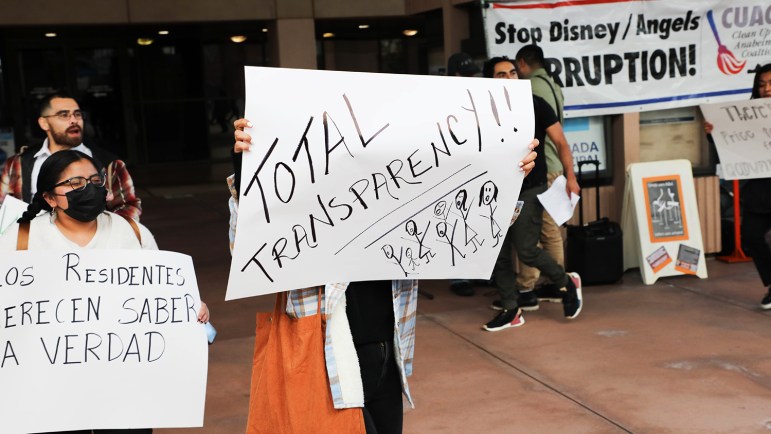 A resident holds up a sign during the rally against city hall in Anaheim, California on Tue Feb 28, 2023. Credit: NATALIE CARTWRIGHT, Voice of OC
To see a copy of Anaheim’s disclosures, click here.
“I think there’s a strong public interest in knowing who they meet, because it shows how has the ear of public official and potentially strong interest over public officials,” said David Loy, general counsel with the state’s First Amendment Coalition, which advocates and often litigates for open government on behalf of the public.
“It’s important to assess things like nepotism or conflicts of interest, or access being bought and paid for by campaign donations,” Loy added in an interview with Voice of OC earlier this year.
“Personally, do I think they ought to share their calendars? Absolutely, there’s nothing that stops them from doing so, and when in doubt the government should always air on the side of transparency.
At the end of the day, elected officials work for the people.”
Related