
By KONSTANTIN TOROPIN
WASHINGTON (AP) — The Pacific-based aircraft carrier USS George Washington has begun heading toward the Middle East as reports have emerged of mental health and supply issues aboard the long-deployed USS Abraham Lincoln.
The San Diego-based Lincoln has been supporting the U.S. war against Iran, and its deployment has included a record-setting uninterrupted time at sea of more than 240 days. Several Democratic lawmakers, including San Diego’s congressional delegation, are pressing for accountability from the Pentagon over conditions aboard the carrier, which Defense Secretary Pete Hegseth on Thursday said were “completely misrepresented.”
Extended deployments of carriers during the Iran conflict have raised concerns about the impact on service members who are away from home for long periods as well as the increasing strain on the ship and its equipment. While renewed hostilities between the U.S. and Iran have calmed in recent weeks, the Navy has reimposed a blockade on Iranian ports in the crucial Strait of Hormuz, and the Trump administration has offered no clarity on how it intends to wind down the war.
The USS George Washington left port in Da Nang, Vietnam, last week, a Navy statement said. The carrier, along with a cruiser and a destroyer, has since been spotted crossing the Singapore Strait.
A Navy official, who spoke on the condition of anonymity to detail sensitive ship details, confirmed that the Washington was in the Strait of Malacca, which links the Pacific and Indian oceans and puts the carrier on a course to head into the Indian Ocean. The Wall Street Journal reported earlier that the Washington would replace the Lincoln as one of the two aircraft carriers now stationed in the Middle East.
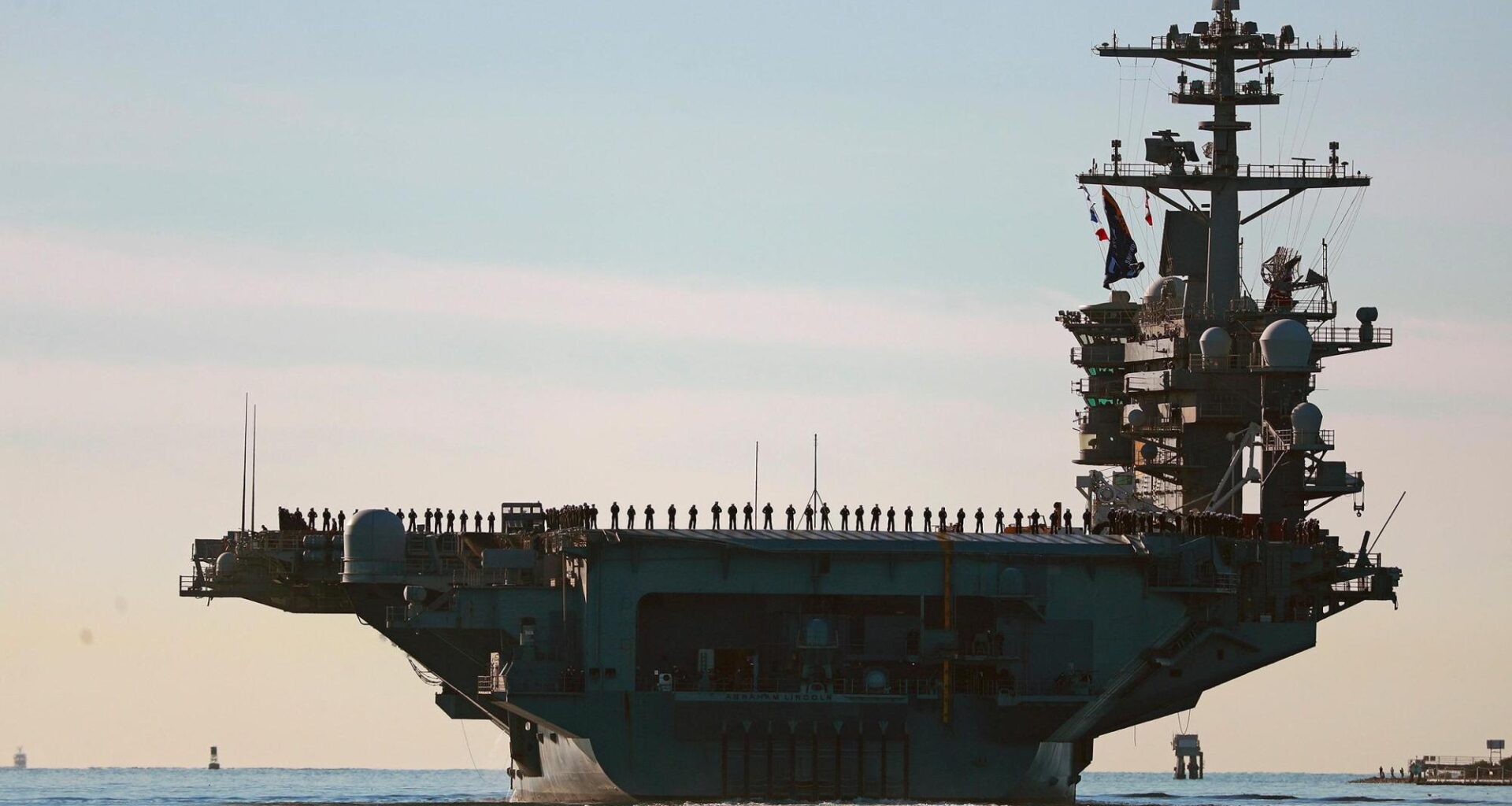
The 1,092-foot flattop, which many sailors call “Abe” and is homeported at Naval Air Station North Island, is the flagship of a nine-ship strike group operating in the region. It is operating with mostly F/A-18s, F-35C stealth fighters and other supplemental aircraft from North Island and Marine Corps Air Station Miramar in San Diego County and elsewhere.
The Lincoln originally deployed Nov. 21 from San Diego on assignment to patrol the Indo-Pacific, but it was diverted to the Middle East in January, ahead of the launch of the Iran war on Feb. 28. The Navy conceded that the conflict created a “highly contested environment where traditional supply hubs in the Middle East were disrupted by combat actions.” That, in turn, led to shortages and loss of mail aboard the aircraft carrier, the Navy said in a statement.
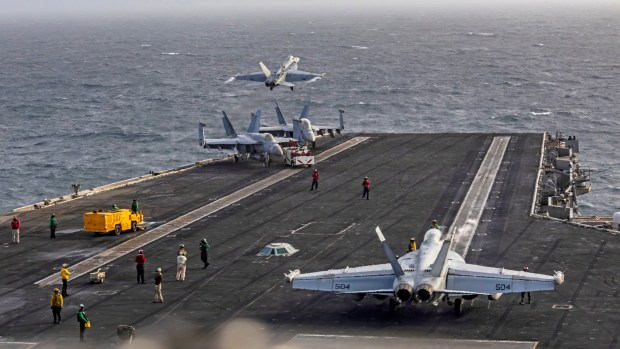 An F/A-18E Super Hornet, assigned to Strike Fighter Squadron (VFA) 151, launches from the flight deck of Nimitz-class aircraft carrier USS Abraham Lincoln on July 31. (U.S. Navy photo)
“Leadership prioritized mission-critical supplies: first food, then hygiene items, then mail,” the statement said, before assuring that sailors aboard the ship now have access to clean water and “healthy meal options.”
Democratic lawmakers are calling for investigations, more information and greater visibility into conditions aboard the ship, which was originally set to return home in May.
“The Lincoln’s prolonged deployment is especially significant because it is occurring in the context of continuing military operations against Iran and the possibility that substantial US naval forces will be required in the region for an extended period,” Connecticut Sen. Richard Blumenthal, a member of the Senate Armed Services Committee, wrote in a letter to Navy leadership asking for a response to several questions.
San Diego’s Democratic congressional delegation said in a letter to Hegseth and acting Navy Secretary Hung Cao that Marines and sailors aboard the Lincoln and their families have contacted the lawmakers directly to report “dismal conditions.”
“These concerning reports are significant enough to warrant serious questions about the Navy’s preparation and ability to maintain operational readiness for this protracted war,” the letter reads. “Yet, on top of these concerns, we are hearing reports of an overwhelming workload which is contributing to extreme fatigue and burnout that have caused a strain on our Marines and Sailors beyond the physical demands.”
The letter, signed by Reps. Mike Levin, Sara Jacobs, Scott Peters and Juan Vargas, said the situation “indicates a clear failure from this Administration.”
The lawmakers also chided Navy leadership for not notifying them of a town hall that Navy leaders, including Cao, held in San Diego last week for families of troops aboard the Lincoln. During the tense meeting, commanders of the Navy’s air and surface forces promised to do everything they could to relieve the aircraft carrier.
Arizona Sen. Ruben Gallego, a Marine Corps veteran, said on social media that he is looking to take a bipartisan delegation on an official oversight visit to the ship and that the way sailors are being treated is “not just disgusting; it’s dangerous.”
Hegseth told reporters during a visit to Panama that he wants the Lincoln’s sailors home and crews rotated as quickly as possible but pushed back against reports of problems aboard.
“We make sure that every ship, every crew, every captain has everything we can provide them at every single moment. Some deployments are longer than others, and I have more respect and gratitude for those sailors than anybody. What they do in those high seas in those austere conditions with less port calls — it’s incredible.”
When reports of food shortages aboard the ship first surfaced in April, the Navy pushed back, calling those reports “false.”
Reports have since emerged that sailors on the Lincoln are struggling with mental health concerns. The Navy said in its statement that it has “not observed an increase in suicidal ideations or attempts aboard the ship,” but officials declined to provide data, citing operational security and patient privacy concerns.
The Navy official said that a sailor aboard the Lincoln went overboard in early August but that the person was quickly recovered, treated by the ship’s medical department and transferred off ship for follow-on care. The official would not say if it was being considered a suicide attempt.
Other carriers also have had long runs that have raised concerns about morale. The USS Gerald R. Ford returned home in mid-May after an 11-month deployment, the longest since the Vietnam War, that had it support the U.S. war with Iran and the capture of Venezuelan leader Nicolás Maduro.
During its deployment, the Ford experienced a fire in a laundry space that forced the carrier to turn around and return to the Mediterranean Sea for repairs and left hundreds of sailors without places to sleep.
Concerns about the demands of battle and the dangers of overextending ships and their crew predate the Iran war, with a number of mishaps on ships battling Houthi rebels in Yemen in 2024 and 2025, including the aircraft carrier USS Harry S. Truman on a longer-than-expected deployment.
Associated Press writer Ben Finley and Union-Tribune staff writers Maura Fox and Kristina Davis contributed to this report.