
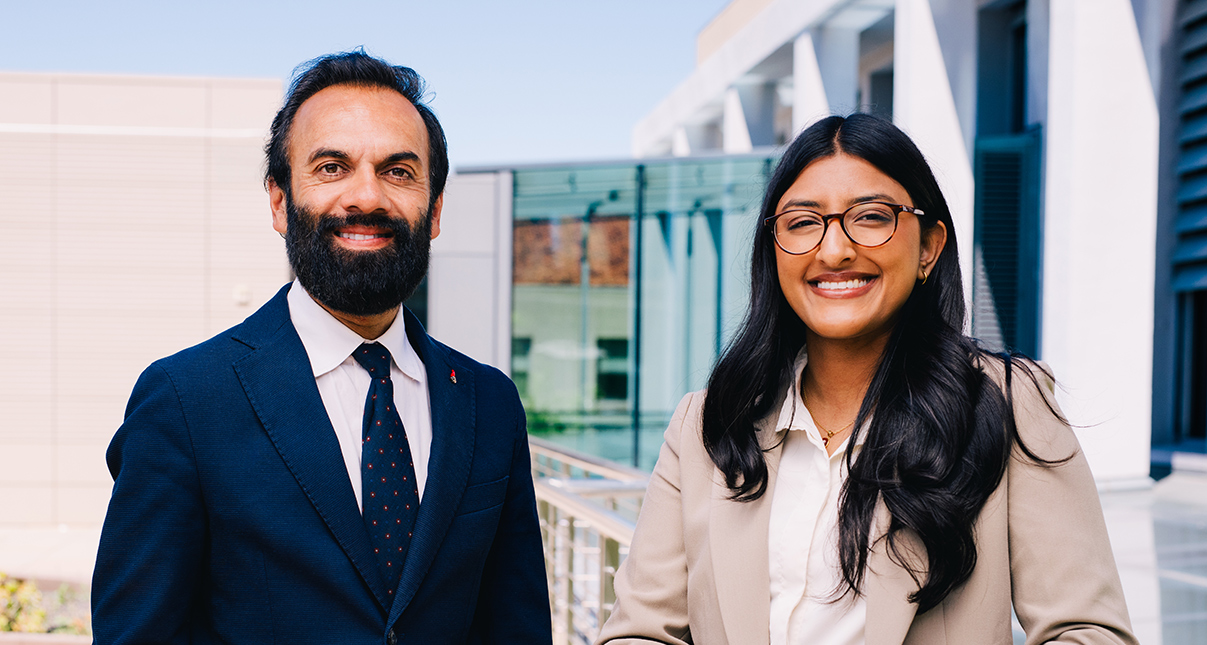
Tayebjee showed up at Syed’s office hours before his 1L Torts class had even met. Three years later, that visit has become one of the defining relationships of her legal education, the reason she now plans a life in academic research, and the seed of a student-organized seminar on legal, social, and political theory that Syed has taught for three terms running.
Syed teaches Torts, Intellectual Property, Antitrust, and Health Law at Berkeley Law, where his research takes a law and political economy approach to questions of rights, markets, and distributive justice. Tayebjee came to law school with a master’s degree and a background in statistics and graduated this spring. She heads next to Davis Polk and Wardwell’s Northern California office, with the questions she and Syed have worked on together still very much open on her desk.
They sat down together to talk about office hours, the Socratic Method, and what it takes to have a real thought. This conversation is part of a Berkeley Law series on mentorship, intellectual formation, and the relationships that shape legal scholars and professionals across generations. It has been condensed for clarity.
An office hours start
How did the two of you connect, and what were your first impressions of one another?
Syed: She was in my 1L Torts class, and she came before the first day of class.
Tayebjee: To office hours.
Syed: To office hours? Were there even office hours?
Tayebjee: There were office hours. You have office hours before class.
Syed: Before class? I don’t believe that’s true. You must have just come in, because I don’t think I’ve ever done that.
Tayebjee: My first impression of him was actually before we had ever met. The reason I had gone to office hours is because I had asked a friend, “I don’t know how to be good at law school. What should I do?” And she said, “Who do you have for Torts?” And I replied, “I have Professor Syed for Torts.” And she said with a reassuring tone, “Okay. You just have to figure out what he’s doing with the law, because if you understand his method then you’ll be fine across all of your law school classes.” And so, I went to office hours to find out more about Professor Syed’s method.
Syed: I think I had two first impressions of Zara. One was she was clearly extremely eager, and the other was she was clearly extremely nervous. So I basically just said, you’re very eager, you’re clearly very smart, and you probably have a bunch of misimpressions of what you need to do. So just chill for a couple of weeks and see how it goes. She was always offering and volunteering. I, being me, wasn’t shy about letting her know when it was not right, and she took it really well in stride.
Tayebjee: That was one of my favorite parts about Torts. It wasn’t hard to be wrong in Torts. It wasn’t like, oh, you were the only wrong person. And that was really great. I think it helped me grow quite a bit, because it reduced the pressure of trying out new ideas, and finally allowed me to think without fear. I got to just be wrong several times in a row, taking risks each time, until finally I was right several times in a row, and had grown immensely in the process.
‘Neither subjective nor objective’
What’s a conversation, a piece of advice, or a moment you’ve shared that has stayed with each of you?
Syed: This one hadn’t stayed with me, but it clearly stayed with her, when she came into my office to argue about the reasoning and outcome of a case. She thought I was clearly wrong. I tried to explain to her my reasoning, and she wanted what she thought was an objective answer. I told her answers in law are neither subjective nor objective. And she didn’t know how to respond.
Tayebjee: That’s right. That would be the moment that set me down the path to do the research that I do nowadays. It wouldn’t have happened without that conversation. I wanted a more objective theory of how to weigh the interests at stake in that case, and what’s really incredible about this story is I sit down in Professor Syed’s office and say, “Well, I think you’re wrong about this case,” and Professor Syed says, “OK, here’s what you’d have to start reading to prove me wrong. Go read some Rawls, Dworkin, and Sen. And then you can come back to me and we’ll talk.”
“You have to sit there and just experience an absence for a long time. And only when you actually do that do you appreciate the presence of a real thought.”
— Talha Syed
I spent weeks thinking alongside these authors, and the more I read, the more I realized Professor Syed was right, there was no satisfying, “objective” answer. What sticks out to me about that experience is that Professor Syed could have easily told me I was wrong, but instead he gave me the tools I needed to approach it my way. Then only by doing the work to try to formulate my response was I able to realize that my original point of view was mistaken. This ultimately led me to be extremely confident in the theoretical worldview that would allow me to do the research I want to do going forward.
Syed: In a way, Zara’s this sort of ideal student or interlocutor for my version of the Socratic Method, which is simply to get the student to the point that they experience the absence, not of the right answer, but even of the right question or the right thought. And you have to sit there and just experience an absence for a long time.
And only when you actually do that do you appreciate the presence of a real thought or a real answer. You actually have to have the pain of simply not even knowing how to articulate in words your uncertainty for a while, before you realize: This is what it means to have a real thought. This is what it means to have a real answer.
Hohfeld and the pen
Syed: She once read one of my articles, and she came in very eager to discuss it. And I simply said, “So what’s the Hohfeldian relation between me, you, and the pen?” And she thought, oh, that’s a very basic answer. I should know that, I just read your take on Wesley Hohfeld. And I knew she probably couldn’t, because it’d be miraculous if she could.
“You can read something; you can think you understand it. But you can’t make it work in the real world until you really feel like you have it.”
— Syed
And so, rather than be daunted or discouraged, she just sort of had a click: You can read something; you can think you understand it. But you can’t make it work in the real world until you really feel like you have it. There’s no way to teach that to someone if they don’t want to learn it. All you can do is give them a bunch of pointers and see if they want to go down that path or not.
Tayebjee: I remember that day. Specifically, I remember walking out of office hours and then coming back to class half an hour later, being like, “I don’t think I’ve ever thought that hard in my entire life.” It was just Hohfeld and the pen. We sat there for literally half an hour thinking about the different types of relations you could have between two people with respect to the pen. It was incredible.
Syed: That’s really the whole basis of law: this guy Hohfeld. To get someone to really understand what’s going on in law, vis-à-vis a simple example like that. Now you’ve got the germs of the institutional building blocks of the entire ecosystem. Of course, you have to proceed slowly. The point is, you have some foundations.
A seminar of their own
How has this relationship influenced your experience at Berkeley Law?
Syed: Zara has been a force of nature in getting other peers of hers to share her enthusiasms. And as a result, she’s self-organized, with a bunch of students, an intensive seminar that I do every term now, which I’ve done for three terms in a row. It’s not the usual law courses I teach, but a seminar on foundational questions of legal, social, and political theory.
It’s basically the stuff that I work on and think about when I’m not teaching standard legal doctrinal and policy courses. And so it’s been amazing to be able to share that with a bunch of students who have all bought into the idea of doing what we were doing one-on-one, but now in a more collective gathering. It’s been really enriching for me.
Tayebjee: I think my time at Berkeley Law would have been fundamentally different without this mentoring relationship. I say that both because I think I was put on a path that I didn’t even see as an option when coming into law school, and that this path has been really shaped by Professor Syed’s inspiring work. Academic research and scholarship were not really things I had considered before coming into law school. And now this is a career I am thinking about long-term.
But also, I don’t think I would have even known how to think about the things that now interest me without Professor Syed’s guidance. I wouldn’t have even been close to the ballpark. I wouldn’t have been able to formulate the questions that I care about, much less have the capacity to begin to gesture at answers to those questions. A lot of my work has been profoundly shaped by his guidance.
Syed: Her statistics background was very good, because — and it’s very strange to say this — but I approach law like a scientist. I think you have to have a systematic, rigorous methodology, and having a science background helped mesh my approach and her abilities. She was really into reading the history and philosophy of science that I pointed her towards as a way of understanding questions of epistemology as they relate to law, and that’s not common. I myself got this from a few of my mentors. They turned me on to it, and they were exceptional because of that.
Who are some of your mentors?
Syed: There’s one that stands out above everyone else: Morton Horwitz. Morty Horwitz at Harvard. He was a legal historian and a legal theorist. He blew my mind for an entire term and changed forever how I think. We’re still in touch. He’s now in a retirement community outside of Lexington, Mass.
He always feels a little, “I am not quite up to this ‘level of abstraction’ anymore.” And I’m like, “Hey Morty, I just want to hang out. I just want to have Chinese food. We don’t have to talk shop.” Horwitz is a giant. I’m not sure there’s a bigger figure in American legal thought in the last half century. There are bigger names, but, for me, he’s the best.
Tayebjee: That’s my opinion too. Horwitz’s “The Constitution of Change: Legal Fundamentality Without Fundamentalism” basically puts the question that I want to solve on the table.
Talking with, not at
This series is about mentor-mentee relationships in all different formations at Berkeley Law. Is there anything you find different or special about the way mentorship shows up here?
Tayebjee: I had mentors in grad school, for sure. At other schools, it feels like your professors are talking at you. They’re standing up on the lectern and they’re looking down at you, and you’re just treated like a receptacle for whatever they want to throw at you. And you don’t have the ability to push back or contribute in any way. I think Berkeley professors treat the professor-student relationship far more like a collaboration. So rather than talking at you, they’re talking with you.
“Rather than talking at you, they’re talking with you.”
— Zara Tayebjee ’26 on Berkeley Law professors
When I think back to Torts and the Socratic Method, and when I think back to Hohfeld and the pen, or our self-organized seminar, a lot of what I remember is a feeling that Professor Syed approached teaching as: Let’s produce these ideas together. And I think that changes students’ confidence. They feel like they’re a part of the learning experience in a way that I think is different at other schools.
Syed: It’s hard, because I mainly only experience Berkeley students. They’re kind of special in that they have an incredible combination of intelligence and clarity of convictions. There’s a very strong ethos at Berkeley of students who are extremely serious about what they want to do, in a way that is very meaningful and intrinsic, and not just instrumental and careerist, which I find to be indispensable to having a real relationship: beyond just nurturing someone’s career, helping someone grow as a person. My sense is that that’s something Berkeley is pretty exceptional at.
Three words
If you had to describe each other in three words, what would they be?
Syed: One would be single-minded. Another would be, obviously, brilliant. By single-minded I mean extremely focused, extremely driven, extremely self-aware. Once she’s chosen what she wants to do, she commits to it, follows through on it, is not easily distracted.
Not everyone in academic life is driven by the internal goods of understanding the world to make it a better place, and in fact it’s kind of rare to come across that in strong form. There is no one word that captures that. Although one might be to adapt “aretaic” from Aristotle, as the pursuit of those “excellences” or goods internal to activities that contribute to self-realization within a form of community life.
“Kind in a way that is tailored perfectly, so as to push you exactly how far you need to go.”
— Tayebjee describing Syed
Tayebjee: I can come up with one easily: Obviously, he’s brilliant. And I want to say “kind,” but kind in the sense that he’s always willing to push me. Sometimes it’s hard to see how the push is being kind in the moment, but it’s definitely needed, and also tailored perfectly to the student at hand. With the Hohfeld and the pen situation, for example, I know that he knew that I could do it with some guidance. It was just a matter of sitting down and thinking about it and working through it together.
In that moment, did I feel really great about working through it? No, I felt really challenged. But did I feel really great after, having achieved what I achieved and looking back at it? A hundred percent. So I want to say “kind,” but in a similarly Aristotelian sense, tailored perfectly so as to push you exactly how far you need to go to allow you to maintain a pursuit for excellence.
Chinese food, eventually
Now that graduation has arrived, how do you see this relationship evolving in the years ahead?
Syed: A lot of it depends on external factors, on what Zara decides after one or two years in Big Law life. But even if she stayed in legal practice, I think we’d maintain a mentoring relationship, even though I’m an academic who doesn’t have any specialty in legal practice. Even when she was working last summer in New York, she would tell me how the stuff we did was helping her do legal analysis. And if she goes back to grad school, then that’ll be different.
Will you come back and take him out for Chinese food?
Tayebjee: I would love to come back and take him out for Chinese food.
Read another mentorship series article on how guidance from Professor Catherine “KT” Albiston J.D. ‘93, Ph.D. ‘01 helped Veena Dubal J.D.’06, Ph.D. ’14 shift gears, maintain confidence, and pursue scholarship grounded in care and public purpose.