
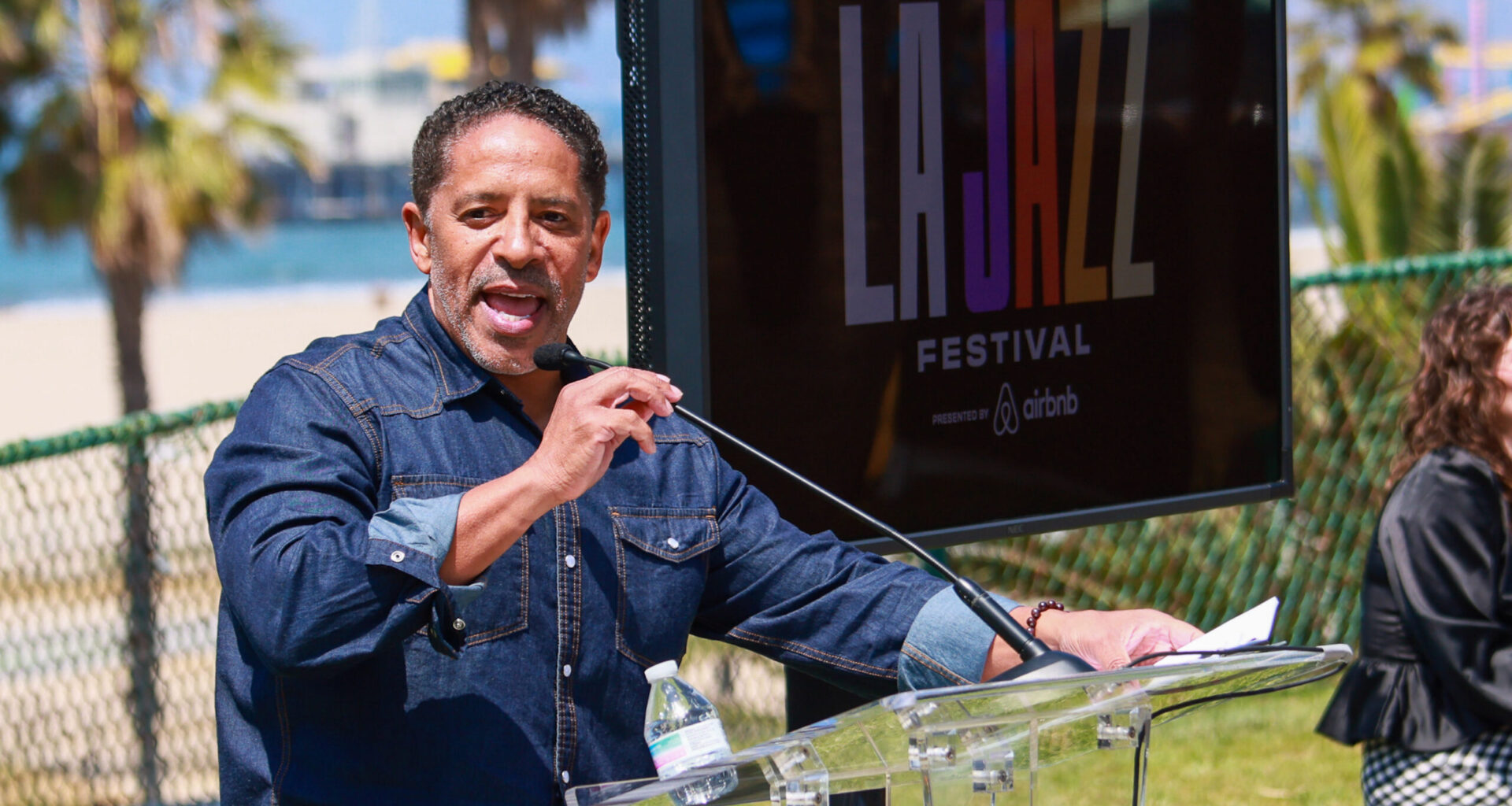
On the evening of April 11, 2025, a few dozen high-powered political players and community members gathered in the backyard of a $3 million home in the historic View Park neighborhood for an event that was billed as a “Forum with Karen Bass.”
The home belonged to former L.A. City Councilmember Martin Ludlow, the CEO of Bridge Street Inc., a company which bills itself as a “live entertainment and public engagement company.” They were assembled in the centerpiece of the four-bedroom midcentury modern house, a spacious backyard deck built around a kidney-shaped swimming pool that sported panoramic views. On this day, the yard bustled with well-heeled guests who plucked canapés and wine glasses from the trays of servers who moved through the throngs.
The party location was a far cry from the federal prison cell Ludlow avoided in 2006 after he pleaded guilty to public corruption charges connected to illegally diverting union funds into his City Council campaign coffers. The fraud led to both federal and state charges, and Ludlow agreed to testify against his codefendant and former friend Janet Humphries, the then-President of SEUI Local 99, in exchange for a lighter sentence.
But that was then.
On this day, Ludlow was in his plush, well-appointed home about to hit the stage with the Mayor of Los Angeles, where the two would dance to 803Fresh’s big hit “Boots on the Ground,” an attendee at the festivities told Los Angeles on the condition of anonymity. [The mayor’s office has ignored repeated requests for comment.]
The party must have been a nice reprieve for the Mayor. The year had been a crisis-filled disaster that started with the deadly Palisades wildfire that claimed a dozen human souls in Los Angeles, and another 19 in Altadena. Thousands of her Pacific Palisades constituents lost their homes and businesses. When the Palisades fire began to cut down their community, Bass had been out of town on a diplomatic mission to Ghana, and raced back to face criticism about tapped fire hydrants and drained reservoirs.
In the hours before the backyard gathering, there was more bad press for Bass. Her hand-picked fire recovery czar, Steve Soboroff, had officially bowed out of his role following public friction and planning disagreements. Not to mention there was also an ongoing official recall effort to get her out of City Hall.
Scroll to continue reading
The party guest remembered that “a pastor prayed over Bass” at the Ludlow home before the forum part of the night began. “Bass was fighting for her political life. Martin’s party turned into a fundraiser to fight off a recall,” the guest recalled. “Envelopes were passed and the mayor thanked Martin for hosting, and then brought up the jazz festival as a ‘big thing’ he was doing.”
That big thing would have a big corporate sponsor: Airbnb.
Just weeks before the backyard Bass forum, Airbnb had given Ludlow’s Bridge Street company more than $2.2 million, according to Los Angeles Ethics Committee filings. Ludlow was hired through his company Bridge Street Inc. to push for deregulated short-term rental restrictions on behalf of Airbnb’s political action coalition Save Our Services. The coalition presented as a grassroots movement to save city public services during a deficit, but was quietly pushing its campaign to deregulate vacation rentals behind the scenes with Ludlow’s help.
“With millions of visitors planning to attend the 2026 World Cup, 2027 Super Bowl, and 2028 Olympics, L.A. has a once-in-a-generation opportunity to maximize the benefits of tourism to close the budget gap and protect city services,” the website for Save Our Services reads. “Short-term rentals already generate major tax revenue for the city, but in order to help bridge the budget gap, they can be leveraged even further to help prevent anticipated layoffs. By allowing a limited number of people to rent their second home, Los Angeles can unlock millions in new, annual tourism revenue — paid for by tourists, not taxpayers!”
It was a strong pitch. But what’s unclear is why Airbnb paid a convicted criminal $2.3 million to deliver it. The answer likely connects back to longtime City Hall alliances.
Airbnb’s chief lobbyist Justin Wesson is the son of longtime California political player Herb Wesson, the former Los Angeles City Council President. Both the younger Wesson and Ludlow worked at City Hall together and held jobs at different times at the Los Angeles County Federation of Labor.
These relationships, and the money that has flowed between them from Airbnb, a mega-donor to political action committees working to get Bass reelected with $1.5 million in contributions, are now in the spotlight after this week’s abrupt cancellation of Ludlow’s “big thing,” a 17-day jazz extravaganza that Bass and Ludlow announced together with a glittering City Hall press conference in February. Airbnb donated $750,000 to the jazz nonprofit Ludlow created under the arm of Bridge Street. Its logo is prominently displayed on promotional materials for the jazz event as the title sponsor.
 Credit: Courtesy of the LA Jazz Festival
As Bass and Ludlow announced the jazz fest, that same month Bridge Street was awarded a second contract from Airbnb for a $92,479 to continue to push for the deregulation of short-term rentals agenda, according to filings with the Los Angeles Ethics Commission.
This year Bass also tucked the Vacation Rental Ordinance (VRO) provision into the city’s FY26-27 budget proposal, aimed at temporarily suspending Los Angeles’s primary-residence requirement for short-term rentals, bypassing prohibitions voted in by the City Council in 2018 to protect affordable housing.
The fallout from the abruptly canceled festival has reverberated across the city. Many artists were not paid, and lost out of pocket expenses for rehearsal space, travel to L.A., and promotion. Vendors invested in perishables anticipating throngs of music lovers at the scheduled kickoff event in Leimert Park this weekend that never happened. Venues slated to participate in Jazz After Dark were left with what one booker called “talent deficits” in their summer lineups.
Many people in L.A.’s creative community have taken to social media to express their outrage, among them Qur’an Shaheed, who said a performance she booked for Saturday was canceled without warning. “People have booked flights,” she wrote in an Instagram post, “canceled gigs, miss opportunities, flew people out and missed out on financial securities and for what? ‘unforeseen circumstances?’ Anyways we all deserve answers AND more so compensation for this.”
Many artists who were thrilled to play in Los Angeles, and local musicians, also agreed to radius clauses that prohibited them from accepting other gigs around the dates of the LA Jazz Festival.
“Some of the artists were all tied up in contracts with the jazz festival, so they couldn’t book with us,” said luxury hospitality CEO Lavae McClinnahan, the owner of the Redondo Beach hotspot Montauk, an upscale restaurant that is also home to a speakeasy-style intimate jazz club. “I can’t be mad. We’re focusing on trying to help acts come here and make money. I need to support artists and my own space.”
Al Strong, a longtime musician who books talent for the Montauk and is the founder of the internationally revered “Art of Cool” festival in North Carolina, immediately thought Ludlow’s vision may have been too ambitious when he began to work with festival organizers this spring. Montauk is a sought-after location for celebrities to sneak in for a show, which made it a perfect venue for the Jazz After Dark plans for the festival. Strong said he blocked out dates, and then never heard back from the organizers. “It was radio silence for weeks. Things started to get really scary, it put us in a talented deficit. Something wasn’t right.”
Strong’s instincts have borne out with Ludlow canceling the event with a single statement citing unanticipated costs that led to the nixing of the entire undertaking. He hasn’t been seen since. Ludlow has not returned requests for comment sent to Bridge Street, LinkedIn, or his Instagram page.
Ludlow created the LA Jazz Festival as a 501c3 charity, but the required tax declarations for the charity were last filed in 2023, so it remains unclear ultimately how much money was brought in for the event, or how that money was spent. A spokesperson for Airbnb said the company was also blindsided by the event’s cancelation.
“We were incredibly excited to be one of the top sponsors for LA Jazz Fest to help put Jazz culture and history in a much-deserved spotlight this summer,” the Airbnb spokesperson told Los Angeles on Thursday. “We share the disappointment of the artists, vendors, and other community members and likewise demand answers from those involved in the planning failures of this event.”