
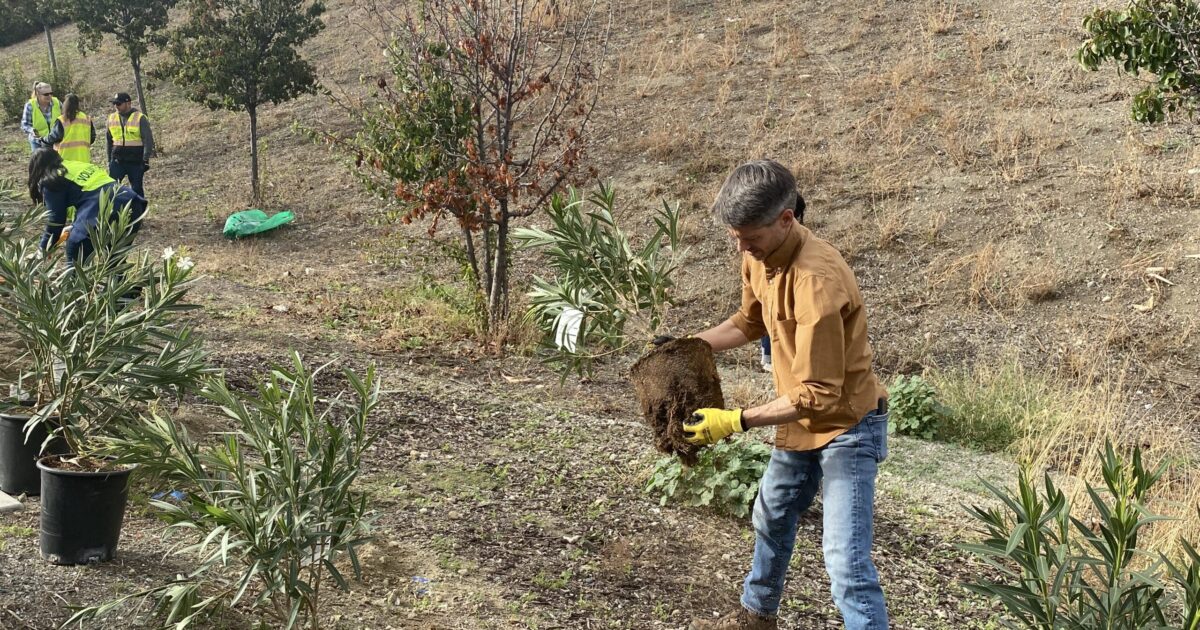
San Jose is cleaning up state-owned land in an attempt to keep freeway underpasses free of homeless encampments.
San Jose and Caltrans have an agreement that allows the city to clean up trash and sweep encampments on 13 sites owned by the state. California will partially reimburse the costs up to $400,000, and the city is in charge of removing trash and encampments. When possible, the city will also provide outreach two weeks before removing homeless people from the land.
On Friday, Mahan planted trees along the Highway 87 underpass and West Julian Street alongside Caltrans workers and a team of volunteers.
“This is all about getting stuff done,” Mahan said at the news conference. “I ran for mayor to solve problems, to make our city safer, cleaner, more affordable. Let’s be honest, people don’t care whose land it is. It’s all public land.”
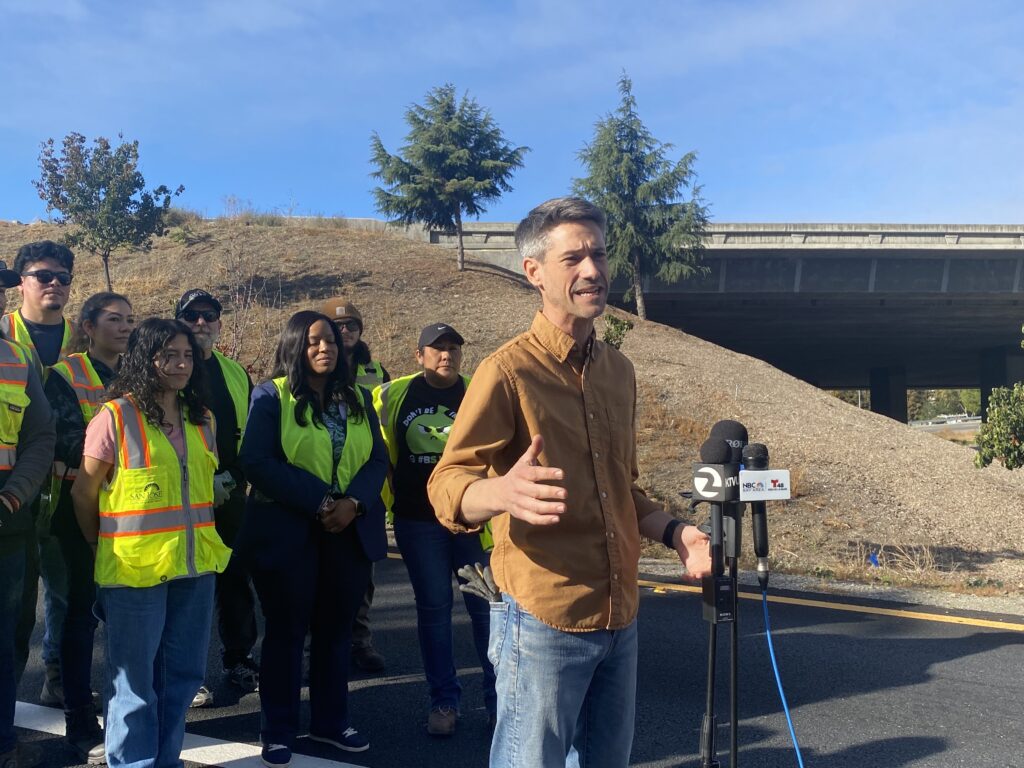 San Jose Mayor Matt Mahan said the city is taking over the maintenance of state land “because they can’t do it.” Photo by Joyce Chu.
This agreement builds upon previous agreements Caltrans has had with the city, and Caltrans has similar agreements with San Francisco and San Diego. San Jose had to previously ask Caltrans for permission to clean its freeway underpasses, a process that took weeks.
“For years, our hands have been tied. Meanwhile, the trash and human suffering have only grown,” Mahan posted on X last week. “We are literally taking over the maintenance of state land because they can’t do it.”
Last fiscal year, Caltrans cleaned 9,200 cubic yards of debris and removed 115 encampments in San Jose, a 50% increase from the prior fiscal year, according to Gov. Gavin Newsom’s office.
Caltrans representatives did not respond to a request for comment.
Mahan said the agreement allows outreach workers to offer services to homeless people directly, and outreach workers will visit a site prior to an encampment sweep.
“We don’t always have the amount of time we have at Columbus (Park), where we spent 70 days doing outreach every single day, but we do follow a 72 hour rule in the city of San Jose,” Mahan told San José Spotlight.
The city swept its largest encampment of 370 homeless people and 120 lived-in vehicles at Columbus Park earlier this year.
Homeless advocate Shaunn Cartwright said she filed requests for two homeless people sleeping at the Interstate 280 underpass near First Street to stay longer due to their health related issues, but said the city rejected the requests. Representatives with the San Jose Housing Department and Parks, Recreation and Neighborhood Services, the department that handles encampment sweeps, didn’t respond to a request for comment.
Cartwright said having the city conduct sweeps on Caltrans property makes it harder for her to help homeless people living along local freeways.
“It creates a lot of confusion,” she told San José Spotlight. “Is the city going to sweep them, or is Caltrans going to sweep them?” People who get swept without moving into housing often return or move to another area in the city. One homeless encampment on southbound Highway 85 at the Santa Teresa Boulevard onramp had to be cleared four times within the past year.
There are 10,711 homeless people in Santa Clara County, according to a point-in-time count conducted in January — with 6,503 in San Jose. But there are only 3,454 beds across 38 temporary shelters and programs countywide to help homeless people move into permanent housing, according to data compiled by the San José Spotlight in July.
San Jose has since added hundreds of beds through converting multiple hotels into homeless shelters, but that still isn’t enough for the thousands of people who are living on its streets. According to the count conducted in January, 3,959 people in San Jose were unsheltered, or about 60% of the city’s homeless population.
Contact Joyce Chu at [email protected] or @joyce_speaks on X.