
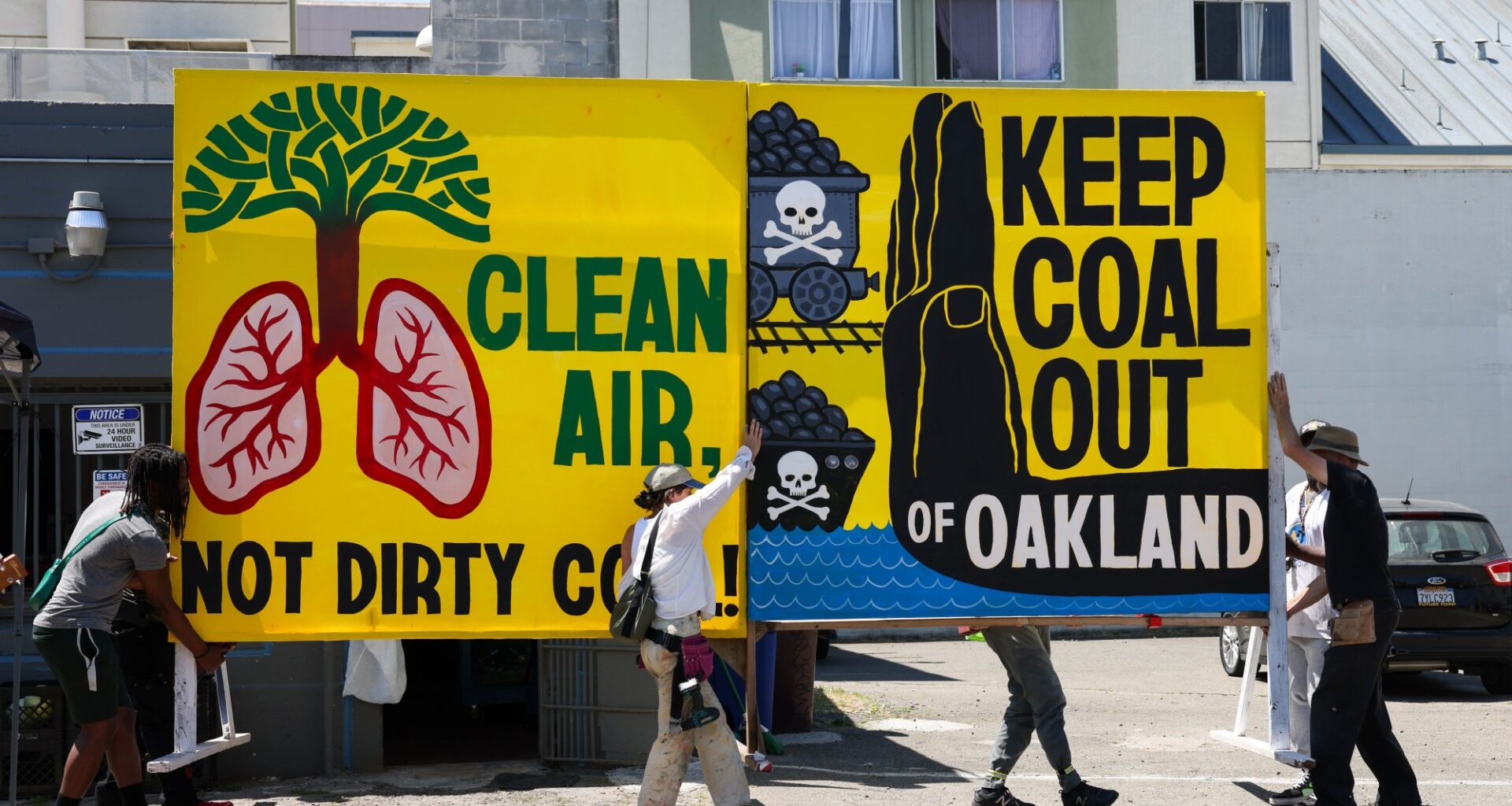
After over a decade of entrenched community opposition, the developers of Oakland’s proposed coal terminal are aiming to start construction soon — and they’re attempting to circumvent the cornerstone of California environmental law.
My organization is cosponsoring Assembly Bill 40, the Community First Coal Review Act, to mandate a robust environmental impact report for any mass scale coal terminal looking to operate in California under the California Environmental Quality Act (CEQA). We need to understand the health impacts of toxic coal dust and put mitigations in place — before construction begins.
The Oakland Bulk and Oversize Terminal (OBOT) would be built a mile from my home, where no matter how much I clean, the windowsills are covered with a layer of fine black dust. It’s not just dust: it’s the buildup of pollutants from port pollution, freeway traffic, rail pollution and heavy industry clustered in the East Bay’s flatlands.
West Oakland is a historically Black, under-resourced neighborhood that already suffers from some of the worst air quality in the state. We pay the price with our lives: the life expectancy for West Oaklanders is shorter than the Alameda County average by two years, and within West Oakland, African Americans’ life expectancy is about six years below the average.
West Oakland’s air is steadily getting cleaner thanks to our local Black-led environmental justice movement, which has reduced levels of deadly diesel particulate matter (DPM) by more than 30%. But the coal terminal would take us in the wrong direction, undermining decades of advocacy and millions of dollars of state investment.
Mile-long coal trains would release toxic coal dust through the East Bay, causing “higher rates of asthma, heart disease, hospitalization and death” for people living nearby. Investing in new coal infrastructure also threatens to accelerate climate change, intensifying extreme heat and natural disasters. Most frighteningly, without an environmental impact report, we have no idea how bad our air quality could get and no way of demanding more accountability.
Developers are arguing that an environmental impact report is unnecessary because of an outdated assessment from 2002 and an addendum from 2012. But neither one assessed the environmental impacts of coal shipping, handling, or storage. How could they have, when developers previously insisted that they had no plans to build a coal terminal? They stated in a 2013 newsletter that rumors of a coal distribution facility were “simply untrue.”
An environmental impact report for a project of this scale is common sense. It’ll require communities, developers and regulators to work together to put lifesaving mitigations in place. It will allow decision-makers at government agencies to make informed decisions. OBOT’s developers have promised to use mitigation and emissions capture technologies: an environmental impact report will empower regulators to hold the developers to their promises.
The whole country is looking at Oakland right now. In June, President Trump gifted a shocking $75 million of taxpayer money to OBOT, and the National Coal Council named the terminal as a priority in their latest report. President Trump is pushing fossil fuel extraction at any cost, regardless of community health. Will the East Bay hold the line?
Assembly Bill 40’s scope is extremely limited, designed to provide the transparency Californians deserve when coal terminals come to their communities. We owe it to families, seniors, homeowners, business owners and everyone along the East Bay shoreline who’s at risk of breathing in toxic coal dust. It’s time to put CEQA to work where it matters most.
Veronica Eady is the executive director of the West Oakland Environmental Indicators Project and a West Oakland-based environmental lawyer.