
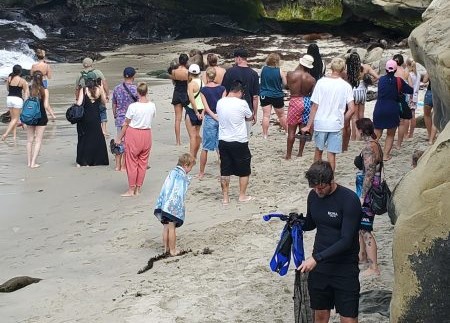
Following a series of local incidents involving people and sea lions in recent months and years, some members of the California Coastal Commission are wondering if a partial closure of La Jolla Cove might be on the horizon.
During the CCC’s Aug. 14 meeting, Commissioners discussed these interactions — including a recent attack on a sea lion by a local teenager, the video of which has been widespread online — and what steps could be taken to prevent similar incidents in the future. The discussion comes after months of attempts to prevent these types of encounters.
During the Commission’s December meeting, Andy Field, director of the San Diego Parks & Recreation Department, explained that a plan was in place that included several steps to keep people and sea lions apart while keeping The Cove open. Some of these measures have already been implemented, with more planned.
Steps already taken include adding more rangers to the area equipped with bullhorns so they can issue warnings to those on the beach, posting new signage and authorizing the use of cones as a visual deterrent should beach-goers get too close to animals on the beach. Possible next steps include construction of a viewing platform overlooking The Cove and the installation of cameras.
Nevertheless, in July, a video surfaced online appearing to show a person chasing and kicking at a sea lion near La Jolla Cove.
In the video, the sea lion appears to have been sitting atop a low wall that separates the colony at La Jolla Cove and Point La Jolla from a public walkway. The video shows a young man taunt and then kick at the sea lion before chasing the animal as it tries to escape along the wall.
Sea lions are protected under the federal Marine Mammal Protection Act, making it illegal to harass, harm, pursue, feed, capture, injure, restrain or kill the animals. Such actions may be punishable through fines or jail time, a statement from the National Oceanic and Atmospheric Administration said.
Thus, at the August CCC meeting, Commissioner Matt O’Malley said he was “beyond angry” about the July incident.
“I’m quite honestly just embarrassed to be a city of San Diego resident right now,” he said. “Frankly, I’m sick and tired of the failure of the city to implement the previously proposed plan in a coordinated way.”
He said that additional ranger presence was needed on the beach, and opined that a partial closure might also be needed.
“I’m left to conclude that where there is a will there is a way, and I can only conclude there is no will on behalf of the city (of San Diego’s part) to protect the wildlife in this area,” he said. “I know there are some limits to the role the Commission can play here, but I would like for us to push those limits to their greatest extent. … I’m at the point where I believe a partial closure is the only way to deal with this issue until the city gets their program implementation figured out and investigate what is going on here. I’m sorry to have to be an advocate for that at this point.”
Commissioner Jose Preciado added that he, too, questioned whether the city “needs some sort of reboot in the sense that maybe preserving the environment completely … while everyone gets policies and practices squared away.”
Other Commissioners noted that in similar coastal areas of California, when sea lions are present, those cities close the beaches.
“There are certainly alternatives to manage this than to … see the kind of chaos that we’re seeing in La Jolla,” said Commissioner Susan Lowenberg.
Commission vice chair Caryl Hart opined that the situation at La Jolla Cove “has gotten worse and worse instead of better” in recent months.
“It is completely out of control … but how can we protect these natural resources?” she asked.
Speaking on behalf of the office of San Diego Mayor Todd Gloria, senior policy advisor Emily Piatanesi said the city plans on having conversations with lifeguards and rangers so the two departments have consistent messaging and can respond in a consistent manner should issues arise.
“Making sure we are ensuring coastal access and also preventing any incidents is something that has been challenging but something we have been … trying to come up with solutions (for),” she said. “We are constantly evaluating what measures we can use.”
But the city is not authorized to enforce the Marine Mammal Protection Act, creating a new challenge in terms of enforcement.
In lieu of enforcing the Marine Mammal Protection Act, she added that the mayor’s office has been in communication with the San Diego City Attorney to see if there were other laws that local municipalities could cite so violators could be ticketed and fined.
“That is an ongoing conversation we are having,” Piatanesi said. “The enforcement piece is the biggest next step we have been working on.”
She added “There has not been a commitment to close The Cove either seasonally or year round … we have not entertained the idea to close The Cove just yet.”