
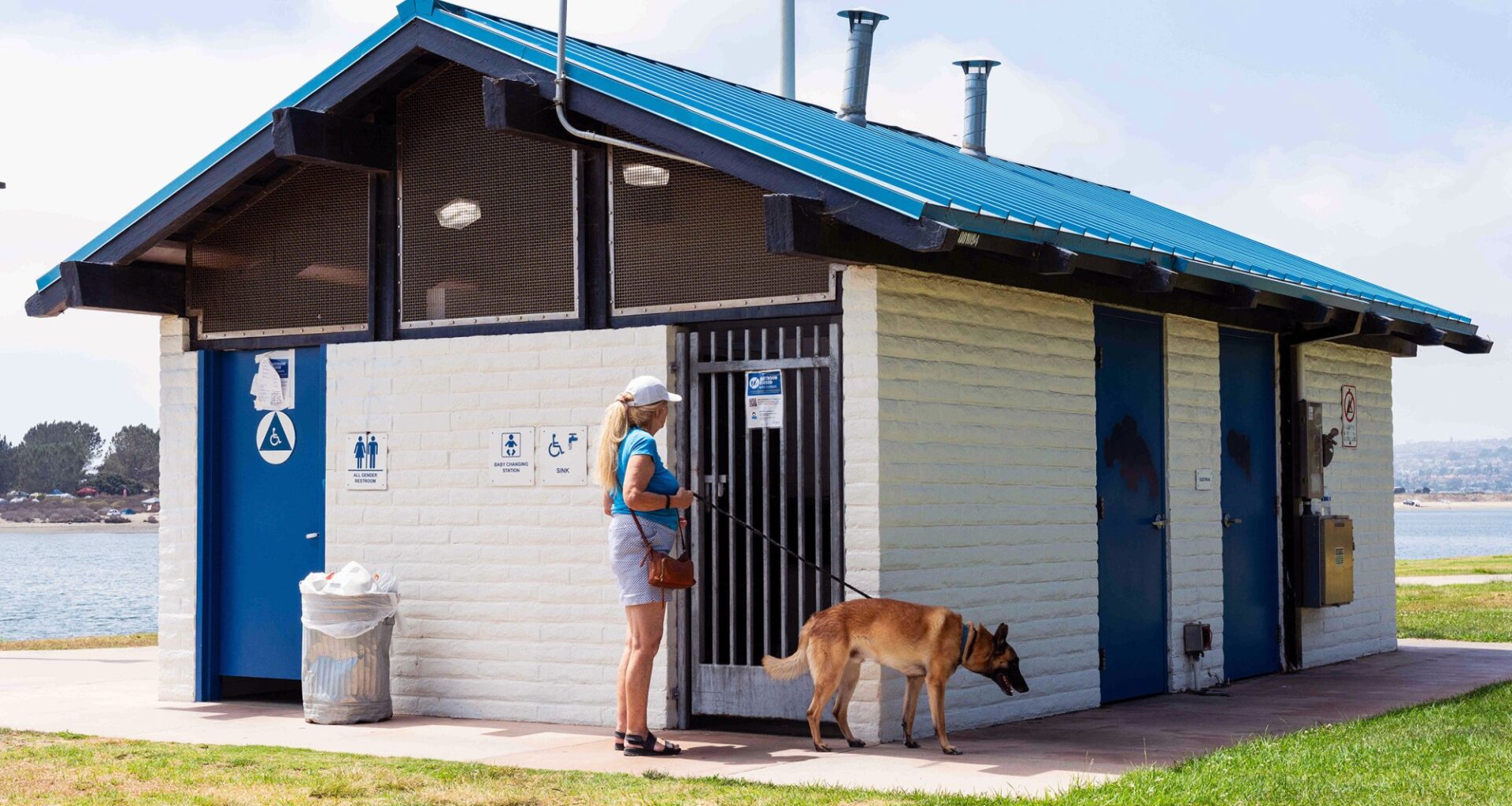
San Diego has had a troubled history with public restrooms.
For years, there was criticism that there weren’t enough or they were closed or not well maintained, particularly in downtown and the surrounding area.
That problem infamously peaked starting in late 2016 and lasting for more than a year with the deadly hepatitis A outbreak, which resulted in 20 deaths and nearly 600 cases, with the majority of those stricken hospitalized.
The outbreak and its spread were attributed — all or in part — to unsanitary conditions because people, mostly those thought to be homeless, were relieving themselves on sidewalks, streets and in other public places.
Public officials were late going into emergency mode, eventually placing portable toilets and handwashing stations around central San Diego and reaching out to vaccinate people to keep them from contracting the viral disease. The city started power washing paved areas.
That dark chapter in San Diego history came back into public discussion with the city’s decision to close 13 of 28 restrooms that serve visitors to Mission Bay Park during high tourist season. The city’s reasoning was to save more than $500,000 to help close a budget deficit of more than $100 million.
On Wednesday, six weeks after the closures, the mayor and council members announced they had scraped together enough money to reopen them through the end of the year, responding to an all-too-predictable backlash.
Commentary about people doing their business in the park where they’re not supposed to peppered news articles, letters to the editors and social media takes.
While there’s been no related infectious disease reported so far, many people warned of the potential. That included San Diego City Councilmember Raul Campillo, who had joined his fellow council members in unanimously approving the city budget with the restroom closures but had since proposed a way to reopen them.
Mayor Todd Gloria had refused until now.
Given the city’s past issues with restrooms, it’s perplexing why they were deemed a target to save money. That some sudden unexpected revenue was not being used to reopen them, as Campillo suggested, made it even more mystifying.
Yes, the city’s budget crunch requires unpopular decisions on cuts. And Gloria’s concern about using one-time money — some $1.8 million for a city election that isn’t happening — for ongoing services is widely considered prudent, at least in the abstract.
But none of that would matter if things became more serious than people having to hold it until they hike to the next restroom — or failing to make it. In the end, the mayor and Councilmembers Jen Campbell and Joe La Cava found a different way to come up with the $200,000, with no plan yet to keep the restrooms open for the first six months of next year.
That means it’s one-time money. That amount would have been all of about 11 percent of the saved election money and could have reopened the restrooms a bit sooner.
There were weeks of outrage almost from the moment the restrooms were shuttered, with former Councilmember Donna Frye, who has long sought to protect Mission Bay, boosting the push to reopen them.
Beyond health concerns, which were paramount, the optics were terrible.
The dynamics of a disputed decision followed by swift, constant criticism and then an about-face follows a familiar pattern. Public outcry, and accompanying political pressure, preceded the rollback of new trash collection fees for single-family homes and the eventual elimination of parking fees at Balboa Park.
It’s easy in hindsight to say City Hall should have seen this coming about the restrooms. Still, it seems odd that officials didn’t given choices they made.
There was a budget decision to restore money to reverse a plan to close some shoreline restrooms at city beaches. That initial proposal certainly wouldn’t have been any better received than the closures at nearby Mission Bay, which, by the way, has beaches fronting Pacific Ocean water.
In addition to the high-profile impact closing the restrooms would seemingly have, the city’s message blaming the budget, and ostensibly a shortage of revenue, contributed to suspicions that Gloria was actually trying to teach people a hard lesson.
“This is Mayor Gloria’s way of punishing citizens for not approving past tax hike propositions and showing us what will happen in the future if the next tax hike propositions aren’t approved,” Bay Park resident Lynn Lowder wrote in a letter to The San Diego Union-Tribune.
Others have expressed similar concerns.
“The suggestion that the Mayor is punishing San Diegans for the outcome of previous ballot measures is simply false,” a Gloria spokesperson said in an email the day before the re-openings were announced. “These reductions were debated publicly and adopted unanimously by the City Council as part of a budget that required difficult choices about limited resources.”
Not surprisingly, the closures opened the door for critics to point to what they say is bloat at City Hall, rather than single out programs to trim to fund the restrooms.
Former City Councilmember Lorie Zapf did that in a commentary published by the Union-Tribune in which she specifically noted the growth in council staffs in recent years that she said can’t be defended by population growth and inflation.
Modest staff reductions could easily fund the restrooms, among other programs that have been cut, she wrote.
The ghost of the hepatitis A outbreak was resurrected this week in another Union-Tribune op-ed by Audrey Pham, a pediatrician and San Diego resident.
“San Diego has already seen what public bathroom closures can mean for our health,” wrote Pham, whose piece was published Tuesday.
Pham added that even the full complement of Mission Bay Park’s restrooms was “already woefully short on providing adequate sanitation,” never mind closing nearly half of them.
The physician also made a reference to 50 cases of Shigella, another intestinal bacterium that can be debilitating, in 2021 in San Diego. And Pham mentioned the nationwide cases of Cyclospora that have been dominating the headlines.
In 2023, the county reported a much smaller uptick of hepatitis A cases, mostly among people who were homeless.
In the midst of the 2016-18 hepatitis A outbreak, the Union-Tribune reported that four grand jury reports in previous years discussed concerns about the risk of human waste on the streets and the lack of adequate toilets specifically for people who are homeless.
Maybe all visitors to Mission Bay Park experienced these past weeks were the sights and smells of people using the grounds and water as a restroom, which is bad enough.
Once again, dire warnings were issued. It should never have gotten to that.