
It will help better track the effects of climate change on the ecosystem.
Aug 14, 2026
Updated 4:01 pm PT
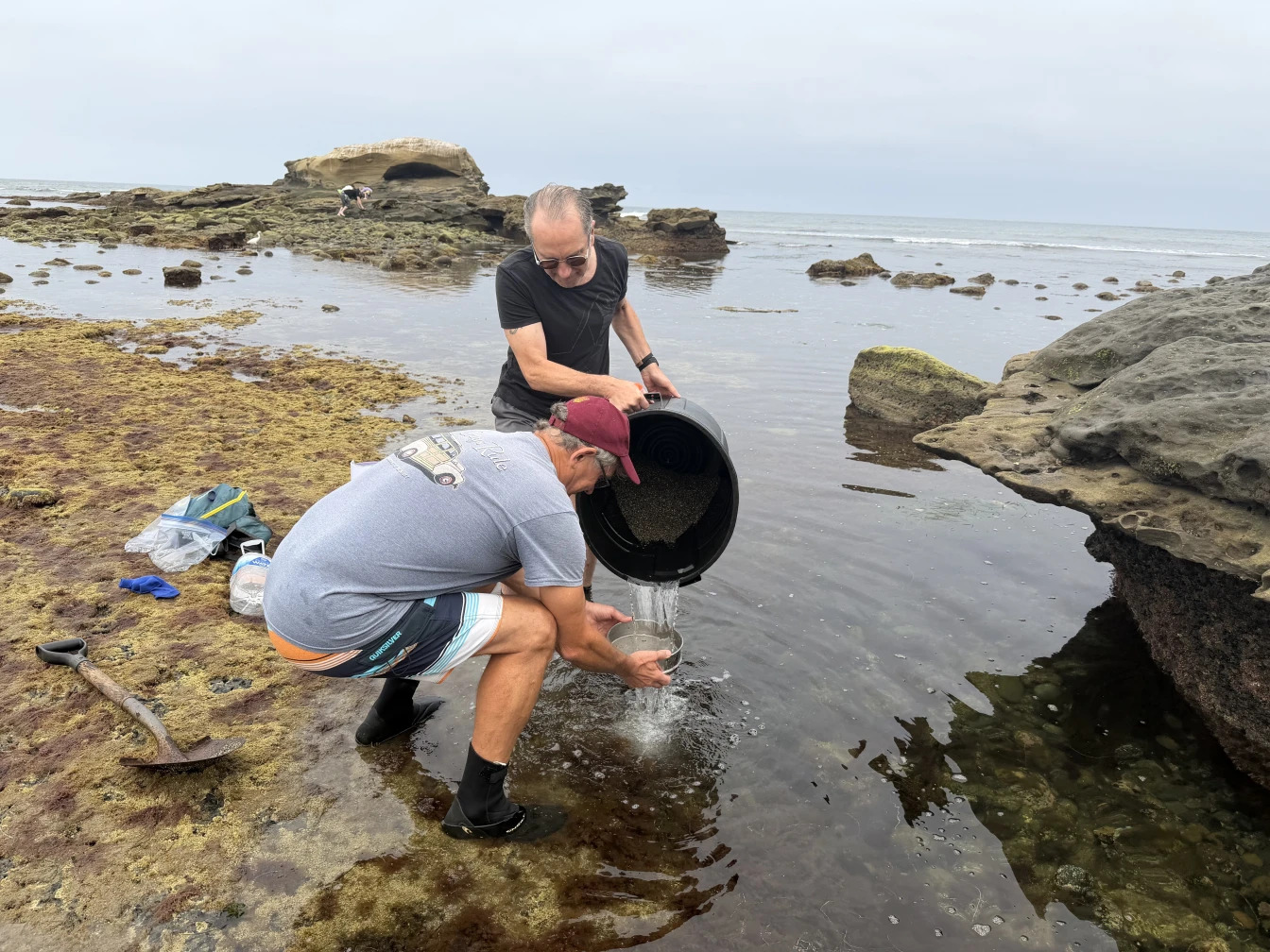
Marine biologist Greg Rouse, standing, and chemist Steve Taylor collect seawater and sand from La Jolla tide pools. (Lucas Brady Woods/LAist)
Here are the morning’s top stories on Friday, August 14, 2026
Dinosaur bones and taxidermied animals get most of the attention at the Natural History Museum in LA County. But researchers are excited about a new collection that could have big implications for monitoring climate change. The U.S. Department of Justice says California is failing to protect incarcerated women from sexual abuse and harassment by prison staff. A federal judge says she’s leaning toward ruling that federal immigration agents can not make warrantless arrests under most circumstances in Los Angeles.
On an overcast morning in July, marine biologist Greg Rouse knelt next to a large tide pool near La Jolla’s Bird Rock. “This place is incredibly diverse in habitats,” Rouse said, scooping a sample of seawater into a plastic bag.
A few miles down the beach, in his seaside lab at the Scripps Institution of Oceanography at UC San Diego, Rouse separated the sampled water into a petri dish. At first glance it was just water and some floating ocean debris.
But when Rouse slid the petri dish under a microscope, hundreds of nearly-microscopic animals burst into life on a high-resolution monitor: shrimps and snails, pillbug-like isopods, worms of all sorts of different shapes, and at least one bright-orange sea slug. Sampling tide pools like this is fairly routine for Rouse, but lately, it has been part of something bigger. Rouse is leading the first phase of an effort to document California’s intertidal ecosystems. That means logging every organism found in the tidal seawater, sand and rocks from San Diego to the Oregon border over the next two years. “It’s a baseline of what is here right now,” Rouse said. “It’s a shame we didn’t do this 20 or 40 years ago. But in those times, we didn’t really have the DNA technology and the cost efficiency that we have these days.”
The project, called the California Intertidal Biodiversity DNA Barcode Library project, is ambitious. Nothing of this scale has been attempted in the U.S. It’s being led by a coalition of top research institutions, including Scripps, the Los Angeles County Museum of Natural History, the California Ocean Protection Council and the Southern California Coastal Research Project. The goal is to create a comprehensive picture of California’s tidal habitats by focusing on the algae and invertebrates that live in them, including their DNA profiles. Scientists say that will let them more effectively track changes in those ecosystems.
The intertidal region is made up of the narrow strip of coastline that alternates between being submerged at high tide and exposed at low tide. It’s habitats are some of the most vulnerable to the effects of climate change, including rising water temperatures and sea levels. The two-year project launched with $10 million in state funding earlier this year but kicked into high gear this summer.
Last month, Rouse led a group of dozens of scientists to the tide pools, where they pulled more than 7,000 samples from the area around Bird Rock. “Anything we could see, we took. But also we took a lot of stuff you can’t see back to the lab and had many people on microscopes finding all the tiny creatures,” Rouse said. “Because most of the diversity is actually too small to see.” Testing is still underway, but so far the samples represent 1,600 species of invertebrates and algae, hundreds of which could be new to science.
California prison officials have failed to protect incarcerated women from sexual abuse and harassment by staff for years, the U.S. Department of Justice said in a new report.
The Justice Department began investigating the Central California Women’s Facility in Chowchilla and the California Institution for Women in Chino nearly two years ago after hundreds of incarcerated women filed legal claims alleging sexual exploitation by staff and an officer was arrested for sexually abusing at least 22 women. The department reviewed 350 allegations of sexual misconduct, interviewed prisoners and looked at body-worn camera footage.
In a report released Thursday, investigators said they found an “unbroken pattern” of staff sexual assault dating back over 20 years at California’s two women’s prisons. The department concluded that prison officials knew women faced a substantial risk of sexual abuse but failed to adequately protect them. Investigators pointed to gaps in surveillance camera coverage, a lack of confidential reporting options, inadequate investigations and failures to hold staff accountable — systemic problems the DOJ said amount to “deliberate indifference” and violate incarcerated women’s constitutional rights.
“None of this should be surprising to CDCR [California Department of Corrections and Rehabilitation], none of it should be surprising to the Legislature,” said Amika Mota, executive director of the prison advocacy organization Sister Warriors Freedom Coalition. Survivors have spent years speaking out at “hearings, in town halls, in reports,” she said, trying to get officials to address sexual abuse by prison staff.
State prison officials say they have a zero-tolerance policy for sexual assault by staff, and that they have taken steps to improve reporting options and expand the use of cameras. But Assistant U.S. Attorney Alexandra Young said those reforms have not fixed the underlying problems. “Women were not being protected,” Young said in an interview with KQED. “It was the cycle that’s continuing to happen.”
A judge on Thursday indicated that she’s inclined to order federal immigration agents to stop arresting people without warrants in Los Angeles if they haven’t assessed their flight risk.
If she grants the order, it would be one of the most significant so far in a wide-ranging lawsuit over the government’s ongoing immigration raids in Southern California. It would force agents to fundamentally change the way they’ve conducted the sweeps at the heart of President Donald Trump’s mass deportation campaign.
Since 1946, federal law has allowed immigration officers to arrest someone without a warrant only when they have probable cause both that the person is in the country unlawfully and that they are likely to escape before a warrant can be obtained. Courts have long held that to mean that agents are required to consider the person’s ties to the community, like a person having a job, a home and a family in the community where the arrest occurs. However, in raids in Southern California and across the country, supervisors have told agents to “get out and start grabbing people,” and agents have ambushed people without knowing their immigration history and targeted Latinos at places like car washes and bus stops, court records and body camera footage show.
Last month, plaintiffs attorneys in the lawsuit filed with the court text messages and body cam footage that showed federal agents using racial slurs to identify targets in the Los Angeles raids. They argued the evidence showed immigration agents simply detained people who looked Latino. U.S. District Judge Maame Ewusi-Mensah Frimpong’s tentative ruling Thursday means agents would need to obtain “individualized, pre-arrest probable cause determinations of flight risk” in the city and the areas surrounding Los Angeles, home to 19 million people.