
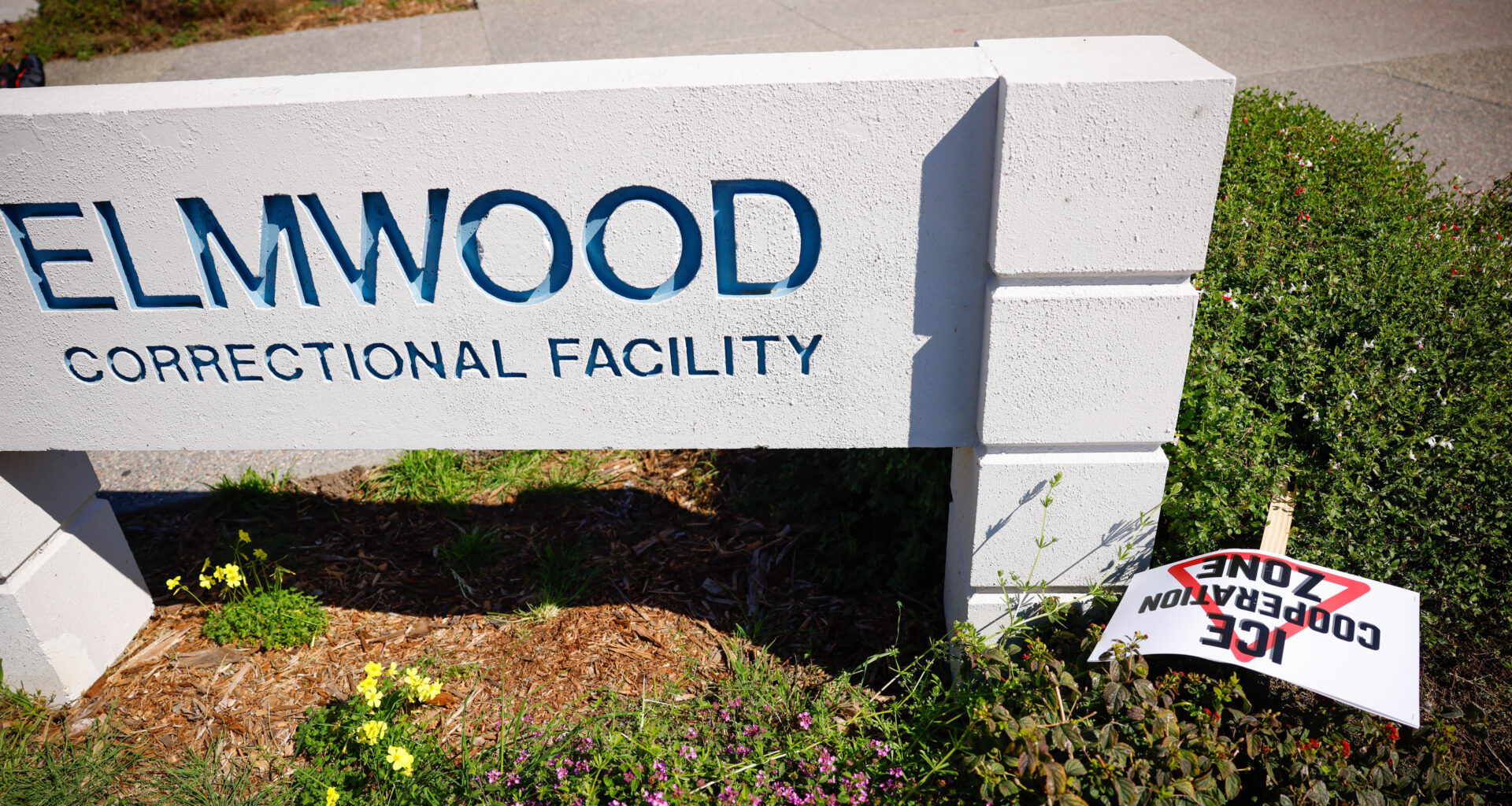
Two Elmwood jail inmates were convicted at trial of murdering another inmate in a vicious gang beating that was executed over the course of 11 agonizing minutes, and went undetected even as it was recorded on surveillance cameras.
The Jan. 27, 2025, beating of 23-year-old Oscar Umul Xicay brought heavy scrutiny to the Santa Clara County Sheriff’s Office, which runs the minimum-security camp at the Elmwood men’s jail in Milpitas.
While the agency’s civilian overseer, the Office of Correction and Law Enforcement monitoring, did not find liability in the death, it blamed systemic issues — including short staffing that meant security video feeds were not being watched, and predictable welfare checks that were tracked and exploited in the crime.
Pedro Arevalos, 43, was convicted Aug. 6 of first-degree murder and an allegation that the killing was gang motivated. Jordan Patrick Haase, 40, was convicted of second-degree murder, but acquitted of the gang-motivation allegation. Both men face a second trial phase Monday, covering related gang enhancement and gang conspiracy charges.
“That is one form of accountability,” Sean Allen, president of the San Jose-Silicon Valley NAACP branch and a former correctional deputy, said of the convictions. “But the murder convictions do not answer the institutional questions this killing raised, and they are not the accountability the branch and this family have been asking for.”
A third murder defendant, 20-year-old Jose Antonio Rufino Jr., pleaded no contest in June to first-degree murder, and gang enhancement and gang conspiracy charges. Records show he is imprisoned at Wasco State Prison, where he is serving a 25-years-to-life term on top of a 3-year, 8-month term for seven unrelated convictions for grand theft, auto theft and gun crimes.
Three other co-defendants, Alex Arreola, Ricardo Charles and Alexavier Victor Rodriguez, pleaded no contest in March to gang participation and gang conspiracy charges, after they were initially charged with, then cleared of, murder charges. All six defendants initially faced torture charges that were dismissed.
According to an investigation and Santa Clara County prosecutors drawing on surveillance footage, Umul Xicay was leaving the facility’s showers around 11:45 a.m. when Arevalos and Haase, both shirtless, blocked his path through a barracks. The pair was joined by Rufino, and he and Haase dragged the victim back to the showers and started punching him. At several points, Umul Xicay broke free, but Arevalos blocked his escape, and the other two dragged him back, and Rufino could be seen kicking him in the face.
Other inmates tried to join the fight but were turned away by Arevalos, who was portrayed by authorities as orchestrating the attack. About six minutes after the attack started, Umul Xicay was seen using a bedsheet to wipe blood from his mouth and nose, and it looked as if the clash was over as he sat down on a bunk. But then Rufino began punching him in the head and face, and kicked him in the chest, causing him to fling back and hit his head against a window, shattering it.
Rufino and Haase proceeded to punch Umul Xicay in the head, causing him to fall onto a lower bunk, followed by Rufino stomping the victim’s head and Haase alternating kicks and punches with Rufino. Both men stomped on the victim’s head and torso as he lay defenseless on the ground, and Arevalos was seen “with hands tucked into the waistband of his pants and walking casually” while watching the attack.
Umul Xicay never fought back. At 12:03 p.m., 18 minutes after the attack began and about seven minutes after it ended, a jail deputy found him. He was taken to Valley Medical Center, where a portion of his skull was removed because of brain swelling; he was pronounced dead Jan. 31.
OCLEM highlighted gaps that allowed the prolonged attack to escape detection. The housing unit had three out of 10 deputy positions vacant, and the rigid schedule of welfare checks meant the attackers had associates — including the three lesser-convicted defendants — track deputy movements.
“Given the number of cameras and the limited number of available staff, there has never been an expectation that cameras will be continuously monitored, and yet the fact that this brutal beating extended over a 15-minute span, much of which was recorded on video, makes the victim’s death even more disturbing,” OCLEM wrote in an annual report in May.
The watchdog also criticized internal affairs investigators’ reliance on deputies’ logs and detectives’ case files, which were oriented at establishing criminal liability, not examining institutional flaws. It also questioned why the victim, who was in custody for less than 12 hours after a misdemeanor arrest, was jailed in the first place.
Allen and his NAACP branch were among the first to assert that Umul Xicay was mistaken for a rival gang member because of his heritage, and that he should not have been housed with his Norteño-affiliated attackers.
“The placement decision that put Oscar in that housing configuration should not have happened,” Allen said. “Oscar originated from south of Central America. Under the classification protocols this county trains its own corrections personnel to apply, the outcome was predictable. It was also preventable.”
In a statement Friday, the sheriff’s office said it “took this incident extremely seriously and has made several important improvements to enhance safety and reduce the likelihood of a similar incident from happening.”
That includes the installation of larger video monitors and increased camera coverage to fill in blind spots, and the exploration of AI software to detect fights and medical emergencies. The office is also seeking to create a data hub to centralize the various video and data feeds at the jail.
The agency described how it reduced the size of the minimum-security camp where Umul Xicay was being held from 400 to 200 people, and consolidated the barracks to streamline safety checks. The sheriff’s office also stated that it established a Major Incident Review Board to be convened within 10 days of a critical incident “to evaluate training, tactics, supervision, equipment, and post‑incident response,” with OCLEM being part of the board.
“The safety of everyone in our custody remains a priority, and these changes reflect our commitment to learning from critical incidents and strengthening our practices,” the sheriff’s office said.
Allen remains wary. He noted a similar case from 2020 in which an inmate was savagely beaten by 31 men — also at Elmwood and in full view of security cameras — by attackers who believed he was an informant. The victim was left naked on a floor with head injuries and broken ribs, and one attacker poured floor cleaner onto his open wounds.
“The county had four years and two months to address the structural conditions the 2020 case exposed,” Allen said. “In January 2025, at the same facility, in the same housing configuration, the same institutional failure produced Oscar’s murder.”
Staff writer Caelyn Pender contributed to this report.