
It’s a fair question.
Information has spread (word has it) that the California high-speed-rail project will see track being laid sometime this year. When exactly that will be, I can’t say.
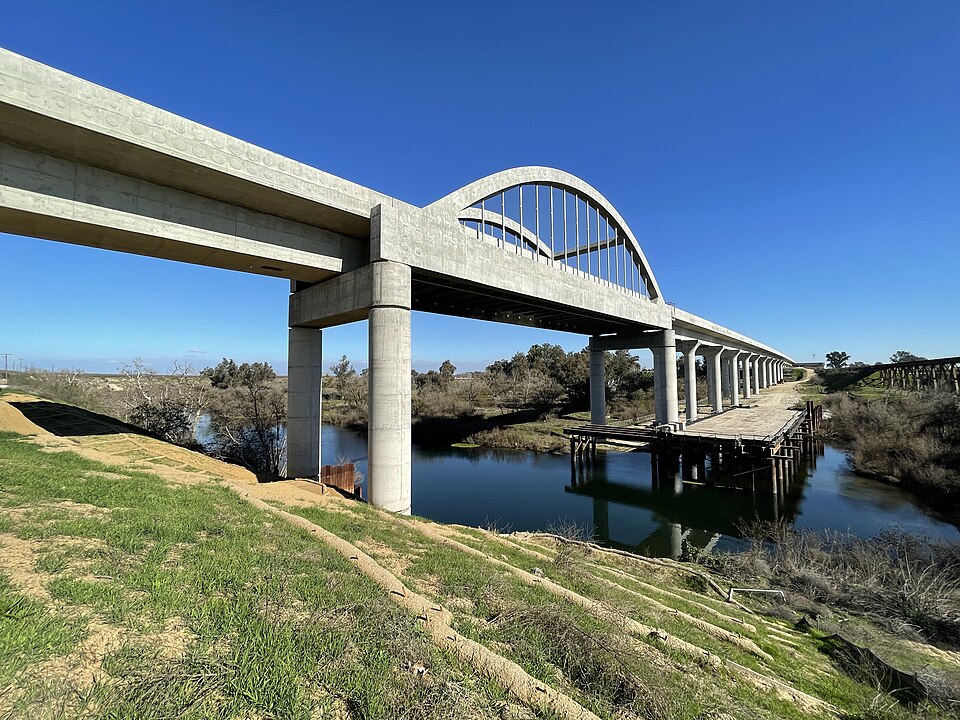
On the project’s first 119 miles — the only portion of the line where active construction work is actually happening — between Shafter in Kern County and Madera in Madera County, 62 sites where construction activity has been taking place, well, those projects have now been completed.
I also mentioned that track will start to be laid this year. But from what I heard, only one track will be laid; what’s commonly referred to as single track. There will presumably be locations where passing sidings will be installed so that trains traveling in opposite directions can get around each other. And, from what I read, no electrical overhead distribution system will be part of that track-laying effort, at least not at first.
So, why take this so-called scaled-back approach to building America’s first true high-speed rail system?
It all has to do with cost and how much money the California High-Speed Rail Authority has on hand and what apparently it can afford to build at present.
Does this mean that more infrastructure won’t be added to the project in the future? No. It’s more a case of “build-what-you-can-with-the-money-you-have”. I’ve seen this approach taken when it comes to building interstate highways. Did the interstate highway system eventually get built? Yes.
What to do with the infrastructure that gets built initially
My understanding is there won’t be enough funds available to purchase trainsets. So, if track is laid and there won’t be any trains, then the infrastructure that does get built won’t even be put to use.
There’s always the possibility that Amtrak could use the track, but that would also require a fully functioning signal system to be installed to keep train operations safe and efficient.
If that suggestion were to pan out, by Amtrak “Gold Runner” trains switching lines (moving off the BNSF’s freight line and onto the new high-speed rail line), there would need to be physical linkups from one line to the other between Shafter in the south and Madera in the north San Joaquin Valley. The advantage in having a cutover of this nature is that Amtrak trains could then operate at higher speeds. A disadvantage would be that fewer San Joaquin Valley communities would be Amtrak served compared to what exists presently. Also, in place of the community of Hanford being served, service in the area will be had at a new station located to Hanford’s west. The new station is known as the Kings/Tulare Station.
That’s one possibility.
Another would be extending a commuter rail service — Valley Rail — beyond its currently planned southern terminus of Merced, south to Madera, the current CAHSR corridor’s current northern terminus. Right of way has already been dedicated expressly to rail between these two communities between Fairmead (near Madera) and Merced. It’s physically located to the west of California State Route 99. So, there’s potential there also.
The worst situation playing out is that this multibillion-dollar infrastructure is left unused. Estimations now are that if high-speed trains in the Valley do start running, this won’t be until 2034 at the earliest.
So, how did California high-speed rail get to where it is today?
Besides a number of lawsuits filed against the project, there have been several change orders made along the way that have affected the project’s overall building timeline. Then there’s the matter of cost overruns coupled to the change orders.
But, I think the one item that has worked in the project’s disfavor is the train route decided upon. To me it was far short-sighted. I believe a key consideration in getting the project approved by state voters originally, is that serving high-speed train stations were to be located in cities. As it stands, only two in-the-city-located stations are to be included and those are in Merced (if the line does reach that far north) and Fresno and that’s it. The remainder of stations will be more rurally placed, the Kings/Tulare station being one.
Moreover, had the high-speed rail route as it exists presently not been decided upon and one that is more direct been agreed upon such as running along the State Route 99 corridor instead, such would have resulted in no or few flyovers (pergolas) having to be constructed. And by going this route, this quite conceivably could have resulted in costs being much lower. As it stands, there are at present four such flyovers that have been built in this 119-mile-long first section alone. Flyovers built at considerable expense. Furthermore, a trench that passes beneath a canal, State Route 180 and two legs of an existing freight railroad wye and the relocation of two miles of State Route 99 between Ashlan and Clinton Avenues in Fresno would not have been necessitated, thus potentially saving even more money.
Last but not least, instead of the line swinging to and from the west at Fairmead (between Chowchilla and Madera), the line could continue along the State Route 99 corridor to Manteca and then swing to and from the west there utilizing an already abondaned railroad right of way through Altamont Pass. This would, in my view, be state taxpayer money better spent in getting high-speed trains into and out of California’s San Francisco Bay Area.
And, maybe, just maybe, final building costs could have been pegged at $80-billion-to-$100-billion instead of the higher current $126-billion-to-$128-billion the full buildout of the San Francisco-to-Los Angeles/Anaheim 494-mile-long line is estimated to cost.
At the end of the day, I think what matters most in this regard is the Madera-Shafter segment just get completed regardless, and start operating trains on that segment and then go from there. Get the starter system up and running, in other words.