
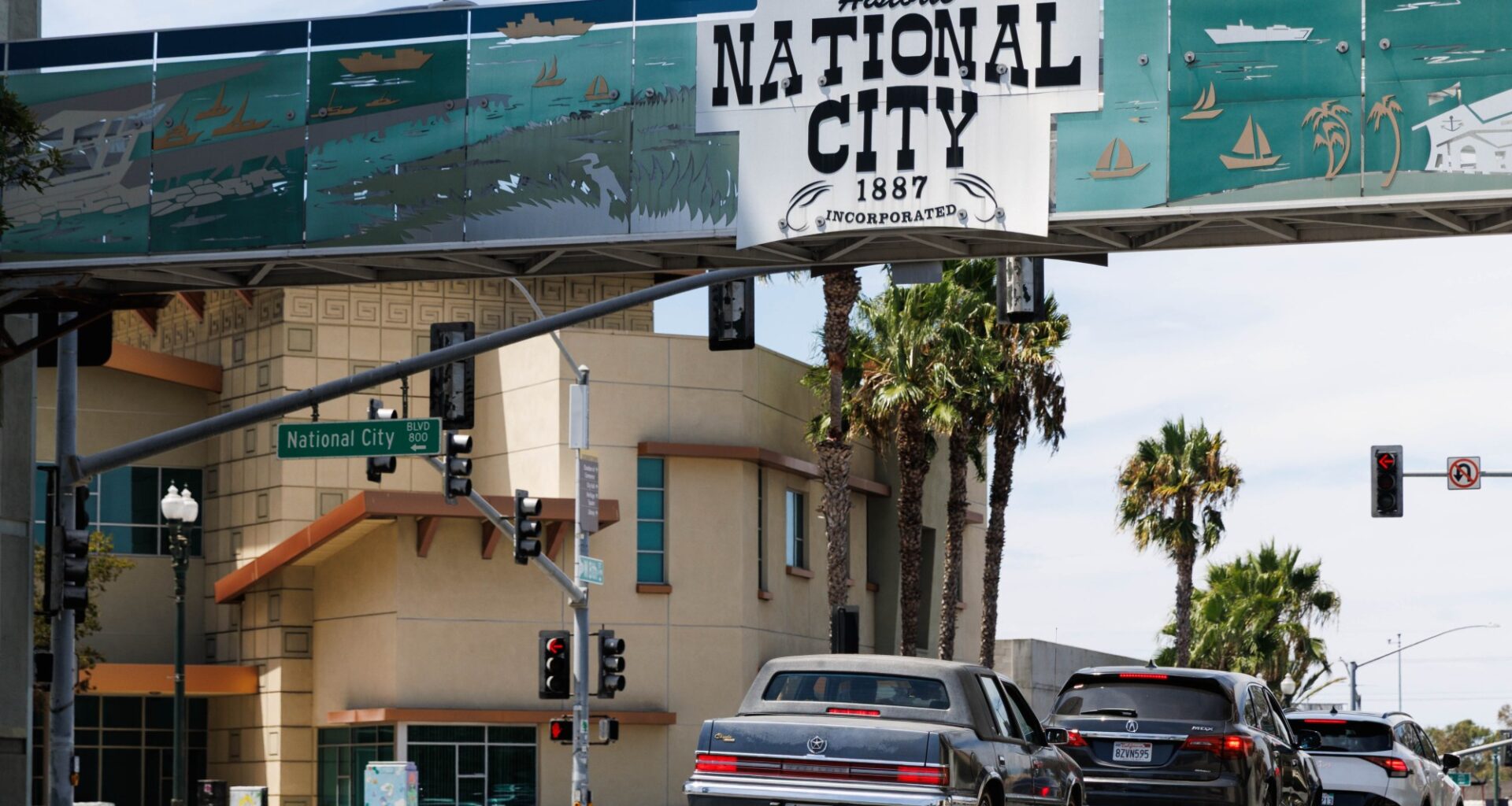
As National City’s leaders last week stood poised to strike a business license tax proposal from the November ballot, newly hired City Manager Doug Schulze made a surprising claim: the city could face insolvency in the coming years unless it addresses a widening budgetary deficit.
The warning came as the City Council, in a split 3-2 vote, pulled the tax measure estimated to generate $7.1 million in annual general fund revenue — more than half the city’s roughly $13 million deficit — following significant pushback from the business community.
During the meeting, Schulze told the council the city’s funding gap could widen from $13 million this fiscal year to $15 million by 2028 and $30 million by 2029, with insolvency possible by 2030 absent intervention — inviting the possibility of National City being placed under state receivership, where an appointed trustee would take over the city’s budget authority from elected officials. He said the figures he reported were projections from the city’s ongoing cost of labor, expected increases in debt service and pension obligations, as well as trending liability insurance cost.
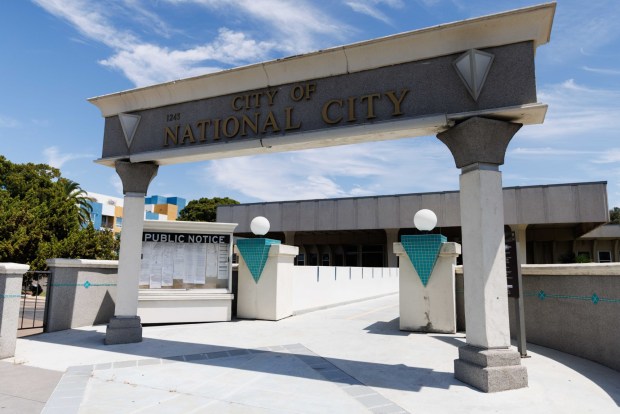 National City City Hall, as seen on Saturday, Aug. 15, 2026. (Kristian Carreon / The San Diego Union-Tribune)
“The city would look like a very bare-bones organization doing the bare minimum that is required by law,” Schulze said.
He said in the event of insolvency, the city would work with creditors to restructure debt and the City Council would lose much of its decision-making authority.
Michelle Wilde Anderson, a Stanford law professor who studies local governments under financial strain, said there is technically a difference between insolvency and bankruptcy.
Bankruptcy, or Chapter 9, is a federal court process that allows a city to restructure its debt with creditors, rather than face individual lawsuits or collapse outright. She compared insolvency to a person struggling financially who doesn’t necessarily file personal bankruptcy but instead “downsizes” — cities can similarly downsize themselves without going to court, albeit enduring “tremendous hardship” along the way.
“Insolvency really just means a city is completely broke and may have to take dramatic measures to cut its budget. There are going to be a lot of painful cuts all across the city’s spending,” Anderson said. “But if a city is warning of serious insolvency, and there’s also a debt overhang that is claiming a big share of the budget into the future, then Chapter 9 may be necessary.”
National City would not be the first San Diego County city to confront the prospect of financial collapse. Lemon Grove faced its own fiscal reckoning in 2019, when years of rising pension and public safety costs alongside declining revenue pushed the city to consider disincorporating and returning governance to the county — a step no California city has taken since 1973.
Outside the county, Stockton and San Bernardino both filed for municipal bankruptcy in 2012, carrying $26 million and $45 million deficits, respectively, as well as significant debt overhang. Stockton exited bankruptcy in February 2015 — with its debt repayment plan running until 2053 — and San Bernardino began repaying creditors in 2017 under a court-approved exit plan. As of the current fiscal year, both cities have a balanced budget.
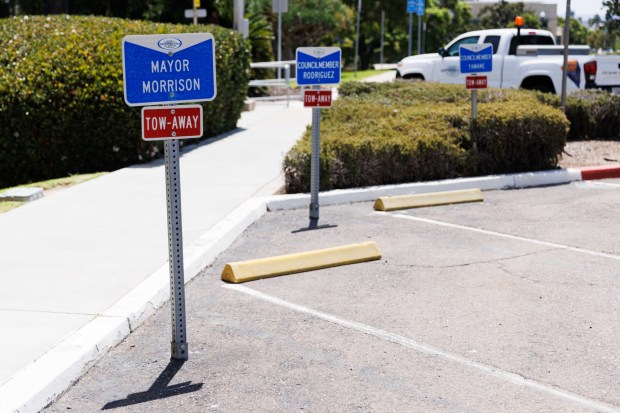 The parking spot for Mayor Ron Morrison at City Hall in National City, as seen on Saturday, Aug. 15, 2026. (Kristian Carreon / The San Diego Union-Tribune)
‘This course is not sustainable’
Council members agree the city faces a serious budget gap, but differ sharply on how to respond.
Mayor Ron Morrison — who is not seeking re-election in November after 30 years in public office — and Councilmembers Marcus Bush and Jose Rodriguez, the two candidates now vying to succeed him, each offered a distinct read on the numbers Schulze laid out.
City budget documents show the general fund’s finances have deteriorated steadily since fiscal year 2023. The general fund posted a modest surplus of roughly $915,000 that year, before essentially breaking even in fiscal year 2024. The deficit then widened to an estimated $3.6 million in fiscal year 2025, $9.3 million in fiscal year 2026 and $12.7 million in the budget adopted for the current fiscal year — a trajectory that has roughly doubled every year or two.
Over that five-year span, general fund revenue grew 18.4%, while expenditures grew 40% — more than double the rate of revenue growth. The city did not experience a revenue collapse, rather, spending consistently outpaced income.
“Everything’s going to have to be on the table when talking about solving this thing,” Morrison said, adding the city is eyeing cuts across the board. “I’ve stated for the last several years, this course is not sustainable.”
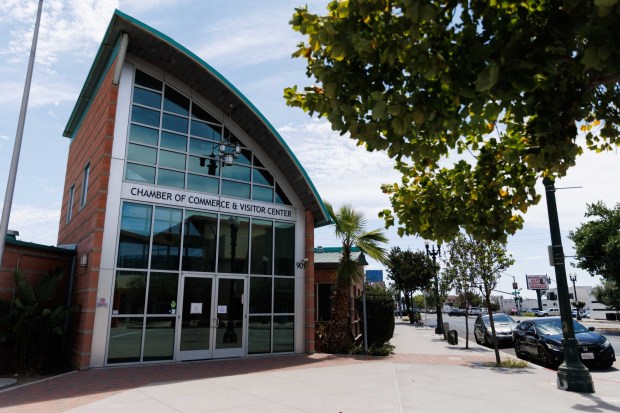 The Chamber of Commerce in National City on Saturday, Aug. 15, 2026. (Kristian Carreon / The San Diego Union-Tribune)
Personnel costs have driven much of that growth. General fund spending on personnel services rose from $45.4 million in fiscal year 2023 to $60.5 million in fiscal year 2027, an increase of 33.1%, according to the documents. Citywide personnel spending across all city funds climbed 34.5% over the same period, from $56.3 million to $75.8 million.
The increases followed a series of employee raises the council approved beginning in 2025, which council members said were overdue given that many city workers earned less than the county median for their positions.
“There’s a direct correlation between the significant increase in expenses in the general fund and the pay raises,” Schulze said.
The city’s reserves have absorbed much of the strain. The unassigned general fund balance — the most liquid portion of the city’s reserves — stood at $23 million at the end of fiscal year 2023 and rose to $26.7 million by the end of fiscal year 2024, according to the city’s Annual Comprehensive Financial Report.
It has since declined significantly.
At the end of fiscal year 2025, it stood at $23.4 million. It is currently at an estimated $13.1 million — and projected to fall to roughly $200,000 by June 2027, according to Schulze.
Rodriguez has pushed back on the severity of the reserve warnings, arguing the city’s broader reserve picture — spread across various accounts, most of which are restricted or designated for specific purposes — is stronger than the unassigned balance alone suggests.
“That being said, although we have nearly a hundred million in reserves as a city, we cannot run $10 million deficits year to year,” he said of the city’s current financial crisis. “It’s not financially feasible.”
Bush has proposed reinvesting a portion of the city’s economic contingency reserve into revenue-generating projects, including a Chamber of Commerce-backed proposal to promote National City’s veteran, Filipino and lowrider cultures to draw visitor spending.
“We’re not broke, broke yet,” he said. “We also have some reserves that we can invest in and spur more revenue generation.”
The economic contingency reserve fund, Schulze said, includes an estimated $10 million to $12 million earmarked for economic development. Though not legally restricted to investing in economic development opportunities, Schulze said tapping it to cover the deficit “would not be what I would call a prudent financial decision.”
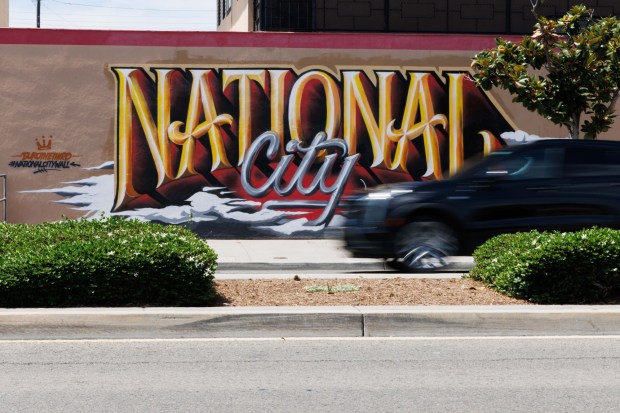 A vehicle passes by a mural on National City Boulevard on Saturday, Aug. 15, 2026. (Kristian Carreon / The San Diego Union-Tribune)
Insolvency is not inevitable
Bush, who has said he does not believe insolvency is inevitable, pushed back on the severity of Schulze’s warning while stopping short of dismissing it.
“Insolvency will happen if we do nothing until 2030 and we maintain the status quo spending levels,” he said. “I know for me that’s not acceptable and so I won’t do that.”
Both Bush and Rodriguez have pointed to potential savings in management-level spending rather than frontline services.
Rodriguez has proposed freezing salary increases for “executives and management,” consolidating departments and pausing new hires, steps he said could save roughly $4 million. He said he wants to protect the senior center, nutrition center, pool and library, calling them programs that “overwhelmingly help working families in National City.”
Bush similarly said the city needs to examine whether it is “too top heavy” before pursuing further tax increases, though he cautioned that any cuts to public safety would need to be weighed carefully against response times.
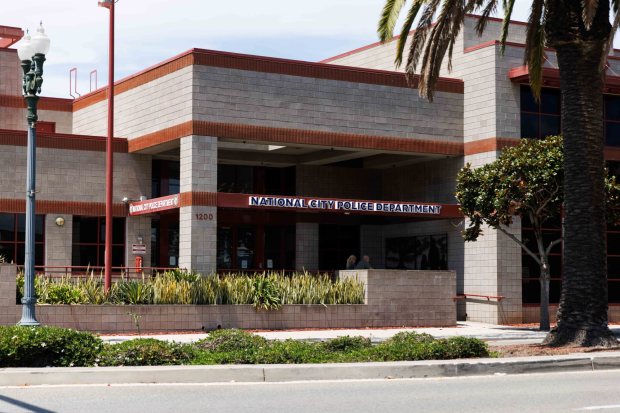 The police department in National City on Saturday, Aug. 15, 2026. (Kristian Carreon / The San Diego Union-Tribune)
Schulze said staff have identified roughly $3 million to $4 million in savings — what he called “low-hanging fruit” — achievable “without having significant impacts on the services we deliver to the community.” Beyond that threshold, he said, “we’re going to be looking at things that the community will feel, unfortunately.”
Schulze said his office will provide the council with monthly status updates on the budget through the end of the year, alongside a broader fiscal sustainability plan he expects to present to the council in September.
The budget fight is unfolding as Bush and Rodriguez head into a mayoral race both have said will be shaped by the city’s finances.
Bush has said the debate will play “a very pivotal role” in how voters judge the candidates’ leadership heading into November, while Rodriguez has said it would be “naive” to think the council’s handling of the current crisis won’t factor into the outcome.
Morrison, who will leave office at the end of his term in December, said he intends to press the council to act before voters weigh in this fall rather than wait for a new mayor to take up the issue.
“There’s a real desire to push this off until after the election,” Morrison said. “We don’t have time to do that.”