
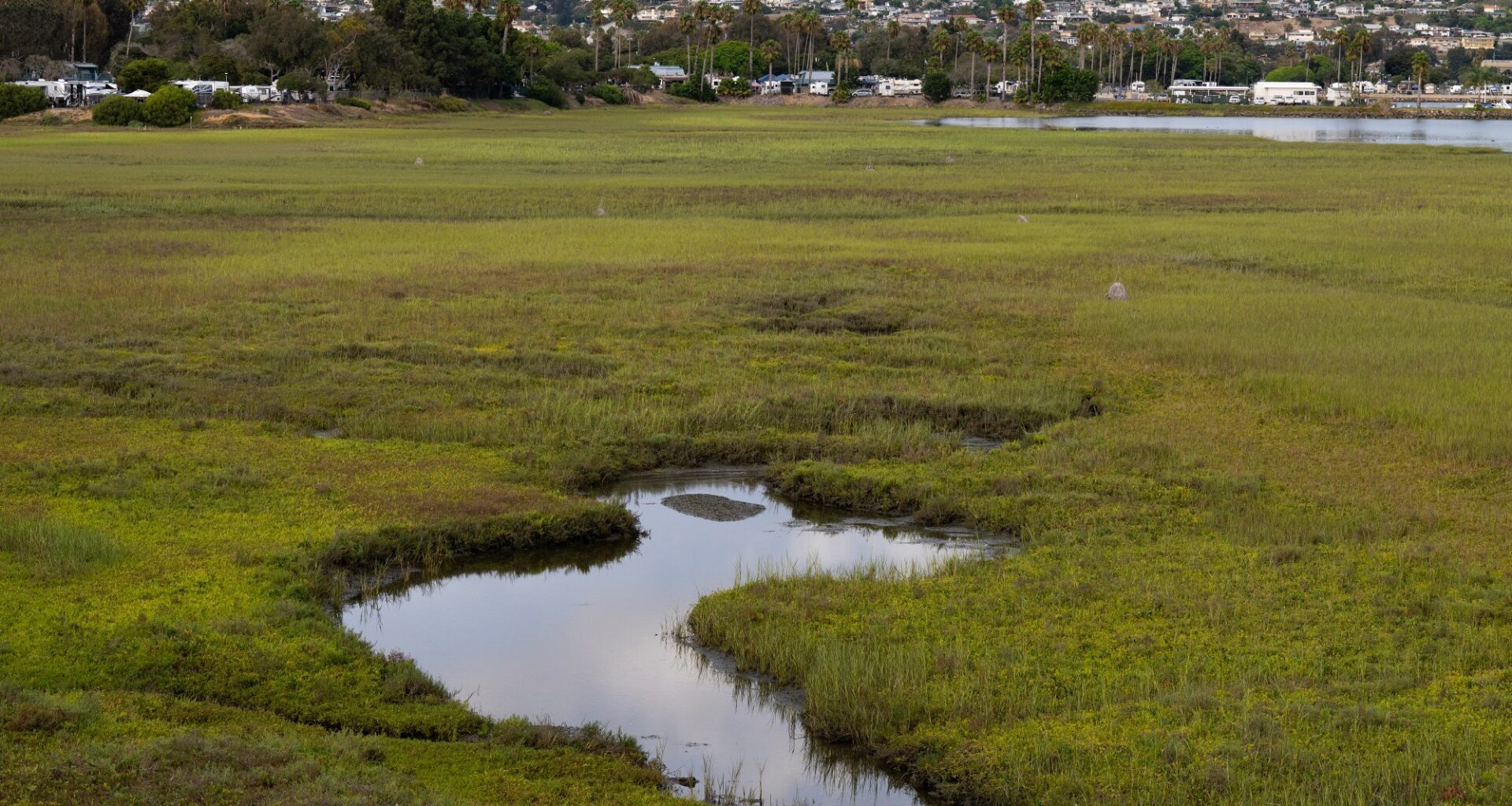
San Diego has secured long-awaited Coastal Commission approval for its ambitious plan to transform much of the northeastern corner of Mission Bay into climate-friendly marshland and new recreation space.
The Friday approval — which forced the city to change the plan in small ways, like rerouting a bike path away from marshland — allows San Diego to start applying for state and federal grants needed for the costly transformation.
City officials and environmentalists hailed the approval as a crucial step for climate resilience, because marshes help suck carbon from the air and soften the impacts of sea-level rise by acting like a sponge for excess water.
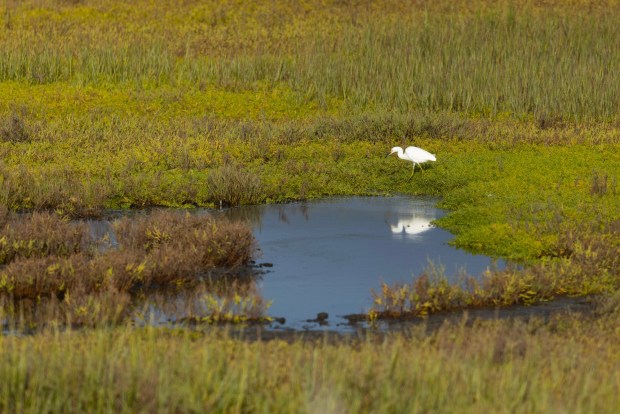 A Great Egret in the Kendall-Frost Mission Bay Marsh Reserve Thursday. (Luke Johnson / The San Diego Union-Tribune)
“This is just such a win for our region,” said Matt O’Malley, executive director of San Diego Coastkeeper. “There’s really nothing else like this throughout the state in a very urbanized area.”
City Council President Joe LaCava stressed that the plan is a delicate compromise between golfers, campers, environmentalists and recreation advocates to determine the future of 500 acres in the bay’s northeast corner.
“The council’s unanimous passage of the De Anza Natural plan stands out as one of my and the city’s more significant achievements,” said LaCava, calling the plan San Diego’s one big chance to boost wildlife habitat and fight sea level rise.
The commission’s approval has been delayed for more than two years since the City Council unanimously approved the plan — called “De Anza Natural” — after the commission sought more details about shoreline changes.
The commission’s unanimous approval Friday made several changes to the plan but left alone the future acreages spelled out in it.
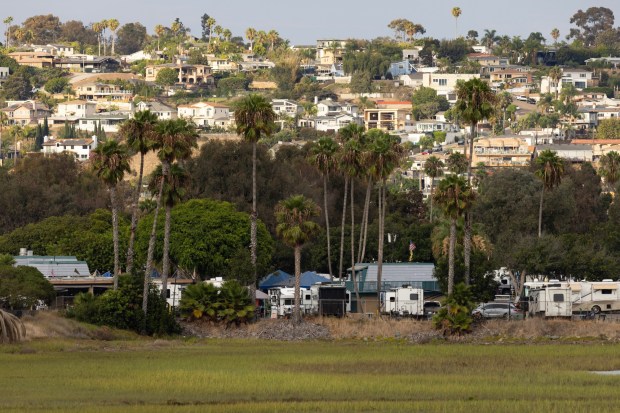 Campland on the Bay adjacent to the Kendall-Frost Mission Bay Marsh Reserve Thursday, Aug. 13, 2026. (Luke Johnson / The San Diego Union-Tribune)
Once fully transformed over the next 20 to 30 years, the area will include 67 acres of recreation, 49 acres of tent and RV camping, 23 acres of parkland and 262 acres of habitat — including 140 new acres of marsh.
“The adopted plan reflects a carefully negotiated balance of uses that will serve San Diego for decades to come,” said Kelly Stanco, the city planning department’s deputy director for environmental policy and public spaces.
The changes include channelizing the bay in some places and transforming it into dunes and marshland in others. The city plans to cut through De Anza Point, site of a former mobile home park that operated for decades.
The principal marsh area would be located generally west of the Rose Creek outfall. Smaller marshes are proposed at the Tecolote Creek outfall and at East Shores south of the visitor center.
The ReWild Coalition, which includes more than 100 environmental and civic groups, praised the changes required by the Coastal Commission.
“They go a long way toward envisioning and ensuring the tidal wetland, water quality, carbon sequestration, recreation benefits and public access restoration that we all need,” said Andrew Meyer of the San Diego Bird Alliance, a coalition leader.

Marbled godwits hunt in the shallow water of the Kendall-Frost Mission Bay Marsh Reserve. (Luke Johnson / The San Diego Union-Tribune)

Various birds hunt on a sand bar in the Kendall-Frost Mission Bay Marsh Reserve. (Luke Johnson / The San Diego Union-Tribune)

Two Desert Cottontail rabbits forage in the Kendall-Frost Mission Bay Marsh Reserve on Thursday. (Luke Johnson / The San Diego Union-Tribune)

The Kendall-Frost Mission Bay Marsh Reserve Thursday, Aug. 13, 2026, in San Diego, CA. (Luke Johnson / The San Diego Union-Tribune)

The Kendall-Frost Mission Bay Marsh Reserve Thursday, Aug. 13, 2026, in San Diego, CA. (Luke Johnson / The San Diego Union-Tribune)
Show Caption
1 of 5
Marbled godwits hunt in the shallow water of the Kendall-Frost Mission Bay Marsh Reserve. (Luke Johnson / The San Diego Union-Tribune)
One of the key changes was requiring the city to account for the risk of sea-level rise eliminating some of the space in the plan for tent camping, which may require the city to devote more acreage long-term to camping.
Stanco called the commission’s changes related to sea-level rise “excessive,” particularly a requirement that the city relocate a nature center outside of areas most vulnerable to rising seas.
But the city’s most vocal objection was to the commission’s requirement that it redesign a new cycling and pedestrian path that aims to boost mobility and allow passive access to the park’s new marshland.
The commission declared that the path can’t travel through any wetlands, even if the city replaces that marshland elsewhere.
“Precluding any and all impacts to wetlands, regardless of mitigation options and the overall increase in wetlands, effectively eliminates the city’s ability to improve pedestrian and cycling access,” Stanco said.
Another key debate was over whether the language in the plan should be advisory, using words like “should” and “may,” or regulatory, using words like “shall.”
The commission decided to require the regulatory language, contending such language is needed to make the policies in the plan enforceable under the state’s Coastal Act.
Commissioner Ann Nothoff said she believes the language required by the commission is necessary for clarity and certainty.
The commission rejected some ideas from the ReWild Coalition, which had wanted more aggressive requirements for how much marshland would survive until 2100 and timelines to force city progress on the plan.
Coastal Commission officials said they declined to make those changes in part because progress on the plan will depend on the city securing grants and other financing for the potentially $1 billion project.
When the city begins tackling specific projects in the plan, it will need approvals from the U.S. Fish and Wildlife Service and the California Department of Fish and Wildlife.
The affected area includes Mission Bay Golf Course, De Anza Cove, Campland on the Bay, Kendall-Frost Marsh Reserve, Rose Creek, several sports fields, a tennis complex, parking lots, beaches and more.