
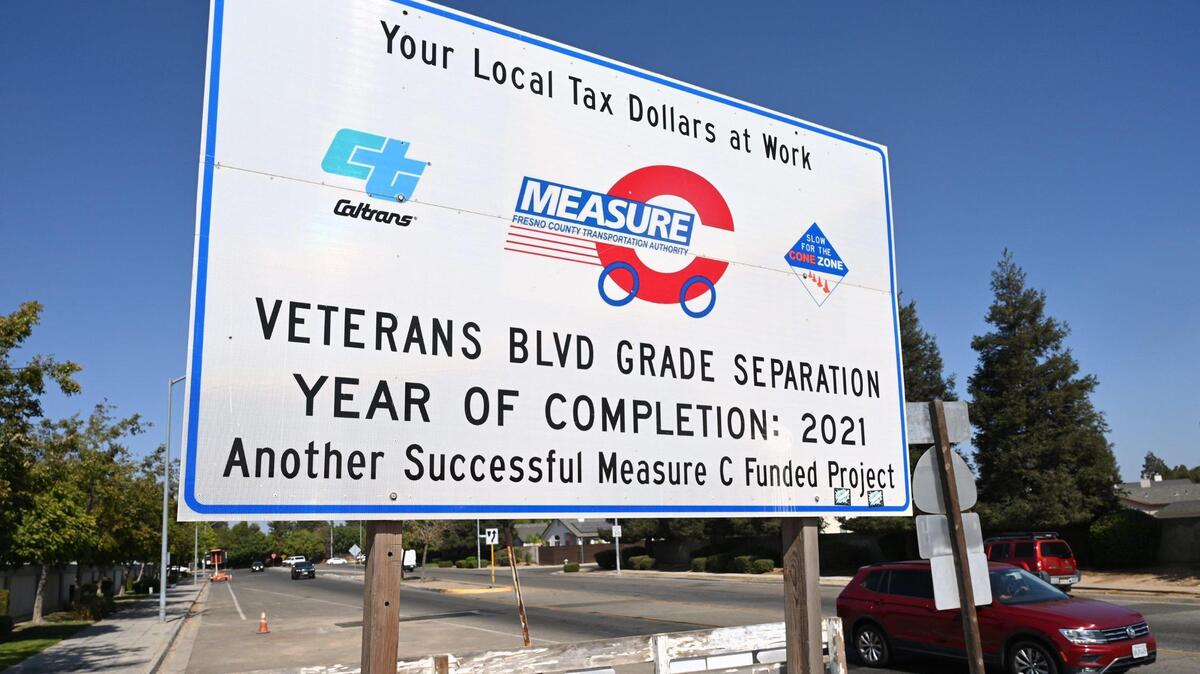
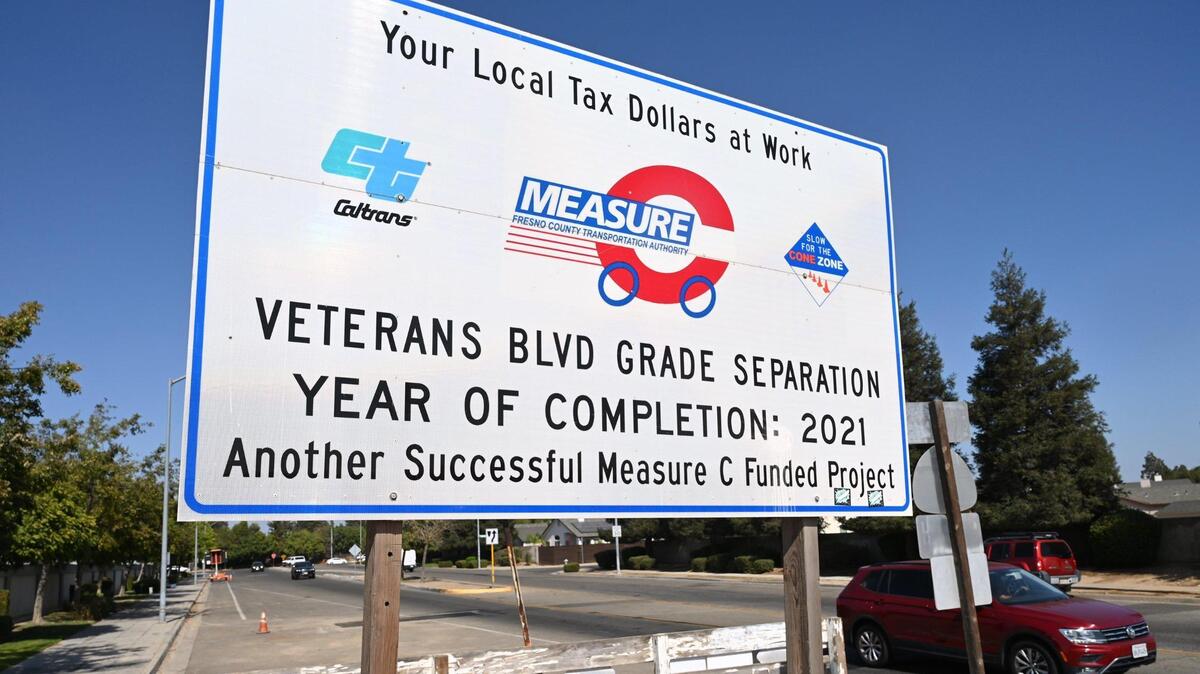
A sign near the Veterans Boulevard project near Golden State Boulevard and Highway 99 in northwest Fresno prominently touts the success of Measure C, the half-cent sales tax to support road and transportation improvements in Fresno County that expires in 2027.
ERIC PAUL ZAMORA
ezamora@fresnobee.com
This much is certain for the tax measure (or measures) to replace Measure C — city of Fresno voters will decide on a city-only tax measure at the November election.
Whether Fresno residents will vote on a second tax measure —the countywide Measure S — could be decided by a court.
Measure S, backed by the Better Roads, Safe Streets campaign, is currently on the ballot — thanks to an extraordinary state law. An ongoing lawsuit could decide whether Measure R is on the Nov. 3 ballot, or delayed to March 7, 2028.
What’s the difference between the city and county plans? Both are half-cent sales taxes, although it would be one or the other, even if both pass.
The city tax measure — now designated as Measure D — goes to the general fund, without a specific purpose. It only needs a majority to pass. The city measure expires in either 10 years, or if a countywide measure passes.
For measures where taxes are spent for a specific purpose, such as transportation, it matters how it reaches the ballot. A signature-gathered measure, like Measure S, needs a majority of voters to pass; a government-led effort for a specific purpose needs two-thirds. There is also another ballot item in November, Proposition 43, which would make the threshold two-thirds no matter how it got to the ballot.
Knowing it was unlikely to gather two-thirds, the city measure goes to the general fund, and only needs a majority to pass.
Here is an updated, chronological timeline of the effort to replace Measure C, the half-cent sales tax dedicated to transportation projects. The measure expires June 30, 2027.
1986-2022
Voters in 1986 approved Measure C with 58% of the vote, a 20-year tax that promised to raise $700 million for transportation projects. The tax helped extend the major highways in Fresno County — 41, 180, 168. Voters renewed it for another 20 years in 2006, with 78% of the vote.
A third renewal in 2022, for 30 years, ran into opposition from social justice groups. Sandra Celedon of Fresno Building Healthy Communities and Assemblymember Joaquin Arambula, D-Fresno, campaigned against it. Needing two-thirds of the vote, Measure C received 58%, failing to pass. A post-election analysis found tax-conscious voters in Clovis and north Fresno voted it down.
The Fresno Council of Governments, one of the government agencies charged with administering Measure C, bypassed a 2024 attempt, and started a complicated process last year to renew the measure.
2025
Fresno COG began a bureaucratically-oriented method for the official Measure C renewal. The third iteration would raise an approximate $70 billion.
The policy board — composed of the 15 mayors in Fresno County and a supervisor representative — formed a steering committee, made up of city community members and experts in the transportation field.
A social justice group called Transportation for All (later to form as Better Roads, Safe Streets) demanded seats at the table. If not, they would gather signatures for its own initiative. Like 2022, they argued Measure C did not focus on public transportation enough, and did not help poorer, rural communities. A policy board subcommittee acquiesced — adding 12 Transportation for All members to the original board of 24 — and the group essentially took over the Measure C renewal.
Opponents said Transportation for All hijacked the steering committee and proposed something different from the Measure C mission for fixing roads. Eventually, the policy board voted against the official Measure C renewal, allowing the social justice groups to circulate their own plan.
The Better Roads, Safe Streets plan dedicated 65% for fixing roads and 25% for public transportation, drastically different amounts than the current Measure C. That created a schism among supporters — including Fresno Mayor Jerry Dyer and Clovis Mayor Vong Mouanoutoua — and opponents such as Fresno County Supervisor Garry Bredefeld and Clovis Councilmember Diane Pearce.
January-July 2026
Better Roads, Safe Streets started the process on January 26, 2026, and turned in 32,562 signatures on April 14. The initial sampling found too many errors, mainly duplicate signatures. This delayed the certification process until the office of Fresno County Clerk/Registrar of Voters James Kus could examine every signature.
Kus completed the process, finding 22,205 valid; the initiative needed 21,909 to qualify. He certified the signatures on July 8. By state law, the Better Roads, Safe Streets plan automatically qualified for the ballot, but still needed a formal vote from the Fresno County Board of Supervisors.
The nonprofit Central Valley Community Foundation — and its president/CEO Ashley Swearengin — financially supported signature gathering. Campaign finance records show CVCF contributed $810,000 from Jan. 1 to June 30.
An alternate plan crafted by transportation experts, Fix our Roads, did not get enough signatures to qualify.
July 14, 2026
With the signatures certified, the plan then went to the supervisors for a formal vote to place the Fresno County Transportation Improvement Act — the official name of the plan — on the ballot.
The supervisors had another option. State law also allows government boards to order a study, pushing back any required votes.
The supervisors on July 14, voted 3-2 for the study option. The study would take up to 30 days, returning at the next supervising meeting on Aug. 11.
However, the delay meant the board would miss the Aug. 7 deadline — a ballot has to be set 88 days in advance — for items to be on the Nov. 3 election. Better Roads, Safe Streets would have to wait until the next state election in March 2028.
Supporters objected, saying the move denied the right to vote in November. Mendota Mayor Victor Martinez even called Bredefeld and two other supervisors “racist.”
Advocates implored Bredefeld, the board chair, to call for a special meeting before Aug. 7. He refused.
It seemed Better Roads, Safe Streets were out of moves.
July 23, 2026
Dyer and Fresno City Council President Nelson Esparza were concerned that without a November vote on the countywide measure, the city would lose $54 million it receives from Measure C dedicated to road repair. More than 200 city employees would lose jobs; bus routes would have to be canceled.
The two Fresno leaders announced a stopgap measure. The Fresno City Council would vote on July 30 for its own tax measure. Like Measure C, it would be a half-cent and would take effect on July 1, 2027, to ensure continuity in taxes. To make sure Fresno residents would not be double-taxed, the measure contained a unique sunset provision — either 10 years or if a countywide measure passed, the city measure would automatically cease.
Unlike the county measure, the city version would go to the general fund. While proponents said it would be spent on city transportation needs, there was no guarantee. A future city council or mayoral budget could spend it anyway it would see fit.
July 30, 2026
Anticipating the county delay, the Fresno City Council votes 6-1 to place a city-only half-cent general sales tax on the November ballot that would raise an estimated $65 million a year.
During the debate, Dyer said he would veto the city tax measure if the county measure found itself back on the ballot. The mayor has 10 days to either sign legislation or veto. In reality, the mayor had until Aug. 7 — the ballot placement deadline — to sign if he wanted it on the ballot.
July 31, 2026
Dyer and Mouanoutoua send a letter to Assemblymember Esmeralda Soria, D-Fresno, and state Sen. Anna Caballero, D-Merced, asking if they could help.
“We respectfully ask that you consider whether there are any legislative, administrative, or other lawful avenues available to preserve the ability of Fresno County voters to consider this measure. We ask for your assistance in protecting the integrity of the democratic process and ensuring that voters are afforded the opportunity to make this important decision under California law,” the mayors wrote.
Mayors from nine other Fresno County cities sent a similar letter.
Days earlier, on July 28, Better Roads, Safe Streets supporters hired Sacramento lobbyist Olson Remcho to help fast track the legislation.
Aug. 3, 2026
Soria and Caballero gut and then amend AB 1923 to declare that any Fresno County initiative certified by July 8 would automatically go on the Nov. 3 ballot, bypassing the supervisors entirely. The bill would be urgent, meaning it could forgo the required 72 hours in print and on the fast track.
Bredefeld and Pearce criticized the move, calling it election tampering and taking away local control.
Aug. 3, 2026
Dyer tells The Bee he supports the Soria/Caballero move.
“Either way, we win. If we get one or both — I don’t really want to have both of them on the ballot because there is a good chance there that maybe people say no, no, on both,” Dyer said after a speech to The Rotary Club of Fresno.
He expressed concern about two tax measure on the same ballot, hinting he might veto the city tax measure.
Aug. 4, 2026
Dyer tells the GV Wire podcast “Unfiltered” that voters may expect two tax measures on the November ballot.
Aug. 5, 2026
The state Senate elections committee approved AB 1923 by a 4-1 vote. An Assembly election committee holds an informational hearing, but takes no vote.
Swearengin, president and CEO of the Central Valley Community Foundation and former Fresno mayor, personally lobbies in Sacramento,
Former Fresno County Supervisor Henry R. Perea, a Democrat, breaks with his party to oppose AB 1923 as “election tampering” that usurps local control. He warns that the maneuvering puts Gov. Gavin Newsom in a tight spot given his stance against federal election interference, and says litigation is “a possibility.” He testifies in Sacramento against the bill.
Aug. 6, 2026
AB 1923 passes the full Assembly, 54-16, and Senate, 27-8, as an urgent measure. Governor Newsom signs later that day, placing Better Roads, Safe Streets on the November ballot, despite Fresno County lobbyist Paul Yoder warning senators that litigation would likely follow.
Aug. 6, 2026
As the legislature took its votes, Bredefeld promises at a news conference to call for immediate litigation (VIDEO), describing the state bill as unconstitutional and pointing to potential challenges over state legislative procedure.
Supporters of Better Roads, Safe Streets in November call Bredefeld a bully and a threat to democracy.
Aug. 6, 2026
With the state bill approved, Dyer announces he won’t sign the city-only tax plan by the Aug. 7 ballot measure deadline. He again expressed concern with two local tax measures on the same ballot.
Aug. 7, 2026
With one hour to spare, Dyer reverses course by the 5 p.m. deadline, signing it as a hedge against the county measure being knocked off the ballot by litigation. In a news release, Dyer said new legal concerns prompted his change — his fourth public reversal during the week.
Critics emerge — especially from the Better Roads, Safe Streets camp — saying the city-only plan has no guardrails and cannot be guaranteed to be spent on transportation items.
Aug. 10, 2026
At a news conference, Dyer explains his reversals and why he signed the city-only tax measure.
Fresno City Attorney Andrew Janz sent Dyer a legal opinion about the risks of the city not submitting its own measure, and the effects of a potential county lawsuit. “All of those were red flags,” Dyer said. “I remain hopeful that the county will do the right thing.”
Pressure increases for Esparza to call for a special Fresno City Council meeting. State law for the city to withdraw its tax measure by Aug. 12.
Esparza said he has no plans to call for a special meeting.
Aug. 11, 2026
The supervisors voted 3-2 to place Better Roads, Safe Streets — now designated Measure S — on the March 2028 ballot, contradicting AB 1923. Kus said would instead follow the state law mandating he would place it on the November ballot. Bredefeld, Buddy Mendes and Nathan Magsig voted for; Luis Chavez and Brian Pacheco voted against.
By the same 3-2 count, the supervisors voted to file a lawsuit against the state, Kus and the Better Roads, Safe Streets campaign.
Aug. 11, 2026
If the city council president does not call for a special meeting, Fresno city rules allow for four members to call for the meeting, as long as it is 24 hours in advance. At 1:08 p.m., Miguel Arias, Tyler Maxwell, Brandon Vang and Nick Richardson call for a special meeting the next day at 3 p.m.
There is one item on the open session agenda — to withdraw the tax measure. However, it would be a race against the clock. A vote, signature from the mayor and physical transmission to Kus’ office would have to be completed by 5 p.m. — when the clerk’s office closes its door for the day.
Aug. 12, 2026
The county officially filed its lawsuit. The county included Michael Der Manouel Jr. — a Fresno insurance executive and longtime conservative activist — and Fred Vanderhoof, former chair of the Fresno County Republican Party, as co-plaintiffs.
“I am all for people deciding to tax themselves or not — that is not the question. The question is are we allowing the State now to come in and override our locally elected county supervisors in tax and other matters? If we don’t defeat the State on this matter, are we giving the State license to essentially govern Fresno County on local decisions?” Der Manouel wrote on his Facebook page.
In 2023, the county sued the state over the law mandating the change of communities like Squaw Valley. A judge ruled the county did not have standing because it is considered a unit of the state. Adding plaintiffs may alleviate that hurdle.
The defendants are the state, Kus, Fresno County Residents for Better Roads and Safe Streets (the ballot committee), and the official proponents who attached their names when submitting the proposal — Fresno Mayor Jerry Dyer, Clovis City Councilmember Lynne Ashbeck, Veronica Garibay-Gonzalez of the Leadership Counsel for Justice and Accountability, and supporter Joan Easton.
Fresno County Superior Court Judge Robert Whalen, a former prosecutor and Clovis city councilmember, will preside over the case. As of Thursday afternoon, no date has been set.
The county is also asking for a temporary restraining order or an injunction. If issued, that could knock Measure S off the ballot until March 2028. The lawsuit notes that ballots start printing Sept. 9 (although Kus told The Bee the date is Sept. 8, but would not clarify because of the lawsuit) to meet the deadline to send ballots to overseas voters and members serving in the military.
Aug. 12, 2026
Three members of the Fresno City Council convened for a special meeting at 3 p.m. at City Hall. The only problem was they needed four — a quorum — to conduct the meeting. While Arias, Vang and Richardson attended, Perea, Karbassi, Maxwell and Esparza did not.
Because the meeting could not legally take place, the city missed its 5 p.m. deadline to withdraw the measure.
Perea said she was out of town. She would not elaborate, citing security concerns. Karbassi said he had a last-minute family emergency. He also missed a regularly-scheduled city council meeting the next day. Maxwell said he had a pre-existing engagement. Esparza never revealed why he could not attend.
The following day, at the regularly scheduled Fresno City Council meeting, Esparza said: “The very short notice nature of yesterday’s special meeting didn’t allow for my attendance. But in case I have not been clear about my intention to leave the city fiscally solvent, in case anyone was still wondering where it stands, we are not going to recklessly leave the city’s finances in the hands of our judicial system.”
Aug-Sept. 2026
A hearing is likely to happen in front of Judge Whalen. There is no timetable of when arguments will be made or when a ruling may be issued. It is likely that whatever the ruling is, it will be appealed to a higher court.
Nov. 3, 2026
As of Aug. 14, city of Fresno voters will see two tax measures — the city-only Measure D, and the countywide Measure S.
The city of Fowler also approved a similar stop-gap measure as Fresno, a half-cent tax for the general fund that would expire in either 30 years, or if a countywide effort passed.
June 30, 2027
Measure C expires.
Melissa Montalvo and Liliana Fannin contributed to this story.
The Fresno Bee
David Taub joined the Fresno Bee in 2026 after reporting 10 years for digital publication GV Wire. He has worked in the Fresno market since 2007. Prior to moving to the Central Valley, he worked for TV and radio stations on the Central Coast. He has also worked behind the scenes in local TV and radio. During his career, he has covered City Hall, the state Capitol, the White House and several houses of government in between. When not in a reporting capacity, he works tracking stats for the Fresno Grizzlies as an official scorekeeper, and also with televised basketball and football games. He has worked the Super Bowl, NBA Finals, and several MLB games. Growing up in the San Francisco Bay Area, Taub is a die-hard Giants and 49ers fan. He graduated from the University of Michigan with dual degrees in communications and political science. Go Blue!