
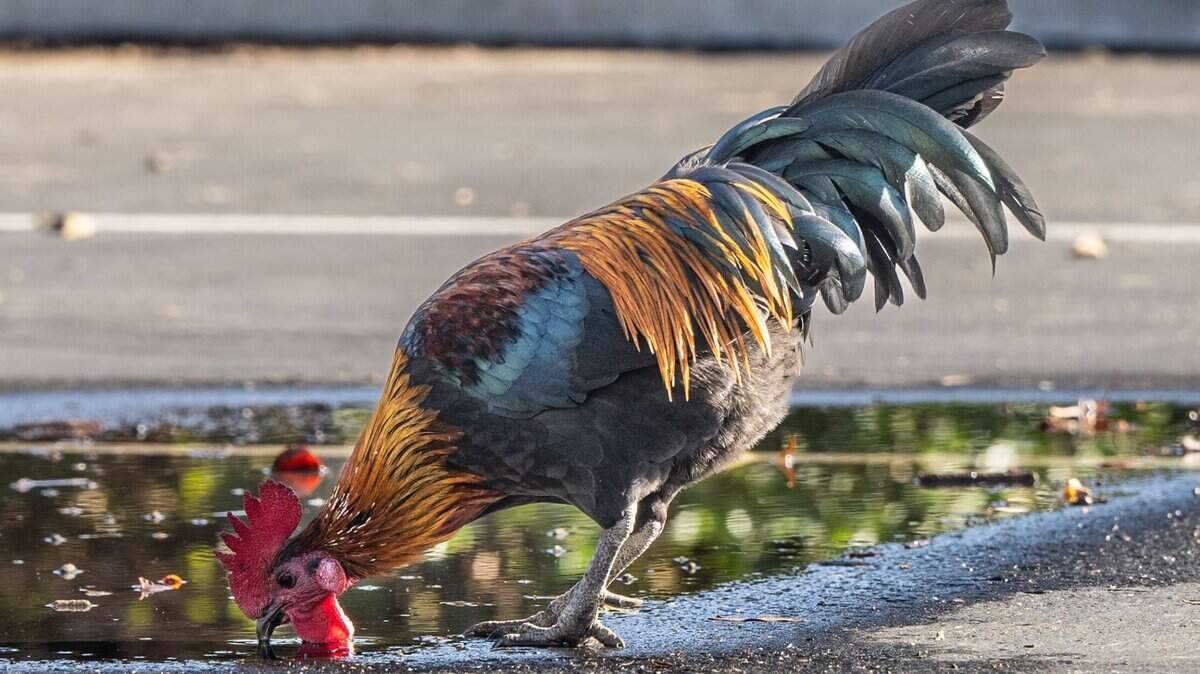
A rooster drinks water in Kohl’s parking lot in Yuba City on Tuesday, Nov. 12, 2024. A bill to limit how many tethered or caged game fowl roosters a person could own was halted in the Legislature.
Hector Amezcua
hamezcua@sacbee.com
After hundreds of Californians protested a bill aimed at curbing cockfighting by limiting the number of movement-restricted roosters a person could keep, the measure was halted in committee, effectively killing it.
Although cockfighting is illegal under both federal and state law, California has been the site of some of the nation’s largest cockfighting busts. In 2017, deputies seized approximately 7,000 birds in Southern California. As recently as February, a months-long investigation led to the recovery of more than 800 birds in Santa Rosa.
As a preventive measure, Assemblymember Chris Rogers, D-Ukiah, introduced AB 928, which would have prohibited a person from keeping more than 25 caged or tethered game fowl roosters. Game fowl are bred for aggression by definition, said Jenny Berg, California state director of the Humane World for Animals, which worked with Rogers on the bill.
“It’s really getting at how the birds are kept in conditions which are consistent with cockfighting,” Berg said. “It’s hard to catch someone cockfighting. But in California, we know there are these huge game fowl yards that breed hundreds to thousands of birds, which are going to be used and exported across the world for cockfighting.”
The bill included exemptions for several non-cockfighting purposes, including food production, educational programs, animal shelters and exhibitions. However, even with those exemptions, it faced immense backlash.
Berg said there was a lot of misinformation circulating about the bill, especially coming from the illegal cockfighting industry.
Hundreds of people came to Sacramento from across the state to oppose the bill in committee. Many of their concerns focused on how the bill would affect their livelihoods or cultural practices.
According to the primary opposition group, the California Association for the Preservation of Gamefowl, 90% of game fowl breeders are Latino. During a Senate Appropriations hearing on Aug. 3, opponents wore shirts with the phrase “Stop targeting minorities.”
“This bill doesn’t target specific communities. It doesn’t target farmworkers. Legitimate poultry businesses are exempt from this legislation,” Berg said. “Cockfighting is itself not a cultural practice. It’s a crime everywhere.”
Loading…
Rogers alleged that many “game fowl preservation” groups, such as the California Association for the Preservation of Gamefowl, operate as political fronts to protect cockfighting. The allegation is based in part on the group’s affiliation with the United Gamefowl Breeders Association, whose leadership has been tied to the commercial supply chain and political defense of illegal cockfighting.
The California chapter denies the allegation and said its opposition to the bill is rooted in concerns about property rights and cultural preservation.
In more recent hearings, immigrant rights groups signed onto the opposition, worried the bill could provide immigration enforcement officers with an additional pretext to enter homes.
“We’re obviously sensitive to the cultural moment that we’re living in right now — and that’s not the purpose of the bill,” Berg said. “This bill is about animal cruelty.”
The bill did not receive enough votes to advance to the Senate floor, meaning it will not move forward this session.
Related Stories from Sacramento Bee

The Sacramento Bee
Naomi Taxay is a summer reporting intern for The Sacramento Bee’s Capitol Bureau. She grew up in the San Francisco Bay Area and studies journalism and political science at Northwestern University. She has reported on immigration and demographics from Washington, D.C., and on agriculture and energy across Illinois.