
By Gerardo Zavala and Katerina Graziosi
As the farm-to-fork capital, Sacramento is surrounded by some of the most productive agricultural land in the country. But living in an agricultural region doesn’t necessarily mean everyone has equal access to fresh, nutritious food.
Data from Feeding America shows that food insecurity affects as many as one in five people in some Central Valley counties, including Fresno, Madera, Kern, Tulare, Kings and Merced.
Those numbers are estimates based on national food insecurity surveys and economic and demographic data. When the Yolo County Food Bank decided to look into the issue in 2024, it found that the numbers were worse than expected.
Their study found that roughly a third of households in Yolo County were food insecure, which far outpaces state and national rates — 15% and 14%, respectively. And the number of people facing food insecurity has been steadily increasing in the Sacramento region over the last few years.
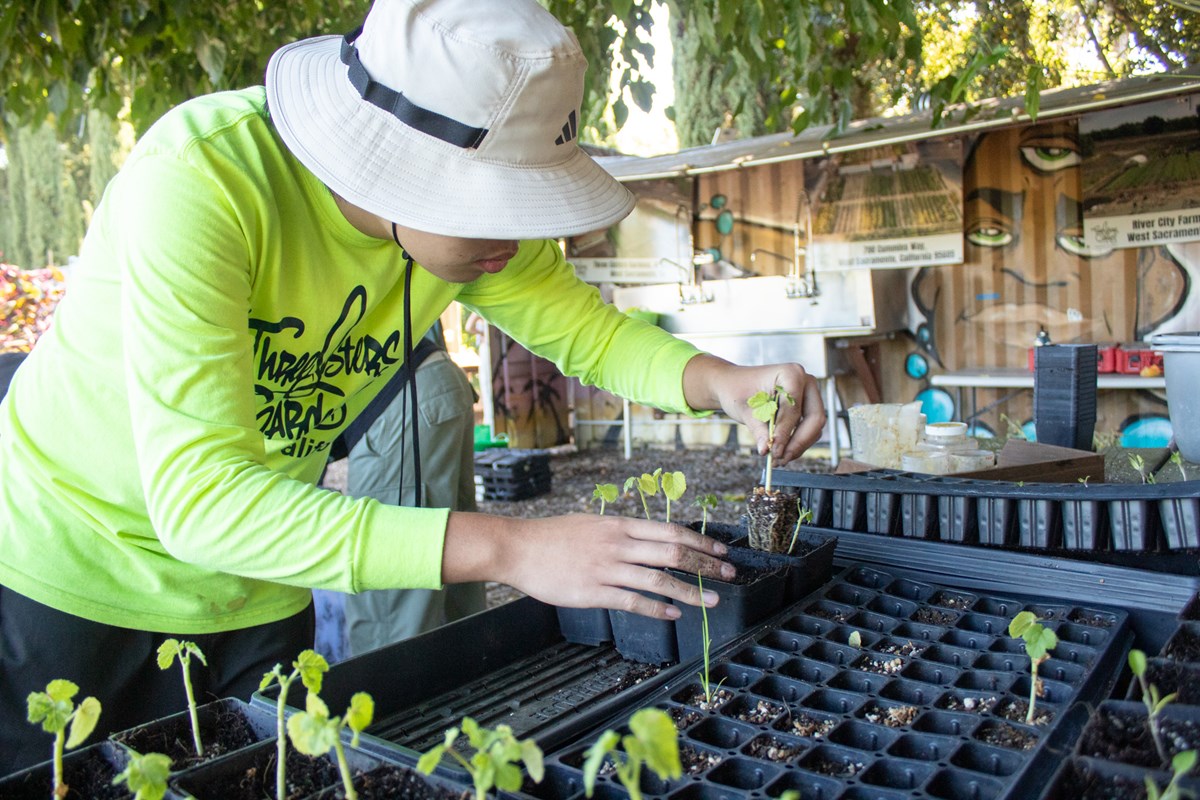 Vance Zeng, 17, upsizes seedlings into bigger pots Friday, July 24, 2026, in West Sacramento.(Gerardo Zavala/CapRadio)
For one area nonprofit, addressing that gap starts with growing food.
Three Sisters Gardens operates four urban farms in West Sacramento, where founder Alfred Melbourne says about 90% of what the organization grows goes back to the community.
Melbourne started his Yolo County-based nonprofit in 2018 after serving nearly two decades in prison. When he returned to his community, he says he was struck by how familiar some of the problems were to his own upbringing, including limited access to fresh, nutritious food.
“For us to get access to good nutrient-dense organic food, to feed kids better —we know that they’ll perform better. And so it’s about creating that access,” he says.
Growing food differently
Three Sisters Gardens is increasing that access not only by distributing fresh produce to the community, but by changing the way that food is grown.
The nonprofit uses regenerative farming practices, including no- and low-till methods, crop rotation and cover crops. Melbourne also describes the work as drawing on Indigenous practices to caring for the land.
“We want to build a relationship with the land,” he says, “not always be so transactional and like commodifying it.”
Farm hand Fatima Arriaga says that relationship starts with rebuilding the soil.
“Applying those healthy farm practices like no fences around our fields, having compost that the community can bring,” she says. “Three Sisters Gardens is also collaborating with some Sac State professors I had… working together to rebuild the soil using biochar to promote healthy soil.”
It’s also given Arriaga the ability to grow food — something she says she’s unable to do at home.
“If more cities implemented urban gardening, I think that it would be something that would transfer on to generations,” she says. “Their kids can come and participate and learn how to grow their own food.”
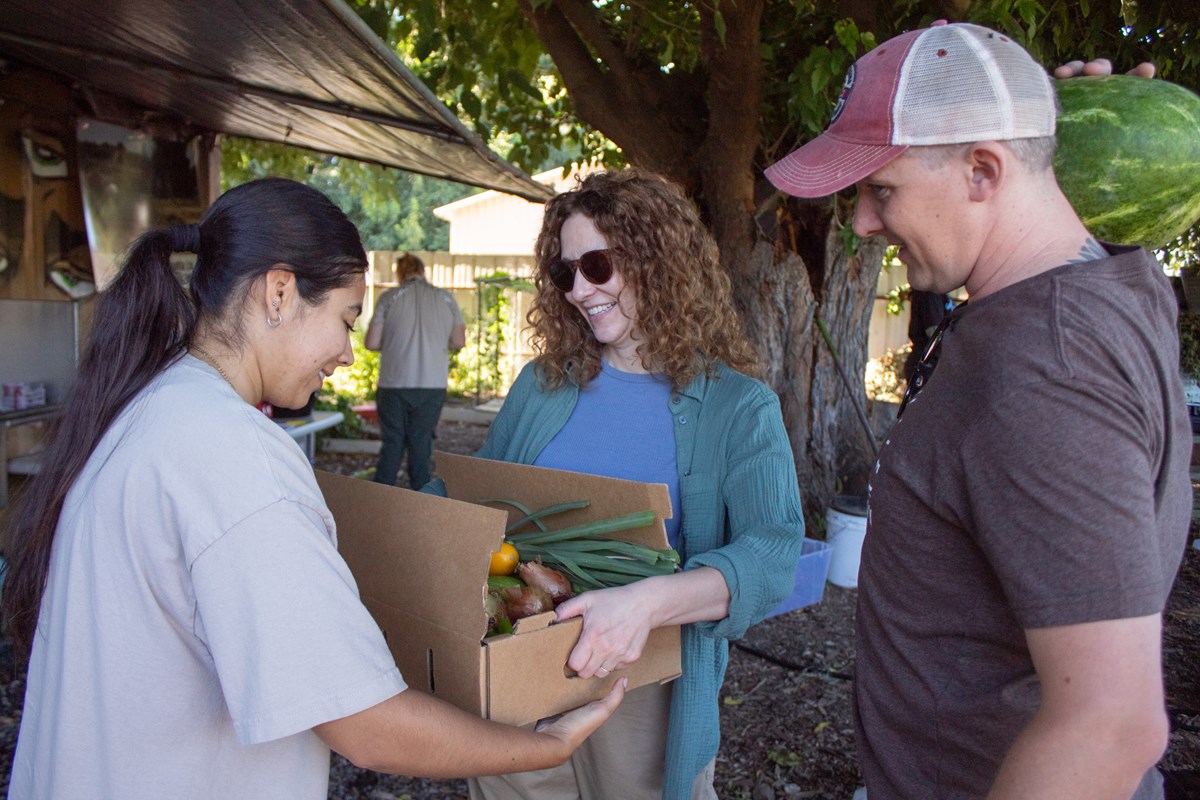 Farm hand Fatima Arriaga hands a CSA box to Lauren Foster and Jared Weathers Friday, July 24, 2026, at Three Sisters Gardens in West Sacramento.(Gerardo Zavala/CapRadio)
Three Sisters’ approach emphasizes reducing soil disturbance, maintaining soil cover and increasing crop diversity — all practices that align with the target outcomes of regenerative agriculture as defined by the California Department of Food and Agriculture.
Jacob Weiss, general manager of Spork Food Hub in Davis, which works with small farms across the region to get locally grown food to schools, hospitals and other institutions, says the way food is grown is particularly important in urban settings.
“The way we grow food definitely matters, especially if you’re in an urban environment, you probably don’t want an urban farm next to a school spraying a bunch of pesticides and herbicides,” he says.
But for Weiss, the issue isn’t just environmental. It’s also about who gets access to the food being produced.
“Just because you’re food insecure, getting food from a food bank or you’re a kid getting most of your calories at school or you’re incarcerated. Just because any of those things are true doesn’t mean you should only be able to access low quality food or low quality calories,” he says.
The connection between how food is grown and who gets to eat it is central to both the Spork Food Hub and Three Sisters’ model.
Weiss says Three Sisters is part of a growing effort to use regenerative agriculture practices to make locally grown produce more accessible.
Farm-to-community
Three Sisters donated nearly 42,000 pounds of produce to the community last year alone, according to Melbourne.
Getting that food into the hands of people who need it is a process of its own. Every Thursday, young interns and volunteers pack produce into bags for distribution to the city’s historically disadvantaged Broderick-Bryte neighborhood on Fridays.
According to Melbourne, the nonprofit serves roughly 140 people in over 60 households in the community.
He says Three Sisters receives around half a million dollars a year in grants from the Yocha Dehe Wintun Nation, Sierra Health Foundation, California Endowment and the California Department of Food and Agriculture.
Melbourne says they receive nothing from the city or county.
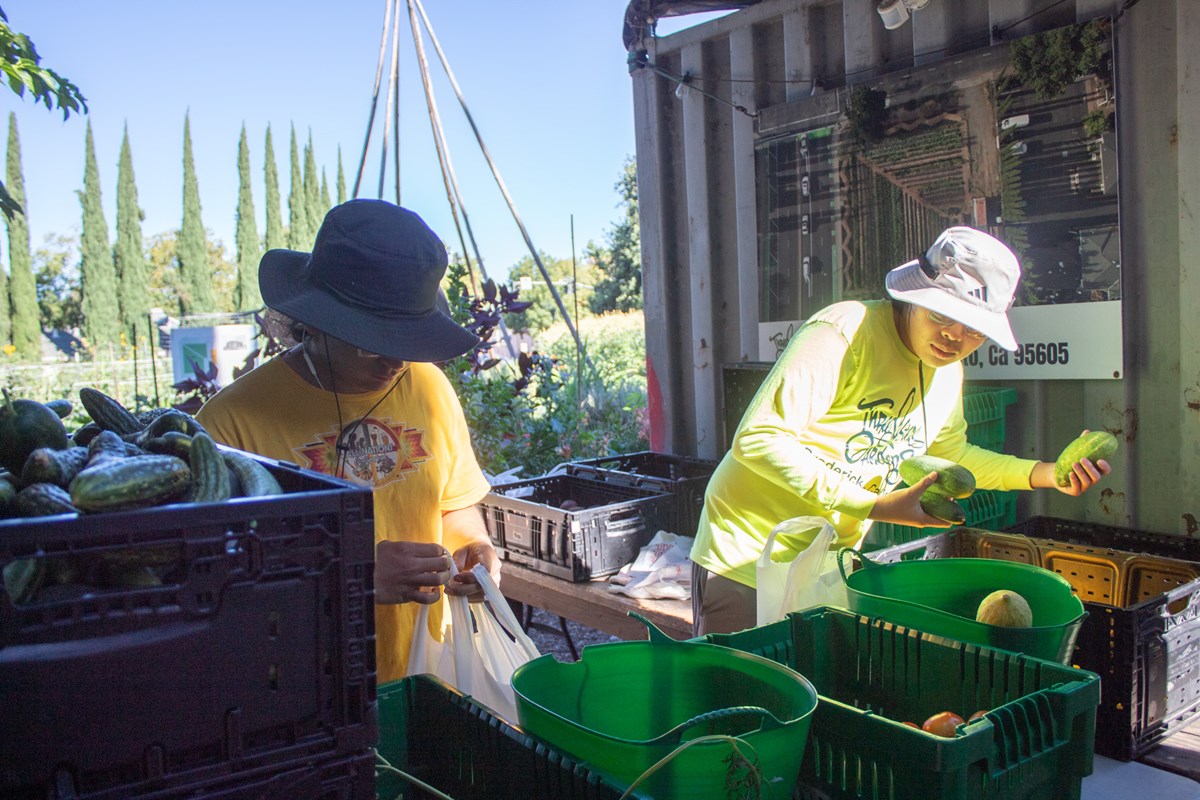 Daniel Rangel (left) and Vance Zeng prepare bags of produce to distribute to community members Thursday, Friday July 23, 2026, at Three Sisters Gardens in West Sacramento.(Gerardo Zavala/CapRadio)
Vance Zeng, an 18-year-old high school senior, spent the summer interning on the farm.
“I feel like I’m fulfilling my sense of duty to my community. I’m giving back for what, for what they give to me,” he says while packing bags of produce to be distributed to community members.
Issac Fraijo leads the Community Food Program. The 18-year-old says he enjoys getting to speak with recipients and check in on them.
“I’ve heard a lot of different stories about how they used to grow this or they eat it all the time,” he recounts. “About how their grandsons and grandchildren will bring them the same thing all the time from Walmart. They like it how they can get it from the garden every Friday for free.”
One of the people he delivers to is 58-year-old Annie Marion Lanzi. She says receiving fresh fruits and vegetables every week has helped her lose more than 100 pounds over the past two years.
“This program helps people that are elderly, the people that can’t afford to go and buy their fruits and vegetables,” she says. “I’m on a fixed income and I only get so many in food stamps. I have to stretch that out.”
Lanzi also says she appreciates the sense of community she gets from it.
“When I go to their little get-togethers, I get to meet new friends and mingle with the community,” she says.
Lanzi says she also has a heart condition and relies on the program to help her maintain her diet.
“I need to stay here on Earth. I got grandbabies to watch to grow up,” she says. “I’m not going nowhere.”
For Melbourne, helping people like Lanzi is what Three Sisters Gardens is ultimately about.
“We grow this food for our community. But, you know, we live in a food desert… How can we give it to others? How can we share?”
This story was produced by the Climate Solutions Studio, a project of the Central Valley Journalism Collaborative and its partner newsrooms. CapRadio is a founding partner.
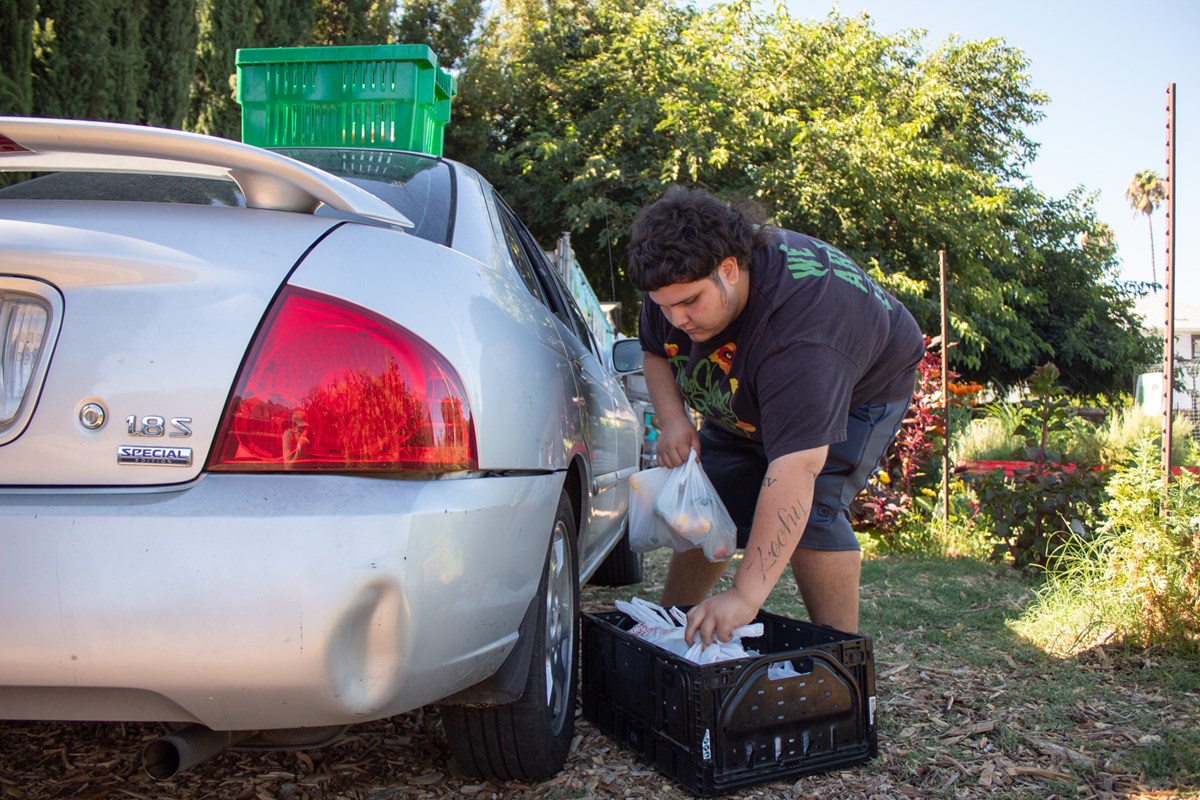 Community Food Program leader Issac Fraijo loads bags of produce in his car Friday, July 24, 2026, at Three Sisters Gardens in West Sacramento.(Gerardo Zavala/CapRadio)
Follow us for more stories like this
CapRadio provides a trusted source of news because of you. As a nonprofit organization, donations from people like you sustain the journalism that allows us to discover stories that are important to our audience. If you believe in what we do and support our mission, please donate today.