
Some of the largest and busiest airports in California are seeing travel numbers taking a nosedive this year.
In a study published by online travel magazine Locals Insider, several California airports have experienced a decline in 2025 of hundreds of thousands of travelers.
The website utilized newly released data from the Bureau of Transportation Statistics to see which airports were hardest hit, as well as its own survey to examine where people are and aren’t traveling.
At the nation’s 100 largest U.S. airports, 13.9 million fewer passengers have flown this year compared to the same timeframe from 2024.
Airports with declining traffic
The hardest hit airport in California is Oakland International, which has experienced a 19% drop year-over-year, or about 574,000 travelers. That 19% drop is the worst among all major airports, the online publication said.
The much busier LAX has seen a larger decrease in total passengers with around 696,000 down from the previous year, which is roughly 4% down from last year. LAX landed at No. 23 on the list of airports experiencing declining traffic.

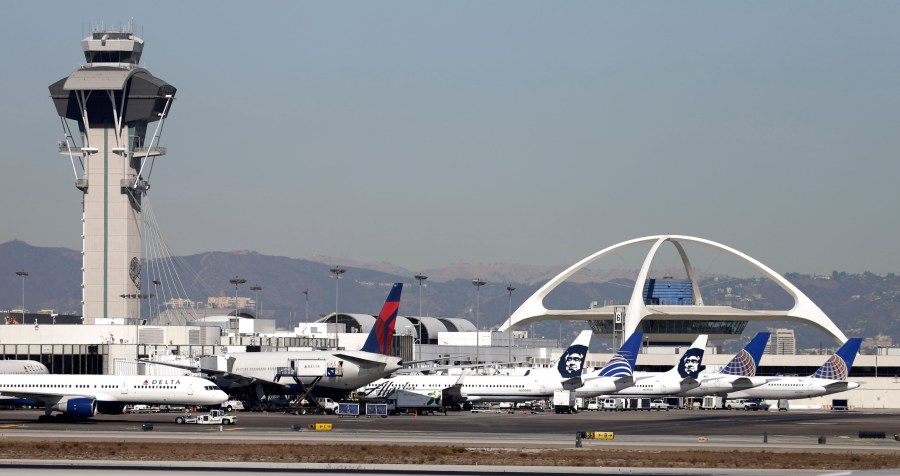
FILE – Airplanes sit on the tarmac at Los Angeles International Airport Friday, Nov. 1, 2013. (AP Photo/Gregory Bull, File)
Long Beach landed at No. 4 nationwide with a decline of around 129,000 passengers, or 10.7%; San Jose was No. 9, down 8.5% or 275,000 fewer passengers.
Hollywood Burbank Airport, a popular local option for a lower-traffic airport, saw a 2% decline, or about 27,250 passengers.
Nationally, both Fort Lauderdale, Florida, and Charlotte, North Carolina have seen passenger declines totaling more than 1 million travelers—Newark, New Jersey isn’t far from hitting that 7-figure total. Chicago Midway International saw a decline of 12.9%, third-worst in the U.S.
What’s the cause?
Perhaps no single issue is more to blame for the decline in airport traffic than a massive reduction in international travel. It’s estimated that more than 1 million foreign travelers have skipped the U.S. this year compared to last.
There are likely multiple factors contributing to the lack of international travel, but many travel experts have identified foreign opinion on the current Trump Administration as a major culprit.
Other factors have also likely played a role in affecting domestic travel, including the ongoing shutdown of the federal government affecting schedules and critical staffing, budget airlines abandoning underperforming routes to cut costs, and lower consumer spending due to inflation and continuing price increases on everyday essentials.
Airports on the rise
While overall travel is down across the board, some airports are seeing moderate increases in passenger traffic.
Knoxville, Tennessee, saw the largest percent-increase of travelers at 13.5%, or about 120,000 more than last year. Washington Dulles International airport in the District of Columbia experienced a 10.9% increase of about 628,000 passengers.

Passengers walk through the international terminal at San Francisco International Airport on March 13, 2015 in San Francisco, California. (Getty Images)
San Francisco International Airport was the biggest mover in California, adding more than 1 million passengers year over year, about an 8.7% increase. Palm Springs International Airport and Sacramento International Airport each saw increases of more than 44,000 and 84,000 travelers, respectively.
Locals Insider says mid-sized airports often see a boost as affordable alternatives to major airport hubs, which is a big plus for “cost-conscious travelers.”
To read more about the study’s methodology, passenger data figures, and additional insight from the publication’s traveler survey, click here.
KTLA 5 reached out to LAX for comment regarding these travel figures but did not receive a response before publishing.
Copyright 2025 Nexstar Media, Inc. All rights reserved. This material may not be published, broadcast, rewritten, or redistributed.
For the latest news, weather, sports, and streaming video, head to KTLA.