
In the latest installment of After Office Hours, Saul Perlmutter recounts his team’s discovery of our universe’s accelerating expansion.
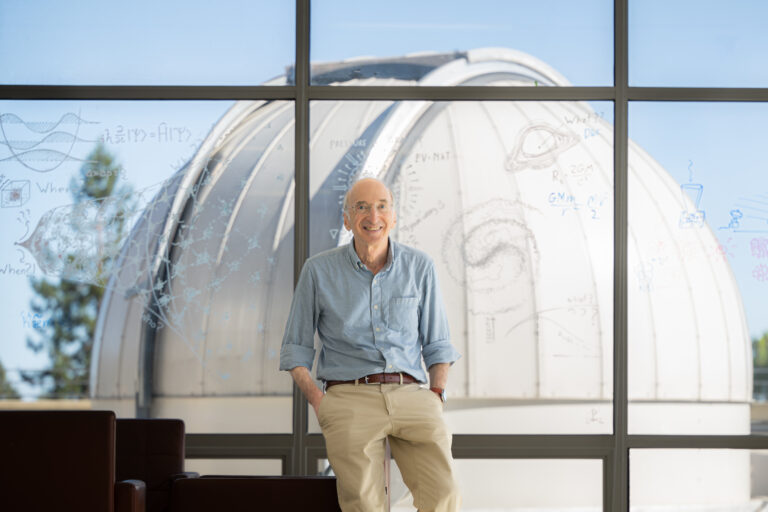
A professor of physics at UC Berkeley and a senior scientist at Lawrence Berkeley National Laboratory, Saul Perlmutter studies our fast-expanding universe. Brandon Sánchez Mejia/UC Berkeley
The universe is full of surprises, and Saul Perlmutter knows that better than most.
A professor of physics at UC Berkeley and a senior scientist at Lawrence Berkeley National Laboratory, Perlmutter had spent years studying the universe at a time when leading theories suggested its expansion was slowing down. But in 1998, he and his team made a startling discovery: The opposite was true, and the expansion was accelerating. That breakthrough led to the realization that the universe is composed of an enigmatic “dark energy.” It also earned him a Nobel Prize in Physics.
Perlmutter is the latest faculty member featured in After Office Hours, a UC Berkeley News series where researchers explain, in their own words, the “aha” moments motivating their work. Perlmutter described the joy of scientific surprises, the importance of rigorous research and why Berkeley remains at the forefront of cosmic discovery.
What was your Fiat Lux moment — the breakthrough or new insight that changed your work?
Our Fiat Lux moment began when my research team graphed the data we had collected from our measurements of vastly distant exploding stars called supernovae and saw something very surprising: The graph indicated that the universe was not slowing down in its expansion as we had expected but instead was speeding up.
Scientists love surprises like this — they are once-in-a-lifetime opportunities to learn something really big about how reality works. After many months of testing and confirming the result in multiple ways, we even started to believe it was likely to be correct. Really, the breakthrough moment took months!
Now the challenge for physicists and cosmologists is to figure out what this “dark energy” that accelerates the expansion is.
What did you get wrong early on — and what did that teach you?
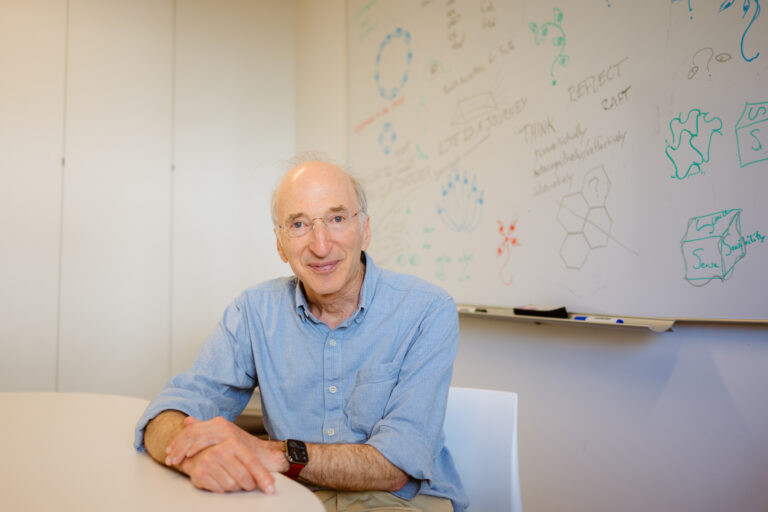
Perlmutter’s interest in teaching scientific-style critical thinking led to a Berkeley course called Sense and Sensibility and Science. Brandon Sánchez Mejia/UC Berekely
I remember when I realized that some early results from my team were affected by what we expected the result to be, apparently because we had hunted down computer bugs or analysis errors until we arrived at a result that we expected — and then stopped without looking for more. And just previously I had been feeling rather smug for having seen evidence of such a problem in a rival team’s analysis!
From then on, we learned to always hide the results from ourselves while debugging any analysis. That “blind analysis” has become a standard in the field — and makes us more open to the possibility of reality surprising us again!
What’s a question in your field that nobody has a good answer to yet?
One of the real excitements of this work is the fact that it’s revealed a key puzzle about reality: Apparently most of the universe is made up of this so-called dark energy and we still don’t know what it is! Sizable parts of physics, astrophysics and cosmology are now devoted to pursuing this question — with an impressive collection of those world-leading efforts happening right here in Berkeley.