
Immigration arrests of Asian Americans and Pacific Islanders in California increased more than tenfold in the first year of President Donald Trump’s second term, according to a new analysis by the USC Equity Research Institute.
The analysis found that AAPI Californians were involved in one of every 10 arrests by U.S. Immigration and Customs Enforcement in 2025. That represented a 1,109% increase from the prior year and was significantly higher than the 386% jump in overall ICE arrests in the state.
The AAPI communities that experienced the largest increases in ICE arrests were from India, China, Vietnam, Armenia and Laos. About 56% of AAPI Californians arrested by ICE had no criminal record, according to the analysis.
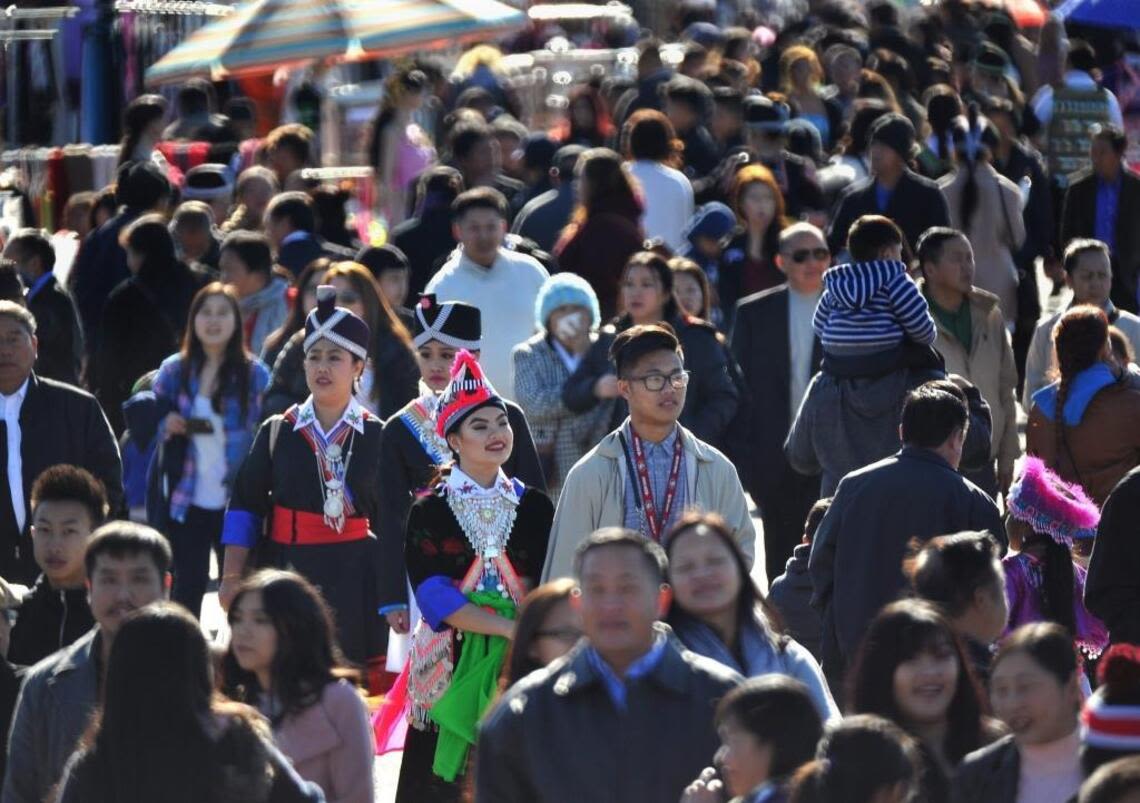
Fresno has a large South and Southeast Asian community, from countries such as India, Cambodia, Vietnam and Laos. It’s also home to the second-largest concentration of Hmong people nationwide, many descendants of U.S. allies during the Vietnam War.
Immigrants in Fresno faced new challenges starting in 2025 as Trump pressured some Southeast Asian countries to receive Hmong and other individuals facing deportation.
Southeast Asian Fresno residents have also been detained at ICE check-ins, where these individuals previously had regular ICE-check-ins in lieu of deportations, advocates and an immigration lawyer told The Bee in October.
“These communities are being impacted in a way that we haven’t seen before,” Tilman Jacobs, an immigrants rights supervising attorney with the Asian Law Caucus, the nation’s oldest Asian American civil rights advocacy group, told The Bee last fall.
Meanwhile, Punjabi American trucking business owners reported their drivers were being “targeted” and discriminated against after a high-profile fatal crash in Florida last August involving a Sikh truck driver.
The analysis was based on individual arrest records between January 2024 and March 2026 reported by ICE and processed through UC Berkeley’s Deportation Data Project.
A separate analysis of Deportation Data Project data by The Bee found that in the first six months of the Trump administration, India and southeast Asian countries including Cambodia, Laos and Vietnam were among the highest represented in deportations from the central San Joaquin Valley region.
Fresno’s AAPI community and Trump administration deportations
During the first Trump administration, the government tried to put pressure on Southeast Asian countries to receive people with deportation orders to those countries. Those efforts ramped up in 2025 during Trump’s second term, Jacobs said.
According to the Asian Law Caucus, Laos doesn’t have a formal repatriation agreement with the U.S., which is a formal agreement between countries that outlines the terms of returning someone to their country of origin. But the Trump administration has pressured Laos to accept deported individuals — including people who were not born in the country and whose parents fled the country — by threatening to withhold business and tourist visas to Lao citizens.
In some cases, Hmong refugees have being deported to countries where they’ve never lived, Fresno community leaders told The Bee.
“A lot of them are refugees or children of these veterans (and) have committed a senseless crime when they were teenagers,” Pao Yang, president and CEO of The Fresno Center previously told The Bee. “And then now you’re sending these children of these veterans that fought with the U.S. back to a country that they were fighting against with you.”
Hmong people are an ethnic group originating from China who have their own language and culture. Hmong have migrated to countries such as Vietnam, Laos, Thailand and Myanmar due to decades of persecution by the Chinese government over their cultural and spiritual practices. In the early 1960s, the CIA recruited Hmong people to help fight against North Vietnam and the communist party in Laos, known as the Pathet Lao.
That operation, also known as The Secret War, lasted from 1962 to 1975. When the Pathet Lao took over Laos’s governance, thousands of Hmong and Laotian people sought refuge in the United States in 1975.
Sacramento Bee Reporter Mathew Miranda contributed to this report.