
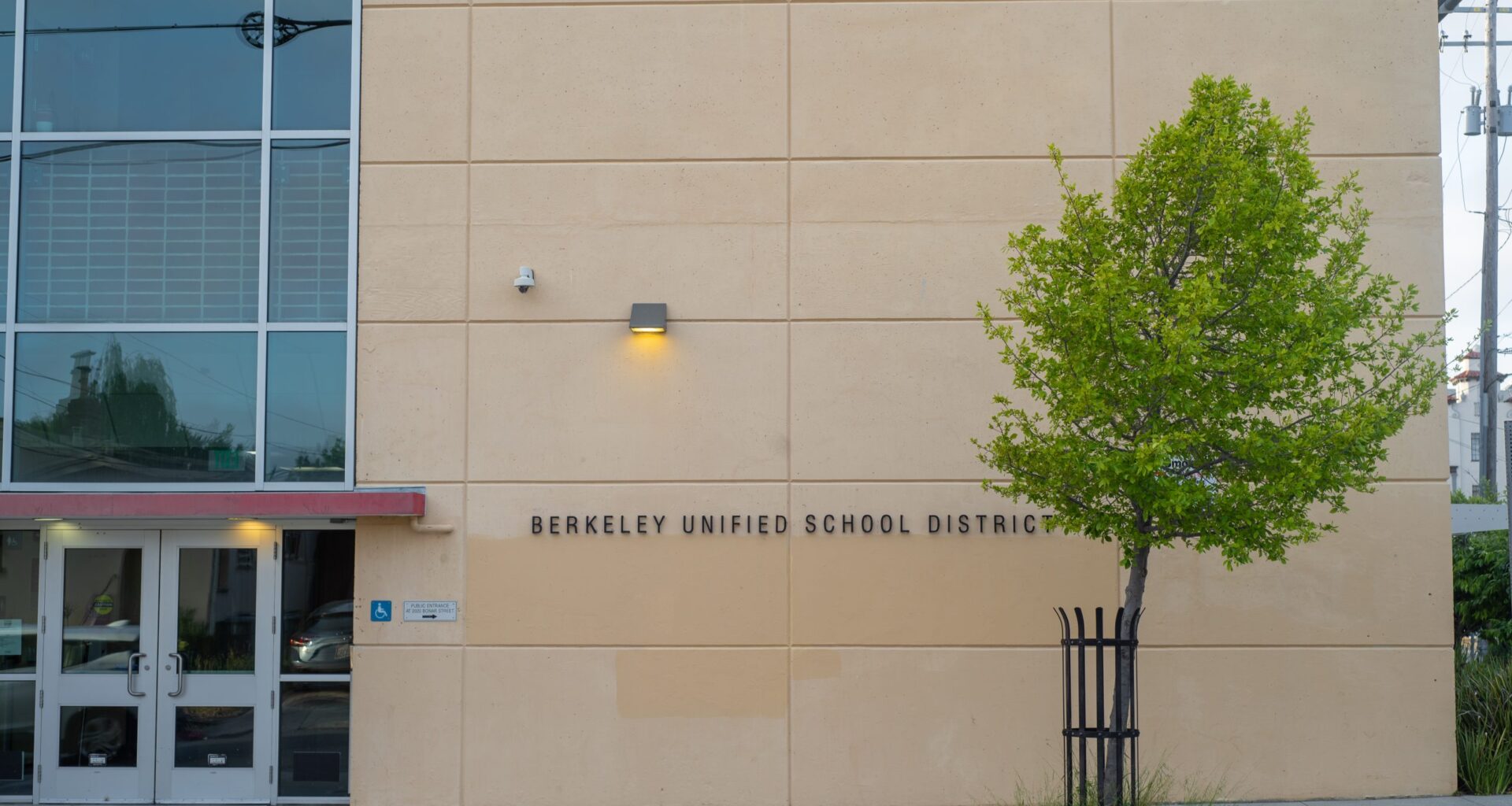
 Berkeley Unified School District office building on 1250 Addison Street in West Berkeley. BUSD has had a vacant seat on its board since former director Ana Vasudeo stepped down on July 1, 2026 Credit: Ximena Natera, Berkeleyside/CatchLight
The Berkeley Unified School District (BUSD) may choose a new board member as soon as Wednesday to fill the seat vacated by Ana Vasudeo, who stepped down on July 1 to join the Alameda County Board of Education.
District officials opted to appoint Vasudeo’s successor, rather than hold a special election. The school board reviewed 22 applications and advanced six who garnered the support of two or more members. The finalists will interview at the Aug. 19 board meeting, with each delivering a two‑minute presentation followed by a five‑minute question‑and‑answer session with board members.
Beatriz Leyva‑Cutler, a former school board director, and Reichi Lee, who ran for the board in 2022 but was narrowly defeated, are among the finalists for the seat. The other applicants are Kevin Gilmore, Scott Hofmeister, Dyamen N. Williams, and Mina Sun.
The school board is expected to vote on Wednesday to fill the vacant seat, with a majority needed. Berkeley voters will have 30 days after the appointment to petition for a special election if they disagree with the board’s decision.
The vacancy has come at a time when the district is navigating multi-year budget deficits, and board members have indicated that they want to return to a full five‑member board quickly. Vasudeo’s successor will hold office for the remainder of her term, which ends in November 2028.
A few board finalists sent in their applications after Berkeleyside had reported that BUSD would not make the materials publicly available. With all of those still in the running now confirmed, we sent each a questionnaire to see where they stand on some of BUSD’s most pressing issues.
The 6 finalists aiming to replace Vasudeo on the BUSD board, at a glance
Gilmore, 63, is a career technical education teacher for the Contra Costa County Office of Education and a former Berkeley Unified substitute. Gilmore teaches at a juvenile hall in Martinez and said he wants to be an active voice for families and educators. He has lived in Berkeley for 52 years.
Hofmeister, 56, is an independent IT consultant and former Kaiser Permanente AI executive who’s lived in Berkeley for 15 years. He is a BUSD parent with two sons who have IEPs and has spent 11 years in various PTA leadership roles. Hofmeister said he would be the board’s only technologist at a time when schools are grappling with their AI and mobile device policies.
Lee, 50, is a children’s attorney and digital‑wellness advocate who founded the tech‑health program Healthfully. A Berkeley resident for 20 years, she has held multiple parent leadership roles in BUSD, including at Rosa Parks Elementary as the school site council chair, and is now Berkeley High’s PTSA president.
Leyva‑Cutler, 70, was a BUSD board member from 2008 to 2020 and previously the executive director of the bilingual early‑childhood nonprofit BAHIA Inc. She has lived in Berkeley for 33 years. In her statements to Berkeleyside, Leyva-Cutler said she knows from experience that academic growth and family engagement in Berkeley Unified need greater attention. If appointed to serve out the remainder of former director Vasudeo’s term, Leyva-Cutler said she would not run for reelection in 2028.
Sun, 44, is a higher-education and nonprofit executive and a UC Berkeley lecturer. She has been a Berkeley resident for 7 years. Due to an earlier reporting error, Berkeleyside had omitted Sun from the initial list of finalists for the open board seat. As a result, and because she received Berkeleyside’s questionnaire days later than the other finalists, Sun declined in an email on Monday to answer the policy-related questions.
“I want to give these important questions the thoughtful consideration they deserve rather than submit rushed responses immediately before the interview (on Wednesday),” she wrote.
Williams, an African American male achievement facilitator at Bret Harte Middle School in Oakland, did not respond to Berkeleyside’s questionnaire or follow-ups by publication time.
We’ll update this article if we receive additional responses by Wednesday.
Here’s where the four finalists who responded to our questions stand on some of the important issues confronting the district.
The growing need for special education services
BUSD has among the largest percent of special needs students in the Bay Area, and these students participate in general education classes — a model called “full inclusion.” This approach is one the district believes in, but it has shown to be more expensive, and BUSD has lately needed to dip into its general fund to cover costs amid staffing shortages and a rise in disability diagnoses of students.
Gilmore stressed legal compliance for special education meetings, plans and evaluations. “We must adhere to all guidelines,” he wrote. “Non-compliance results in costly lawsuits we cannot afford.”
Berkeley Unified settled a civil rights lawsuit in 2021 claiming the district had failed to properly identify and educate students with dyslexia.
Hofmeister, as a parent of two BUSD students with IEPs, said he has seen the benefits of full-inclusion learning as well as its drawbacks. He called for more analysis of how full-inclusion is being implemented in Berkeley schools, and better data on student outcomes. “The delivery model deserves study,” he wrote.
As a children’s attorney, Lee said she’s seen firsthand how hard it is to navigate IEP and 504 programs. “Families should not feel they must fight for what their children need,” she wrote. Lee emphasized trust‑building with families, early assessments, progress monitoring and increased direct funding for special education.
In her statements to Berkeleyside, Leyva‑Cutler called for more timely student assessments and individualized education program (IEP) planning and interventions, as more pre-school children are being identified for special education. She said additional resources are needed to support students who may need smaller class spaces, and for students in full-inclusion classes.
BUSD’s aging facilities
The district has aging buildings with seismic safety needs, and is currently managing several significant modernization projects: The reconstruction of Longfellow Middle School was delayed until summer 2028 after engineers discovered “unforeseen” structural failures at the campus; Sylvia Mendez Elementary has been undergoing a multi‑year modernization project funded by Measure G to update classrooms and improve accessibility, which was scheduled to be completed by the end of this summer; and at Berkeley High, district officials are actively working on plans to add a parking lot and tennis courts after more than 20 years of public discussion.
Gilmore highlighted his background in building and construction, and proposed a career technical education pathway where students would learn about and perform seismic retrofits and repairs for class credit and pay. “I have done seismic retrofits and know what it takes,” he wrote.
Hofmeister said he’d prioritize seismic safety and longer‑term capital planning so that the district wouldn’t find itself “choosing between buildings and people every spring.” He also said BUSD’s “facilities footprint” should match up with student enrollment projections.
Lee said BUSD is already prioritizing safety, modernization and sustainability in its school-site projects. She said she’d emphasize accountability for taxpayers and district families, and prioritize transparency regarding facilities “costs, priorities, impact, budgets, and timing.”
Leyva‑Cutler said she’d support a new facilities master plan and an assessment of the current bond measures funding facilities improvements, to inform possible renewals. She said she’d work with staff, board members and families to identify funding priorities and address “deferred maintenance needs.”
Academic achievement and college readiness in BUSD
BUSD student test scores outpace state averages — over 66% of BUSD students in 2025 met or exceeded standards in math, compared to 37% for all districts in California, for example — but racial gaps in math achievement persist. The district is rolling out a new math curriculum, but some families have voiced concerns about lack of input and transparency.
These conversations in BUSD are taking place at a time of growing debate over SATs and concerns about college preparedness in California. The University of California and California State University systems phased out the use of standardized SAT and ACT scores in their admissions processes in 2020 and 2022, respectively, after a 2019 civil rights lawsuit challenged the use of those tests on the grounds that they are biased against low-income students and students of color. But UC leaders are now actively considering bringing back the SAT admissions requirement, following an open letter urging them to do so that was signed by over 1,400 faculty members.
Gilmore said the SATs are unlikely to return to public college admissions in California, and said teachers should never teach to “culturally biased tests.” He said students need to be taught how to be fiscally responsible and learn math that can be applied to everyday situations.
Hofmeister said grade inflation in high schools has made standardized test scores more relevant in university admissions, and BUSD graduates need to be able to compete. No matter what framework is used, he said, the district should determine if students are fluent in fundamentals instead of “just moved along.” He said he’d want data to show how math pathways in BUSD are preparing students.
Lee said she would bring “urgency” and expertise to issues regarding math, literacy, and technology at BUSD. She said these decisions “will shape whether our students develop the focus, attention, and skills they need to succeed in college and beyond.” She listed strong literacy and math outcomes as her priority, stating that many students lack numerical fluency. Lee said the district should adopt an “evidence-informed curriculum that ensures foundational mastery.”
Leyva‑Cutler said any student who is not meeting math and literacy standards by the second grade should receive targeted resources and support. “As the district implements a new math curriculum, the rollout should reflect best practices, (professional development), and meaningful family engagement across all grade levels,” she wrote.
Budget cuts and financial pressures
BUSD is navigating multi‑year deficits, including a $10.4 million shortfall last school year, and has cut positions and consolidated resources across departments. But with a deficit of over $7 million projected across the 2027-28 and 2028-29 school years, the board’s work is far from over.
Gilmore proposed cutting overtime for all clerical and classified staff, which he said would save the district over $500,000 each year. He would not make cuts to special education and would maintain funding for nutritional services. Gilmore, whose grandmother was a cook at BUSD for over 30 years, said he understands that “these positions are more than a face, they are community members who enhance our children’s school experience.”
Hofmeister said he would cut what the data shows isn’t working and would reduce “administrative overhead before classrooms.” He said he’d protect direct instruction and special education services. He listed multi-year budgeting and facilities planning as priorities, and said board members should not be “picking line items” to cut from the budget, but should instead leave that work to staff.
Lee said she would avoide cuts and reductions for key teachers or school staff, especially those who provide core instruction, curriculum development, and essential student services. She’d instead look to cut where there are duplicative roles and vacancies, and would “rigorously audit” BUSD’s spending on apps, software, and technology to reduce redundancies.
Leyva‑Cutler said that in a budget crunch, she’d advocate for protecting academic and college-readiness supports for the most disadvantaged students, through programs such as Bridge, RISE, and Puente, as well as for staff and resources in the Office of Family Engagement and Equity. Her priorities would include transparently addressing BUSD’s budget deficits with district stakeholders and ensuring that state funds under Proposition 98 are fully allocated.
Access to after-school care in BUSD
Aftercare in BUSD has recently undergone a restructuring amid staffing shortages and high demand. The district has been trying to raise program capacity while also complying with the statewide expansion of transitional kindergarten and stricter staff-to-student ratio requirements. Access to aftercare remains a big issue for working families, especially at elementary sites with chronic waitlists.
Gilmore said BUSD’s communication with partner organizations needs improvement to address access to aftercare.
Hofmeister said aftercare waitlists are “an equity problem.” He said TK expansion and ratio requirements are “real constraints,” but that there are solutions to staffing and scheduling problems. “Reliable elementary after-school care isn’t an extra — it’s what makes school work for working families,” he wrote.
Lee said too many families are still uncertain about their access to aftercare in the wake of BUSD’s recent revamp. “Beloved staff are gone with little explanation,” she wrote. “The Board should require far greater transparency, communication, and family engagement on how families are impacted.”
Leyva‑Cutler urged more coordination between the district, city and private providers, and said BUSD should offer transportation to after‑school sites (the district is not providing transportation to city-operated afterschool program sites this year). She said BUSD needs to pay higher, living wages to aftercare staff and expand their hours to attract workers and reduce turnover.
BUSD English language learner outcomes
BUSD has struggled to improve outcomes for English learners, particularly students who remain classified as long‑term learners. There are about 600 multilingual students in BUSD, with most concentrated in the lower grade levels.
Gilmore proposed holding parent and student literacy classes at BUSD’s Adult School where both groups could receive educational credit.
Hofmeister said BUSD should focus on consistent implementation and “honest” site‑level comparisons to find where learners are best performing and then “spread those practices.”
Lee drew on her own experience as an English learner student, recalling the challenges she experienced while learning to read, write and speak. She said she came to the U.S. in second grade and benefited from “targeted language support and patient teachers.”
Leyva‑Cutler said outcomes for English learners will improve if students are identified early — by third grade if they are not making progress, she said. Additional instructional resources and staffing are also needed to support students, particularly those in high school, she said.
“*” indicates required fields