
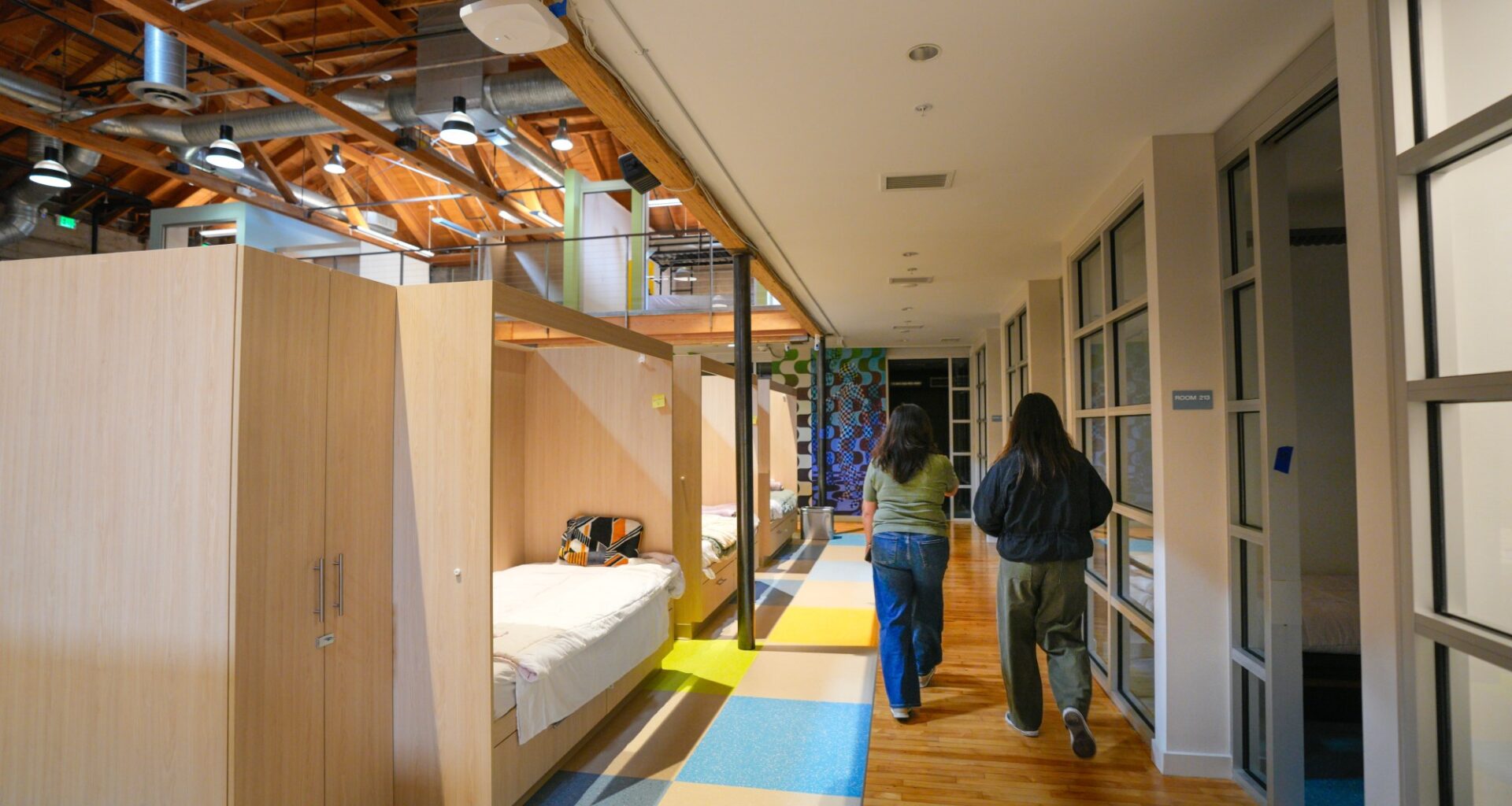
A long delayed expansion of a downtown San Diego shelter for homeless women and children has finished, officially opening in a ceremony attended on Wednesday by Mayor Todd Gloria.
The shelter, Rachel’s Promise for Women and Children, held 50 beds previously. It now houses 210 beds along with a kitchen, dining hall, laundry room, lounge, bathrooms, showers, pet crates and a play area for kids.
“This will surely help more people get off the streets. And not just temporarily, but for good,” Gloria said. “And we’re doing it in a way that I think reflects the class, the pride of this community. It certainly is at a higher standard than what we have traditionally done.”
The new facility inside the shell of the historic Eagle’s Hall building on the 700 block of Eighth Avenue features sleek, modern infrastructure and furnishings.
In the building’s atrium, the floor is filled with bunk beds that are surrounded by private rooms of varied size that can accommodate four to eight people. Some include a stand-alone twin bed for children. Beds and rooms wrap around the atrium in tiers of the three-story building.
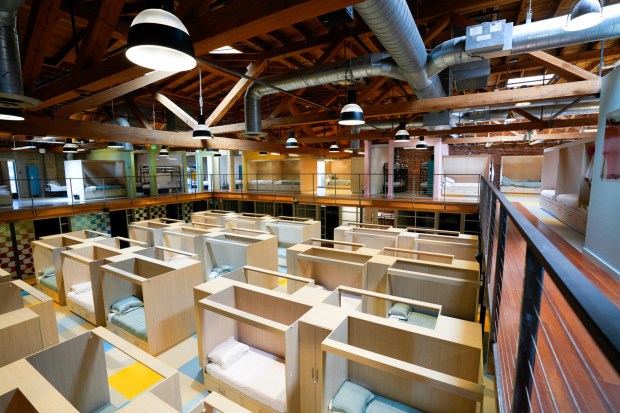 Sleeping pods and family rooms on both the 2nd floor and 3rd floor at Rachel’s Promise Center for Women and Children on Friday, Aug. 14, 2026, in downtown San Diego, CA. (Nelvin C. Cepeda / The San Diego Union-Tribune)
“We wanted to create a model and that’s why there’s so much detail in everything you see,” said Catholic Charities Spokesperson Kimberly Ortiz. “It doesn’t feel like a shelter and it was made to not feel like one.”
Big upgrade
At the official opening the majority of beds were empty; the facility had not expanded to its new capacity as of Friday. Originally, the hope was to have 160 more women and children moved in by Thanksgiving 2025. As of Tuesday, The city’s housing commission did not provide a timeline of when they would move in. A press release stated that would happen this week.
But for those who were in place, the expansion is a big upgrade. For over a year, 50 women slept on bunk beds in an area that’s now a computer/community room decorated with mid-century modern couches and chairs.
Kimberley Edmonds, 53, said she’s been at Rachel’s Promise for almost three months. She became homeless after her mother died and, later, she fled domestic violence. Facing some legal issues and the prospect of having to live on the streets as a vulnerable woman, she called 211 for help.
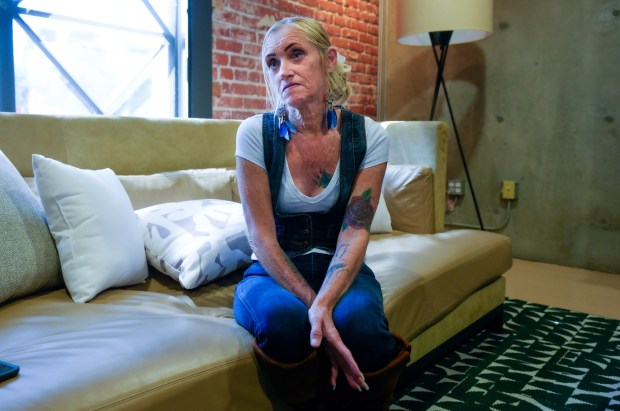 Kimberly Edmonds shares her story about arriving at the Rachel’s Promise Center for Women and Children in downtown San Diego. (Nelvin C. Cepeda / The San Diego Union-Tribune)
Since her arrival at Rachel’s Promise, Edmonds said she got help with her legal obligations, found a job at a National City Ross Dress for Less, sleeps well every night and feels safe for the first time in years. If it was not for Rachel’s Promise, Edmonds said, she’d likely be dead.
“I’d probably be with my mom,” she said. “I promised one of my sons that I’d give it one last shot, trying to get on my feet again. That’s what this is, I actually have a job and I’m going to be human tomorrow.”
Funding cuts
The San Diego Housing Commission unanimously approved the project in February 2025 at a budget of about $5.3 million per year. Those funds go to Catholic Charities to run the shelter’s daily operations. The city still handles the facility’s intake, deciding who will stay there.
Because its funds come from the city, Rachel’s Promise must still adhere to the city’s policy for shelters, which includes allowing pets, removing faith requirement barriers and recognizing anyone that identifies as a woman when considering intake.
The shelter’s new capacity is part of the city’s continued efforts to use a housing-first philosophy towards homelessness. The approach centers on a research-backed approach that housing someone first, even temporarily, can make it easier for them to find jobs, get treatment and permanent shelter.
A debate about housing-first or treatment-first approaches has been ongoing for years, but recently has heated up. On Aug. 12, Health and Human Services Secretary Robert F. Kennedy announced policy guidelines for local officials to prioritize treatment-first programs through faith-based organizations.
It also comes as the city “tightens its belt” when it comes to its budget, Gloria said. In June, the city ended funding for the Neil Good Day Center. The location closed and its services are in limbo until Father Joe’s will absorb them at its campus on 15th and Imperial avenues.
Gloria said that while the city faces budget constraints and bureaucratic hurdles, San Diego is still committed to ending homelessness through a housing-first strategy.
“What we’re doing about building shelter is good but building more housing is even better because that is where people can have a permanent home that they can call their own and end their homelessness forever,” he said.
Historic building
Built in 1917, Eagle Hall’s facade remains but its interior is largely gutted. The outer hull was incorporated into the lobby, which is adorned with local art curated by the building’s co-owner Dene Oliver.
Rachel’s Promise is a public-private partnership between the city of San Diego, local non-profit Catholic Charities and the building’s owners — Jim McMillan and Oliver. The building was most recently the office of their design firm, OliverMcMillan.
The firm still owns the building and collects rent of about $75,000 a month, according to Catholic Charities CEO Vino Pajanor.