
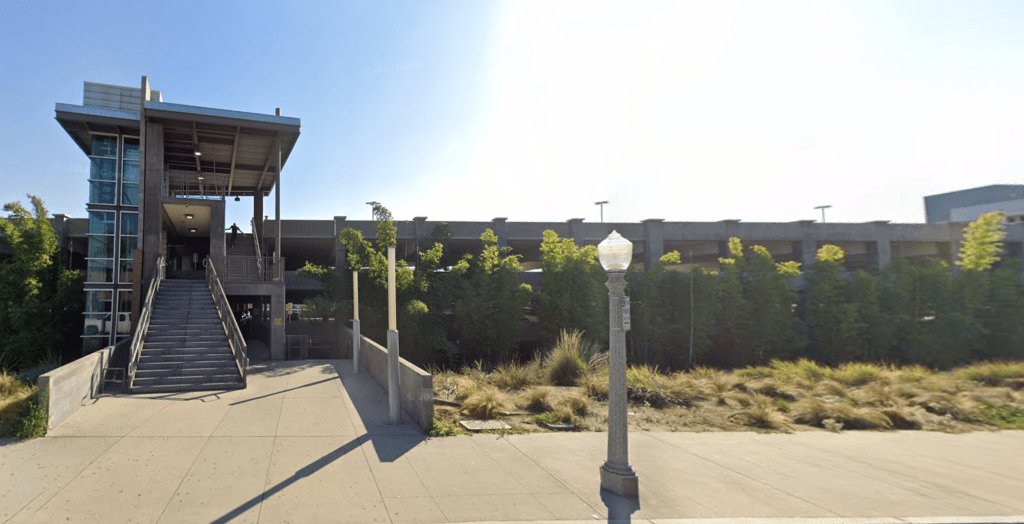
City staff will ask the City Council on Tuesday, August 18, to reallocate a vacant portion of a downtown parking structure lot for housing development. This request follows a consultant’s study that identified the site as the most financially feasible option among five examined. Recently, Meta Housing completed the construction of 1600 Commonwealth (Pointe Common), a 100% affordable housing project on previously city-owned land. Additionally, the Westpark/TA project, which includes both hotel and residential components, involved properties owned by the city and RDA that were sold in the last four years.
The recommendation, contained in an agenda report for the August 18 council meeting, asks the council to receive and file a technical assistance report and to direct the Director of Community and Economic Development to prioritize 118 West Santa Fe Avenue while moving three city-owned sites through due diligence, the Surplus Land Act and developer solicitation “as site readiness, market interest, and staff capacity allow.”
The 118 West Santa Fe site is a vacant portion of the SoCo parking structure lot, roughly 0.45 acres. Conceptual plans prepared for the study envision 60 housing units and 4,500 square feet of ground-floor retail space.
The planning consulting firm Placeworks performed the analysis, funded by a $300,000 Regional Early Action Planning 2.0 grant awarded through the Southern California Association of Governments and the Orange County Council of Governments. The report states there is no impact to the city’s General Fund and that no matching funds were required, though the city had to complete the work and present findings before the grant’s August 30, 2026, deadline.
Staff assembled a list of eight properties — city-owned parking lots and vacant land, along with two church properties and a bank parking lot — that were not already part of the city’s Housing Incentive Overlay Zone. Sites were scored on a rubric that considered geometry, surrounding context, adjacent zoning, topography, existing improvements and parking requirements.
Five sites scored highest and received conceptual plans: 2200 West Orangethorpe Avenue (church property, 36 affordable or senior units), 118 West Santa Fe Avenue (60 units), 122 North Pomona Avenue at the Fullerton Transit Center parking structure (100 units), 401 North Harbor Boulevard on the western portion of a Bank of America parking lot (65 units), and 125 West Chapman Avenue, a city surface lot (105 units).
Three remaining properties — 1601 West Malvern Avenue, 120 East Santa Fe Avenue and a vacant lot at 799 Rollings Hills Drive — also scored well but were not analyzed further because of the grant’s time constraints, according to the report.
Consultants measured each concept against a leverage yield of 8 percent, described in the report as a standard rate for determining whether a project would pencil out for most developers.
The Santa Fe site cleared that bar in every affordability scenario tested, ranging from 9.3 to 9.6 percent. The Pomona Avenue transit center site returned yields between 8.6 and 8.8 percent, and the Harbor Boulevard site between 7.9 and 8.2 percent. The Chapman Avenue lot fell short in each scenario, at 7.6 to 8.0 percent, with the study identifying land value reductions of 11 percent to 26 percent that would be needed to make it feasible.
Plans were drawn using several state housing laws, including Senate Bill 79, Assembly Bill 2097, Senate Bill 4 and California’s density bonus law. The report notes those laws do not guarantee development but reduce hurdles that affect a project’s economics.
The study projects near-term revenue to the city from building permit and park fees — about $87,554 and $721,200, respectively, at the Santa Fe site. The report states the analysis did not account for property tax changes as municipal land converts to private ownership, a shift that could take a couple of years after development.
Any city property directed toward disposition would first go through the Surplus Land Act process, which requires a formal council action declaring the property surplus, a Notice of Availability and good-faith negotiations with qualified entities. Staff could prepare a request for proposals concurrently but could not issue one until noticing and negotiation requirements are complete. Later approvals involving zoning, environmental review or entitlements would return to the Planning Commission or council at noticed public hearings.
The report frames the study as an effort to identify realistic development pathways rather than to advance any specific project, and says advancing underutilized public land could support economic activity in Downtown Fullerton.
The council’s alternatives include approving the staff motion, naming different city properties to prioritize, or directing staff otherwise.
The work stems from the Housing Element the council adopted January 7, 2025, under the sixth cycle of the Regional Housing Needs Assessment, which assigns Fullerton a target of 13,209 housing units. Sunayana Thomas, director of community and economic development, submitted the report, and Planning Manager Chris Schaefer prepared it. The department also held a public workshop on housing development on religious properties on April 30, 2026.
Related
Discover more from Fullerton Observer
Subscribe to get the latest posts sent to your email.