
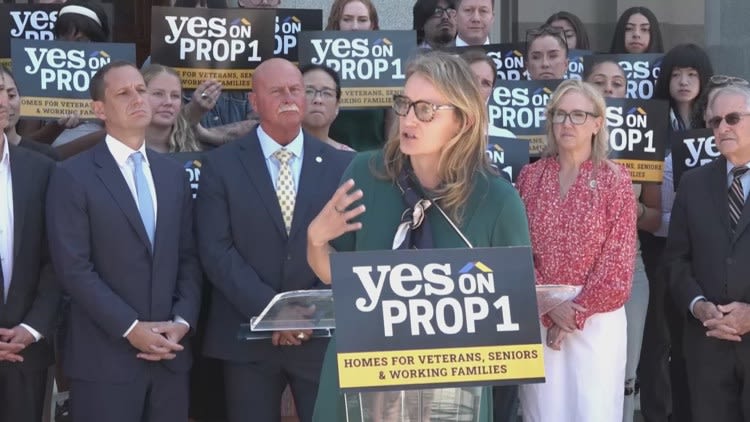
California mayors gathered at the state Capitol to rally for Proposition 1, an $11.25 billion bond aimed at boosting affordable housing and veteran homeownership.
Voters will get the final say on the Veterans and Affordable Housing Bond Act of 2026 in the November general election.
Proposition 1 would authorize $11.25 billion in bonds — $10 billion for affordable housing projects across California and $1.25 billion for veteran homeownership.
“We simply do not have enough housing supply to meet the current or future housing demand,” Fresno Mayor Jerry Dyer said, as Big City Mayors — a coalition of mayors from California’s 13 largest cities, ranging across the political spectrum — on Wednesday rallied in Sacramento for a yes vote on Proposition 1.
San Francisco Mayor Daniel Lurie said local governments cannot meet the state’s housing goals on their own.
“We cannot meet our housing goals with local action alone. That is where Proposition 1 comes in,” Lurie said.
Supporters, including the original bill co-authors, Democratic Assemblymember Buffy Wicks of Oakland and state Sen. Christopher Cabaldon of Yolo, say the state has already worked to make housing easier to build through permitting reform and other changes.
“And we have done so much work in the Legislature of streamlining, making it easier to build, all the permitting reform that we’ve done,” Wicks said.
“We just need to hit the grand slam. That’s what Proposition 1 does,” Cabaldon said.
Supporters say that could help get 40,000 shovel-ready affordable housing units built. They also say many housing projects in California need more funding before construction can begin.
“But a permit alone does not build a house. Projects can be approved and ready to go, but they still face significant funding gaps,” San Diego Mayor Todd Gloria said.
If Proposition 1 passes, the $10 billion affordable housing component would be funded through a general obligation bond. That means taxpayers would repay the borrowed money, plus interest, over several decades.
ABC10 asked leaders how they would justify the additional debt to taxpayers.
Dyer acknowledged that while he generally does not support state bonds, the housing situation has created a need for the investment.
“We’re facing a crisis in our state, and that is a housing crisis,” Dyer said.
The $1.25 billion veteran homeownership portion would be funded through a revenue bond, meaning it would be self-financing as participating veterans in the CalVet Home Loan Program make mortgage payments.
“Those who are serving and those who have come home would love to have a beautiful home. That’s their dream. Well, our dream here in California is to fulfill that,” Democratic state Sen. Bob Archuleta, a veteran himself, said.
But Prop. 1 also faces strong opposition.
The measure advanced through the Legislature and qualified for the ballot despite strong opposition from Republican lawmakers, who argued the state should not take on additional debt in a record revenue year.
“We’re making more money than ever before, and not only are we spending to that, now we’re maxing out the credit card,” Republican state Sen. Tony Strickland said, urging voters to vote no on the proposition. “The initiative would’ve never passed if they didn’t put the one billion for veterans.”
Supporters say Proposition 1 would also help fund farmworker housing, tribal housing and housing for first-time and low-income homebuyers, among other Californians.
Watch more: Funding concerns emerge at 30th annual Lake Tahoe Summit