
Falling wages, not rising prices, drove Republican gains in 2024, according to a working paper by UC Berkeley Haas Professor Francesco Trebbi and Georgetown’s Juan Felipe Riaño.
Once real wage growth is accounted for, counties with higher inflation actually shifted less toward Republicans—a reversal that the authors trace to wealthier, more urbanized counties where prices rose the fastest.
With affordability in the headlines, the same dynamic that helped Republicans in 2024 could potentially work against them now that they’re the incumbent party heading into the 2026 midterms.
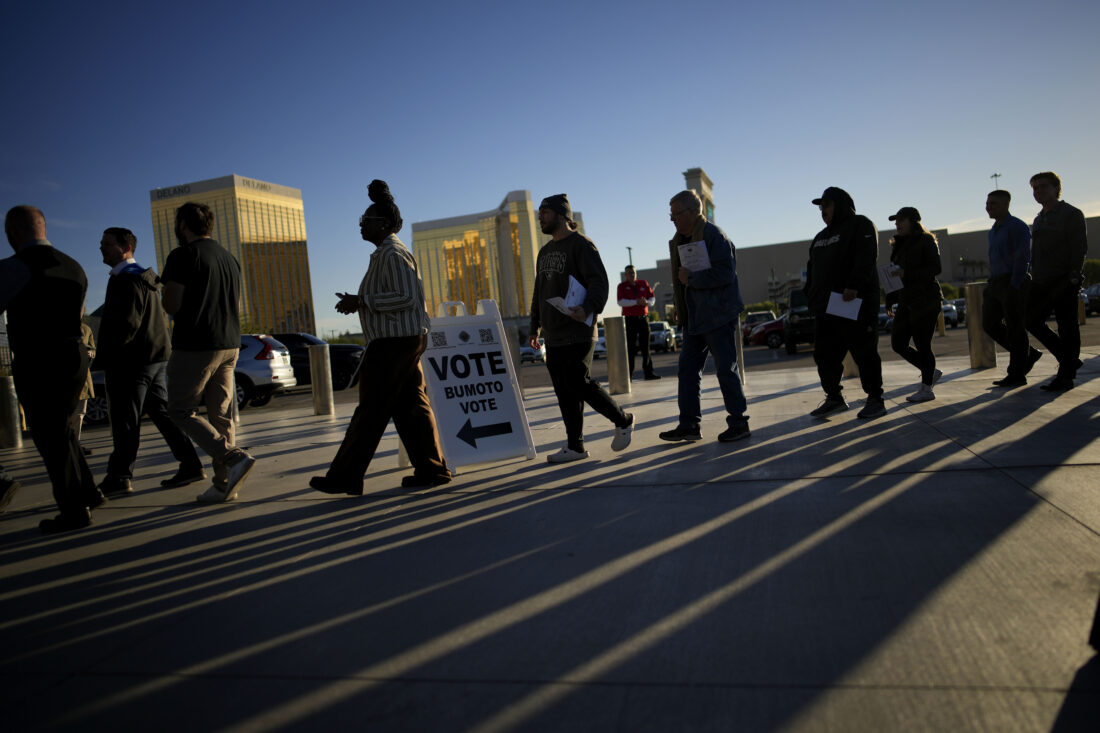 People line up to vote outside Allegiant Stadium in Las Vegas on Nov. 5, 2024 (AP Photo/John Locher).
Voters didn’t punish incumbent politicians for inflation in 2024. They punished them for falling paychecks. That’s the central finding of a new working paper from the National Bureau of Economic Research by Francesco Trebbi, a professor at UC Berkeley’s Haas School of Business, and Juan Felipe Riaño of Georgetown University.
The study, “Do Voters Punish Inflation or Pay Cuts? Inflation and Real Wages in U.S. Elections,” draws on county-level data covering family budget costs, wages, and presidential election results between 2020 and 2024. Trebbi and Riaño found that counties where real wages—adjusted for local cost-of-living increases—fell the most saw the largest shifts toward the Republican ticket. The finding is consistent with the “pocketbook voting” theory of how Americans evaluate incumbents.
“There is the tendency of thinking about US voters as inattentive and sometimes irrational in their electoral choices,” says Trebbi, the B.T. Rocca Jr. Chair in International trade. “In reality, the hard arithmetics of lower purchasing power is always there when voters evaluate an incumbent.”
Surprising inflation result
The paper’s more surprising result concerns the effects of inflation. Once real wage growth was held constant, counties with higher inflation actually shifted less toward Republicans, not more. Trebbi and Riaño attribute this to the fact that, within the same state, the counties experiencing the sharpest price increases also tend to be higher-income, more urbanized places with tighter labor markets. These are the kind of counties that have been trending Democratic for reasons unrelated to the 2021–2024 inflation bump.
The research takes on new relevance this summer. As Republicans and Democrats head into the 2026 midterms, rising mortgage rates and Treasury yields have revived the same affordability debate that shaped the 2024 race. Meanwhile, wage growth has struggled to keep pace with prices.
“In 2026, with the caveat that these are midterm elections and results are much less precise for the House in our analysis, this may mean that the table could turn for Republicans,” Trebbi says. “They are the incumbents now and real wages have been growing at half the pace of real GDP over the last two years.”
Trebbi and Riaño are careful to note that the county-level associations they document describe local economic patterns, not the behavior of individual voters, and the study cannot fully say whether the inflation result reflects who lives in those counties or how individual voters actually respond to rising prices. Still, the core message—that the gap between wages and prices, not inflation alone, is what moves votes—offers data-driven nuance on the most consequential economic issue in recent elections.
Read the full paper:
Do Voters Punish Inflation or Pay Cuts? Inflation and Real Wages in U.S. Elections
By Juan Felipe Riaño & Francesco Trebbi
NBER Working Paper No. 35301, June 2026
Prepared with AI assistance; reviewed and edited by humans.