
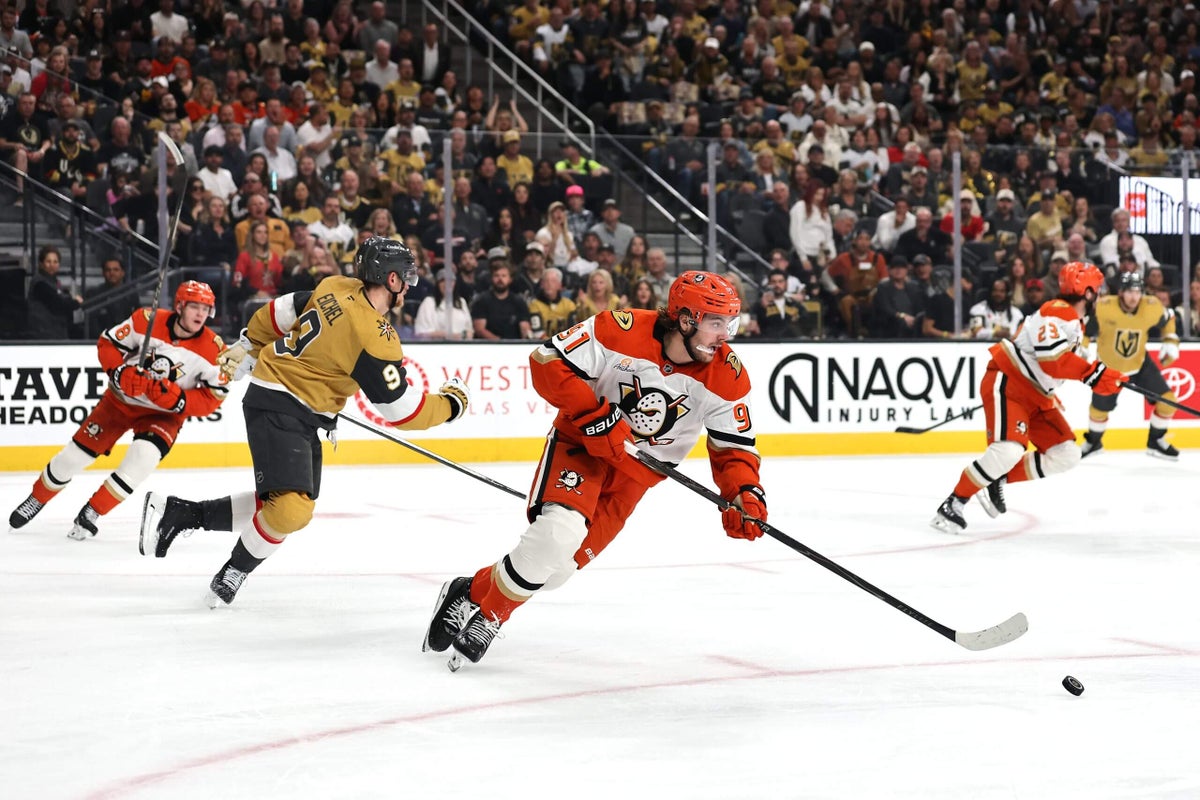
More than 1,300 respondents weighed in as The Athletic surveyed Anaheim Ducks fans on a range of topical issues hovering around the franchise.
It has been a particularly newsworthy offseason for the Ducks. Several questions in the survey pointed to this summer’s developments. But other questions were more on the fun side. All gauged how you felt about those topics.
The Ducks will open their 2026-27 season on Oct. 2 with a road game against the Vegas Golden Knights. Let’s get to how you voted and some analysis on each result.
The splits were fairly even and consistent between two sets of answers – those who feel strongly either way about Pat Verbeek’s work with the Ducks, and those who aren’t as firm in his management to this point and in the future. Many more land somewhere between the extremes, and that may be apropos of the track record for most GMs in the league. In five seasons running the team, Verbeek hasn’t been a savior or a failure.
The Ducks just made the playoffs for the first time under Verbeek. They’ve completely turned over the roster under his tenure and found their first bit of success after emerging from a difficult rebuilding stage. They’ve also dealt away some popular players, and the momentum of a run to the second round was followed by an offseason he might want to forget. Verbeek signed an extension in April and has owner Henry Samueli’s backing. But these results show him teetering toward reaching a tipping point with fans.
In his first season, Joel Quenneville turned his young talent loose and fashioned the most exciting Ducks team in years. Rarely did fans at Honda Center or watching on television felt cheated by their monetary and emotional investment. That came with a price, as Anaheim’s offensive growth was often countered and eclipsed by a wavering commitment to playing stout defense, but it didn’t keep the Ducks from hosting playoff games for the first time since 2018.
How Quenneville fares this season may prove to be a better example of his impact on the franchise than the first-year bounce, but three Stanley Cup championships on his resume and immediate year-over-year improvement only adds more cachet for someone second only to Scotty Bowman on the all-time NHL wins list.
Perhaps there will be a day when Leo Carlsson’s five-year, $90 million contract will be seen as fair compensation if he emerges as a top center, if not a top-10 player in the league. But it could be a long time before fans get past the thought that Verbeek had chances to get an extension done for his 1C at a lower number than $18 million AAV (since surpassed by Macklin Celebrini in his extension with San Jose).
Verbeek took heat last month and nearly half of the respondents place the blame on him as the Ducks matched the offer sheet from the Philadelphia Flyers. But he isn’t the only one involved, and that’s why this question was posed. Flyers GM Daniel Brière came up with the outrageous offer sheet for a player who has yet to break 70 points, and Carlsson signed it.
Let’s not forget Carlsson’s agents, Matt and Ryan Keator, who acknowledged their involvement in thwarting Verbeek’s negotiation efforts to some degree and leaving the door open for Brière to make his audacious play.
Carlsson wants to be a great player. It was evident in how he was eager to take on the challenge of playing his first playoff series against Connor McDavid — and not only thrived with eight points in the six-game victory, but looked dominant at times as a difference-maker. The next round was a tougher assignment against Jack Eichel and a Vegas Golden Knights team that was much more defensively sound than the Edmonton Oilers, but that figures to be another learning experience he’ll carry into his fourth NHL season.
Carlsson exudes an easy confidence when he talks about where he wants to take his game. He said he has dealt with pressure since being the No. 2 pick in the 2023 draft. Most of you will buy into that.
“I’m going to grow as a player, too,” he said in July. “I’ve done that every year so far. Trying to get away from these slumps that I’ve been having, you know, in seasons but try to stay at the highest level I can be all year round. It’s going to be hard, but that’s my goal, too.”
Those 67 points Carlsson scored came in 70 games as he missed 12 after surgery to remove a lesion on his thigh. One could project him having a 80-point total if he plays a full season and scores at last season’s rate. And that number could have been higher if not for a stretch of 10 games in which he recorded only one point – a stretch in which Carlsson said he was playing in pain before getting shut down.
It’s easy to see where a majority have him sitting in the 80 to 89 range for this season, provided he stays healthy. But the voting results are spread out, and it will be fascinating to see how Carlsson performs.
Young restricted free agents who put up numbers in their rookie contracts aren’t waiting to command massive salaries on their second deals. And they don’t have to be generational, as McDavid showed on his entry-level contract. The Ducks witnessed Carlsson barge into eight-figure territory with the unwelcome assist from the Flyers. (It could be argued his AAV was heading there anyway). Now, as they’ve seen what an exploding salary can do for player earning potential, the Ducks are in another major negotiation with their leading goal scorer, Cutter Gauthier.
This will be a consequential contract that will bring more change to the Ducks’ expected roster and affect future deals for their high-impact RFAs down the road. (On deck: Beckett Sennecke.) With players such as Carlsson, Celebrini and Chicago’s Connor Bedard opting for shorter five-year contracts and the possibility of an eight-year max deal disappearing on Sept. 16, it is no wonder that contract term and value for Gauthier’s deal commands a lot of fans’ attention.
Few see Gauthier’s goals total as a one-off. He finished sixth among all players in shots on goal with 285 last season. His shooting percentage was 14.4, below that of Celebrini, Nathan MacKinnon, Kirill Kaprizov, Connor McDavid, Jason Robertson and Tage Thompson. It was a tick better than Alex DeBrincat and Kyle Connor. In other words, Gauthier didn’t have an outrageous level of shooting success and doesn’t make for an obvious candidate to regress. Provided he stays healthy, Gauthier will shoot the puck, and readers have him as a 30-goal lock with a strong feeling that he’ll repeat last season or do better.
Extensions for Carlsson and Pavel Mintyukov, and the specter of how much Gauthier’s contract will cost, have put the Ducks in a cap pickle. Extricating themselves from that before opening night will likely require them to move a roster player with salary. Logical candidates are forwards Chris Kreider ($6.5 million cap hit) and Alex Killorn ($6.25 million). Troy Terry and Mikael Granlund both have a $7 million AAV, but Terry will miss the opening chunk of the schedule as he recovers from hip surgery and Granlund is needed given Anaheim’s lack of a point-producing center behind Carlsson. Terry and Granlund also have modified no-trade clauses in their contracts. So do Killorn and Kreider, but both are in the last year of their deals.
Frank Vatrano ($4.57 million) ranks decisively as the most popular option here. The 32-year-old volume shooter is coming off a nightmarish season in which he was injured and ineffective. His loss wouldn’t be as deeply felt, but with two years left on his contract, there may not be a lot of takers for his contract even in a heightened cap environment.
Most forecast Sennecke to continue his offensive progression after a surprising rookie season that saw him go from a roster hopeful in training camp to an impact rookie who finished third in Calder Trophy voting. The league now knows about the lanky 20-year-old with serious skills around the net and off the rush. This second season will be an intriguing one for Sennecke, who will command a lot more attention from opposing teams. An up-and-down trip through two playoff series provided a teaser into that and how he will adapt.
Save percentage: .870. Goals-against average: 3.54. Goals saved above expected: -5.6.
Those were the numbers Lukáš Dostál put up in his first NHL postseason. The last stat especially illuminated the struggles that stretched across his 12 starts, as his GSAx (as compiled by MoneyPuck) was the worst among all playoff netminders. Layer that on top of a regular season in which his advanced numbers were worse than previous years despite winning 30 games, and one can understand where unease comes from over Dostál joining the ranks of current top netminders.
It’s very true the Ducks haven’t iced structurally strong defensive teams in front of him, but Dostál has also put up better numbers within that environment.
Surveys are interesting in that you don’t want to make them too rigid with only yes-no possibilities for answers, but you also don’t want to make them too fragmented by increasing the gray area with too many options. I’m happy I went with a third option here, with the inference that LaCombe will someday be strongly considered for the Norris even if he never walks away with the trophy.
His star turn against the Oilers opened a multitude of eyes and leads you to believe he’s only scratching the surface of his all-around prowess. But the Norris is tough to win. Just ask Miro Heiskanen.
Speaking of LaCombe, this vote reflects growing sentiment that he should wear the “C.” It would be the second straight time a defenseman has captained Anaheim after Radko Gudas held the role for the last two seasons. LaCombe may arguably be their best player right now and is articulate without stirring up any shred of controversy. Is he a leader off the ice?
Terry has been a willing spokesman and carries importance with his play. But should the Ducks show Carlsson they want him to be their long-term face? (I’ll use this spot to say I’ve thought Terry would be a natural choice. I also thought Cam Fowler would succeed Ryan Getzlaf and Mason McTavish could one day follow Fowler. Oops.)
Not only was Nikita Klepov selected with the No. 15 pick in this year’s draft, but Verbeek traded McTavish with the eye on grabbing the winger, who models his game after Tampa Bay Lightning superstar Nikita Kucherov. Klepov also decided to forgo the college route and turn pro.
Tristan Luneau has basically been gifted a spot on the defense by Verbeek, and Stian Solberg may join him on the Ducks at some point this season. But it’s Roger McQueen, the 6-foot-5 center, who’s clearly captured your fancy here. Especially if he sticks with No. 95. Ka-chow!
The optimism from last season’s breakthrough under Quenneville isn’t carrying over into the start of next season. While the Ducks met their self-imposed mandate to make the playoffs, not many of you who see them building on it. Is it because of losing too many contributors from last season? Is it the fallout of l’affaire Carlsson? Is it that they took advantage of a weak Pacific Division whose issue-laden contenders were merely trying to survive the 82-game schedule? We can spin it as 63 percent seeing a return to the playoffs, so there’s that.
Only one of 32 teams can hoist the Stanley Cup. The odds could soon grow longer when the NHL expands. Some obviously have far better odds than others. But the Carolina Hurricanes won their second championship 20 years after their first. Anaheim is coming up on the 20th anniversary of its lone title. I’m no numerologist, I just play one in this space.
Judging by the responses to this question, the Ducks’ marketing strategy appears to be a success. The fan base isn’t made up entirely of those who originate from Orange County or reside there, but it’s a region that does celebrate being its own entity within Southern California. Identifying the Ducks as the O.C.’s NHL club and the team fully embracing its locale — unlike the nearby Major League Baseball outfit — is nurturing a stronger bond between the club and its supporters.
By my count (well, with help from the NHLuniforms website), the Ducks have had 19 different jerseys in their history. Home, road, alternates, special events. As I noted earlier, having too many options in a survey dilutes it, so I focused on the original sets, what they’re wearing now and grouped the others into two choices. The sweaters where they’ve had the most success in fit under the “any other jersey” and while this wasn’t meant to disregard them, this vote proved there isn’t a lot of love for what they wore between 2006 and 2024.
Originally, I thought to just go with the colored jerseys as choices but I’m glad I singled out the white sweater. That’s reflected in a sizable percentage preferring what the Ducks wore at home in their early years and their current road jersey after the NHL switched to having teams wear white away from home. People still love eggplant and jade — it’d be great if they dedicated one home game a year to wearing their popular initial colors — but they aren’t every Ducks fan’s favorite.