
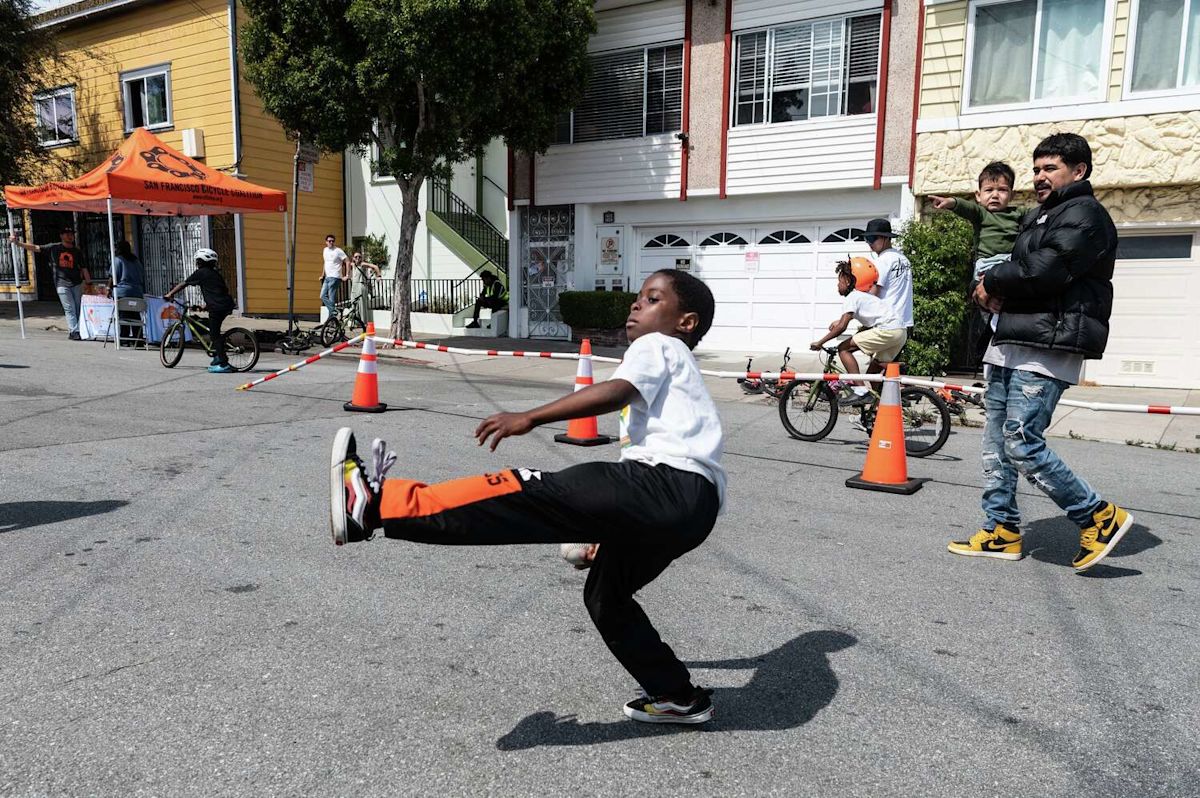
The first rule of Sunday Streets is “playing in the streets is strictly encouraged,” so Hanyu Zhao, 9, tested it by tearing through his front door on Lane Street in Bayview and running directly across the street without looking both ways before disappearing in his friend’s backyard. His little brother Hanson, 3, followed him step by step and didn’t look both ways either.
“There’s no cars,” Hanyu said. “We can run around and burn some calories.”
Sunday Streets is more than a place to run. For 18 years it has provided a roving festival of bands, booths, food, and front stoop camaraderie in parts of San Francisco that don’t normally get summer block parties, but this year it came perilously close to not happening at all.
In February, the city’s health department pulled its annual $215,000 grant, which is the entire budget for the program offered by Livable City, a nonprofit vehicle for community engagement. But that one grant was made up for by piecemeal donations in the sum of $150,000. The summer program was cut in half, from eight block parties to four, and the Livable City staff cut in half as well. But Sunday Streets is out there once a month in the summer, and after hitting the Tenderloin in June and the Mission in July, it came to Bayview on a hot Sunday with vendors and community action booths set up on two blocks of Lane, just a short block off the roar of Third Street.

Families check out booths along Lane Street during Sunday Streets in San Francisco’s Bayview neighborhood. Sunday Streets returns to the Excelsior in October to close out the season. (Pablo Unzueta/For the S.F. Chronicle)
“Sunday Streets provide a car-free environment for residents of a community to meet on the street and support small businesses, music and local food and wine,” explained Barbara Gratta, owner of a winery, lounge and cafe/market at the corner of Third Street and Van Dyke Avenue. All the buildings on this block have frontage on Third, with the T-Third streetcar pulling up at the Williams stop. They also back onto Lane Street, which allowed Gratta to come out from behind the wine bar, go out her Dutch door in back, step onto the stage in the street and introduce the all-woman band Salsa Y Sol.
Ten steps later, she was back inside.
“The Bayview community is celebrating the fact that Sunday Streets was able to return,” said Gratta, who collaborated on the event after bringing in the financial support of the Civic Space Foundation. “It brings activation and foot traffic to the streets, which in turn builds community.”

Sunday Streets vendor Barbara Gratta, 65, has operated Gratta Wines in Bayview for more than a decade. (Pablo Unzueta/For the S.F. Chronicle)
The community Sunday was enhanced by a partnership with the African American Arts & Cultural District. The two organizations combined forces, which allowed the party to expand onto Armstrong Street and set up a zigzag of attractions that encompassed Bayview K.C. Jones Park and Martin Luther King Pool, which has been closed Sundays since COVID-19. But it was open this Sunday, when sunny 75-degree weather added to the effect.
“It is a hot day, and we are happy the recreation and park department agreed to open the pool,” said Patricia Barraza, director of partnerships for Livable City.
Barraza said she’d recruited more partnerships for this event than she could count, but none would qualify as a main funder. Eighty organizations were involved.
“It took a lot of door knocking,” she said.
To the people walking the street, there was no noticeable devaluation in the experience.

Children ride their bikes during Sunday Streets in San Francisco’s Bayview neighborhood. (Pablo Unzueta/For the S.F. Chronicle)
“This is the best Sunday Streets that we’ve had in the Bayview in years,” said Claudia Anderson, a 36-year Bayview resident who has been to all of them. She had entered through the back of Gratta Wines, where she could still hear the live music through the Dutch door.
We’re the most ethnically diverse community in San Francisco, so this has a little something for everyone,” Anderson said.
That included Cub Scout Troop 88 and Bayview United, an all-girls soccer club that has won four city championships and was out kicking the ball around in the street, luckily at the opposite end as the roller skaters.
“We’re here to let the community know this is a free soccer club. This is not pay to play,” said Marsanne Weese, a parent minding the Bayview United information booth. She said she was able to recruit 10 interested players, which is just one short of a side.

Karla Perissinotto, 48, and her daughter, Gianna, 6, step on grapes while barefoot at the Gratta Wines booth during Sunday Streets in San Francisco’s Bayview neighborhood. Only four Sunday Streets were held this summer, supported by private donations after the city withdrew its funding. (Pablo Unzueta/For the S.F. Chronicle)
Also recruiting was Gratta Wines, which had two oak barrels set out for grape stomping.
“Squishy” was the description offered by Gianna Felciano, 10, after finishing work. “Squishier than the bouncy house.”
Diane Sawyer has been selling custom jewelry at Sunday Streets since her son, Jamal Beasley, 21, was slain in Hunters Point in 2008. She calls her designs Jamal’s Jewelry, and she had a good location next to the stage
“I grew up in the Bayview, but I don’t live here anymore,” she said. “I come out and see people I haven’t seen for years.”

Diane Sawyer, 66, fixes a handmade bracelet for a customer at her booth during Sunday Streets in San Francisco’s Bayview neighborhood. Sawyer was inspired to start her business after her son was slain in the neighborhood 18 years ago. “This is therapeutic for me. It helps heal my spirit and well-being,” Sawyer said. “And a lot of praying and therapy.” (Pablo Unzueta/For the S.F. Chronicle)
Of the 13 certified cultural districts in the city, Bayview is the largest, all inclusive in area code 94124.
A chalk mural was underway to show all the various sides of the old neighborhood along Third Street.
“The Bayview is a cultural hub for all of San Francisco,” said Keri Bolding, who was working the booth representing the African American Arts & Cultural District. “This event is about opening up the streets to celebrate our culture.”
Allen Zhao, father of Hanyu and Hanson, was just happy his kids could run free for the entire two blocks of Lane Street.
“It’s very good for the kids,” he said. “It’s safe, and they are not home playing with their phones.”
The last Sunday Streets of the season is Oct. 18 in the Excelsior.
“It took a lot of neighbors and people who love Sunday Streets to make it happen,” Barraza said.
Subscribe
There’s more to San Francisco with the Chronicle. Subscribe today for just 25¢.
This article originally published at Sunday Streets pulls off a major party in the ‘cultural hub’ of S.F. without city support.