
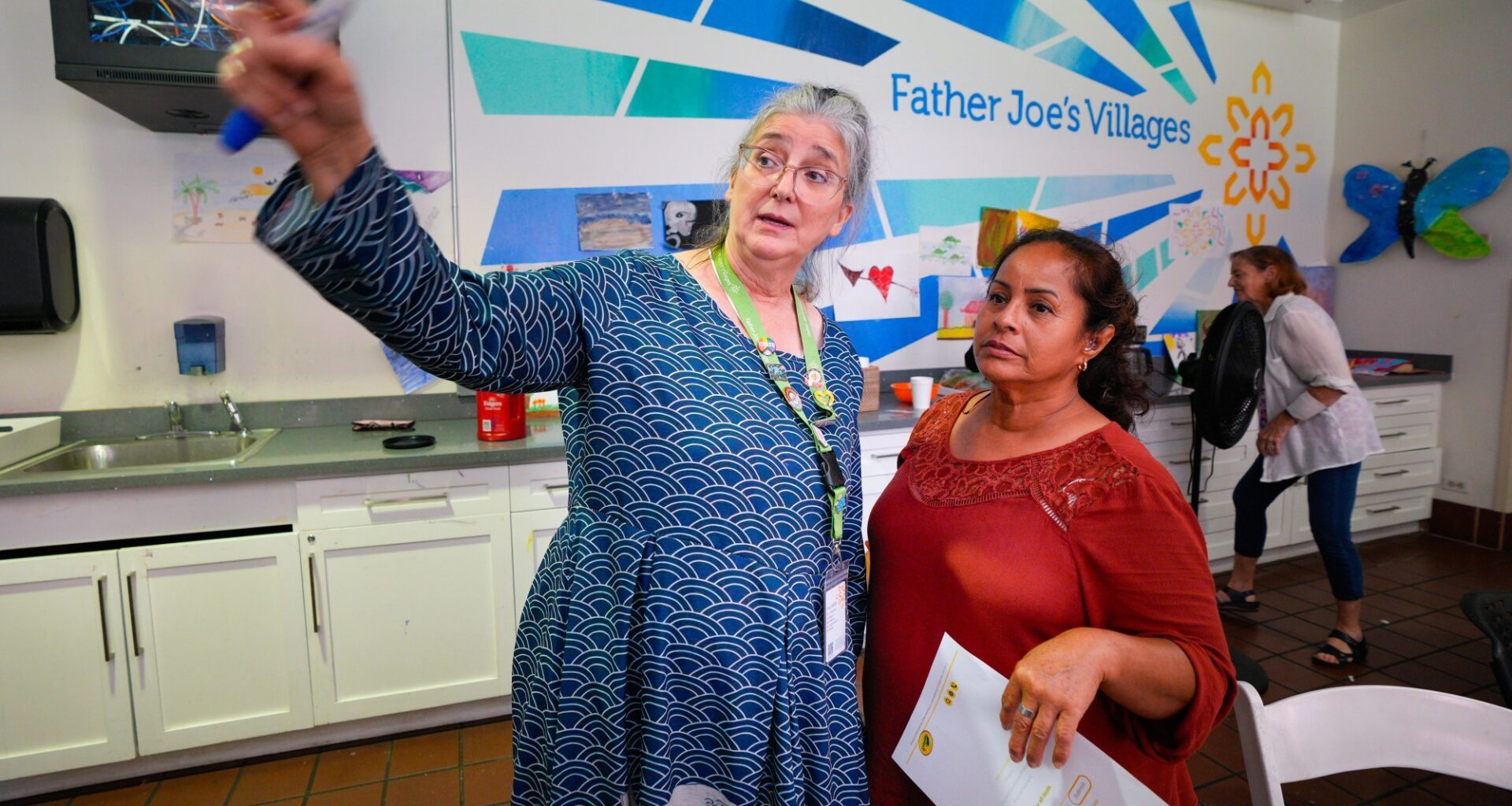
Aleta Barthell stood in front of her class of 12 inside the community room of Father Joe’s St. Vincent De Paul Village on Monday and led them through one of the day’s lessons.
Barthell’s class, which started three years ago, is made entirely of either homeless or recently homeless people and meets every Monday afternoon. One of the activities for this week’s class was a three-minute free-write based on the word “brilliant.” For student Elisa Arenas, 65, this word represented something that she said once saved her life.
“Brilliant is the light so bright, so illuminating, that I see when I had just had a conversation with my lord,” Arenas said aloud to the class. “I was about to meet my maker. Then, it was when I saw that brilliant light.”
Arenas said that as she was escaping an abusive partner many years ago, she fled his van into the freezing-cold night of Shreveport, Louisiana, in the winter. The dome light of a car, left on because its door was ajar, allowed her to take refuge in it until warmer temperatures came, she said.
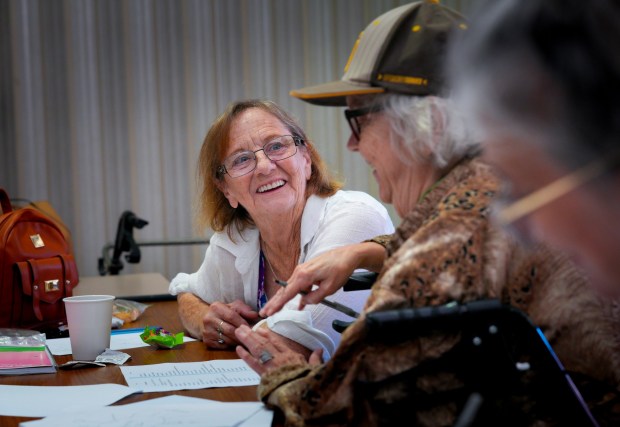 Susan Strauel (left) and Laura Morgan interact during a writing workshop at Father Joe’s Villages. (Nelvin C. Cepeda / The San Diego Union-Tribune)
Barthell’s class began in 2023 through a grant from the non-profit organization California Humanities. The grant allowed for two workshops with another non-profit, Playwrights Project, which allowed the writing of her students to be performed by professional actors.
The class was brought back as a weekly activity and expanded to teach fiction, poetry and even songwriting. The latter involved a collaboration with the San Diego Opera earlier this year, according to Barthell.
After graduating from Northwestern University’s school of theater, Barthell worked professionally as a stage actor in London before returning to the United States. She is not paid to teach the class and works on a volunteer basis.
“I’ve gone through really hard times and, kind of like what (my students) are talking about, that ability to have a place to put it — it really saved me,” Barthell said. “I just want to share that.”
Barthell said many question why teaching the arts to people experiencing homelessness is worth any time or money at all. But she’s adamant that many homeless people have never been in a collaborative, creative environment before.
Laura Morgan, one of Barthell’s students, said she’s been housed for over a decade but was in and out of shelters before that. Morgan first became homeless through a divorce in 1988 but soon after was able to get Section Eight housing. She lived there for 14 years, until she lost that and became homeless again, she said.
Morgan said about writing, “It just all comes out and then things that come out of me are things that I never expected to come out of me ever — secrets.”
For both its students and its instructor, the creative writing class appears to offer a rare cathartic experience. By looking within themselves and expressing outwardly, they’re able to identify, and sometimes overcome, the personal and systemic challenges of homelessness.
“I feel that the arts breeds curiosity and I feel that curiosity breeds compassion and caring for one another,” said Barthell. “I hope that as a community we can support that, the arts are a very positive way to bring people together and we need it…so much.”