
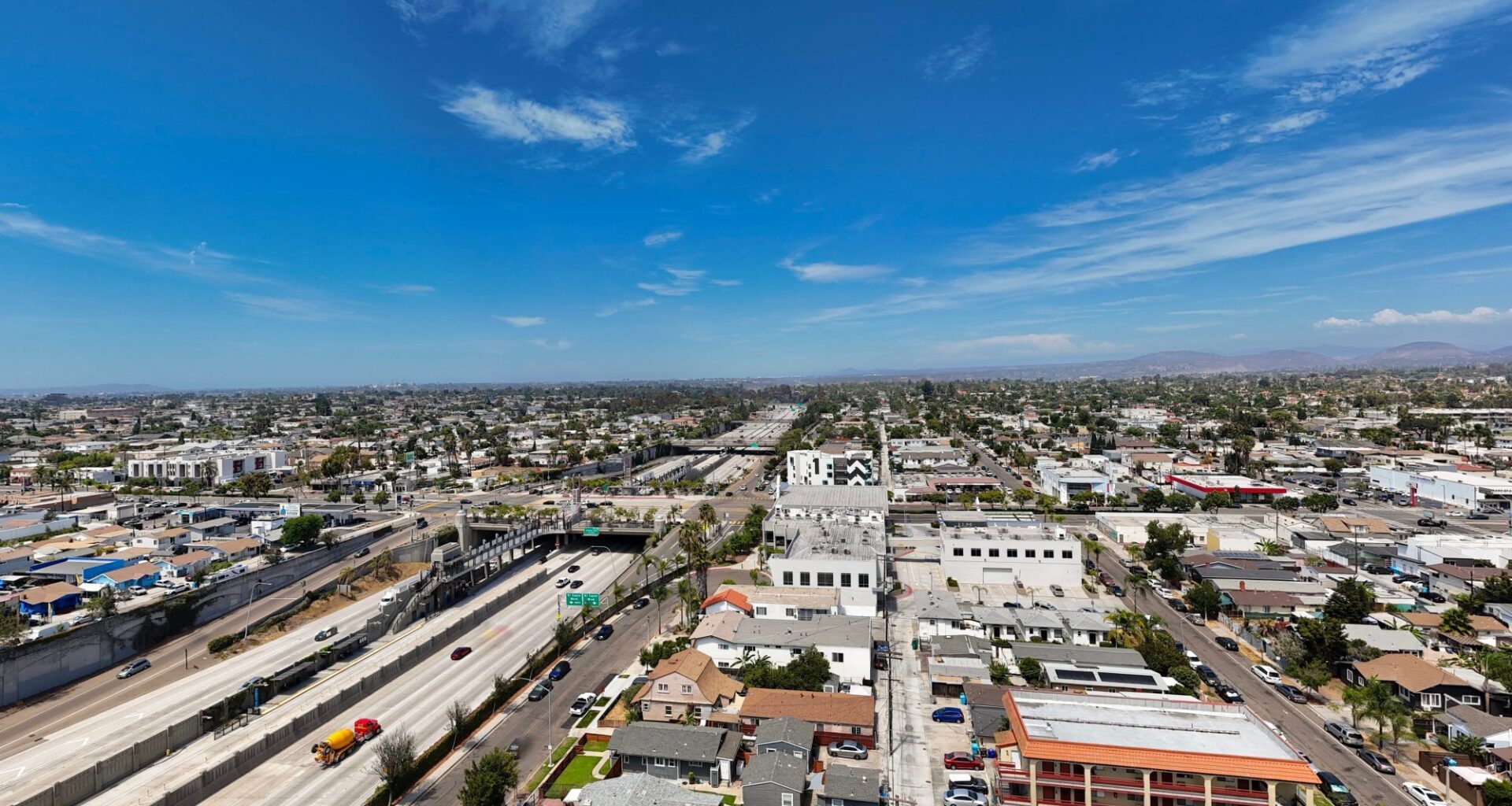
Many of San Diego’s eastern suburbs would undergo a housing and population boom in a newly proposed 30-year vision for an 8,000-acre swath of the city that San Diego officials call Mid-City.
The new proposed development blueprint for City Heights, Normal Heights, Kensington, Talmadge, Rolando and some nearby areas could boost the number of homes from 54,000 to 96,000 and the total population from 138,000 to 227,000.
The plan, which city officials hope to finalize next spring, would bring high-rise and mid-rise housing to much of El Cajon Boulevard, Fairmount Avenue, Federal Boulevard, University Avenue and nearby streets.
Other areas — Adams Avenue, Euclid Avenue and College Grove Drive — would also see more dense housing, but the changes would be somewhat less dramatic.
Areas of single-family homes that are not near major streets would also see changes, because the plan would allow a wider range of housing types there, including townhomes, cottages and other options that allow for greater density than a typical single-family home.
Some community leaders in the affected neighborhoods are criticizing the proposal, saying it wouldn’t provide enough additional park space, expanded libraries or other amenities to support so many more people.
Those leaders also say it’s wrong to combine such a varied group of neighborhoods together in the same development blueprint and that the priorities and cultural makeup of those areas need varied solutions.
City officials say the 159-page proposal would add nine new traditional parks and 24 smaller pocket parks to the Mid-City area, and that library branches in Oak Park and Kensington could get expanded or replaced.
But neighborhood leaders stress that all parts of the sprawling Mid-City area would still have significantly less park space per person than city guidelines call for.
They also note that the only binding part of the new plan would be the zoning changes that increase density. They characterize the other components of the plan as a wish list of ideas that they expect wouldn’t come to fruition without funding.
City officials said they welcome such feedback as the plan progresses. A revised version is slated for release later this year.
“San Diego needs more homes people can afford, and Mid-City is an important part of meeting that need,” Mayor Todd Gloria said. “I encourage Mid-City residents to review the draft, make their voices heard and help us get this right.”
But David Moty, chair of the Kensington-Talmadge Community Planning Group, said the city has essentially ignored more than two years of input from community leaders since the process of updating the area’s development blueprint was launched.
“As a community we were allowed to speak, but the Planning Department never intended to listen,” Moty said.
Heidi Vonblum, the city’s planning director, painted a different picture.
“The first draft of the Mid-City Communities Plan Update is the result of years of collaboration with community members, local businesses and community organizations to create a shared vision for Mid-City’s future,” she said. “This is an important step, but it is not the final step. We encourage everyone who lives, works or spends time in Mid-City to review the draft, share their feedback and continue helping shape a plan that reflects the community’s priorities for generations to come.”
The plan envisions mixed-use corridors with high-rise housing above ground-floor retail and new neighborhood gathering spaces to make many areas of Mid-City more active and inviting.
It also calls for new transit villages near rapid bus lines, such as Route 211 planned for Adams Avenue, and around two Mid-City stops on the proposed future Purple Line of the trolley: Euclid Avenue and Dwight Street/43rd Street.
The Purple Line, which could be built as soon as 2035 or 2040, would travel through Mid-City along the path of Interstate 805 from San Ysidro to Sorrento Valley.
The kind of upzoning and dense housing envisioned for Mid-City is similar to new development blueprints San Diego has adopted for other neighborhoods in recent years — including University City, Hillcrest, Mira Mesa, Kearny Mesa, Mission Valley and the Midway District near the city’s sports arena.
Vonblum says those plans and this one must include a wide variety of possible locations for high-rise housing to give developers choices. She also says the zoning must allow enough units of housing to make projects profitable.
She and other city officials stress that it’s unlikely developers will build all 42,000 additional housing units the new blueprint would allow, estimating that roughly 30,000 new units would be built in Mid-City.
Community leaders say the new proposal is in stark contrast to the last new development blueprint for the area, which the City Council approved in 1998.
That plan actually reduced housing densities in some areas and helped shrink the population of Mid-City from 146,000 in 2000 to 135,000 in 2024.
Lynn Edwards — a neighborhood leader for Rolando, El Cerrito and other communities that make up what San Diego calls the city’s Eastern Area — blames the 1998 plan for the lack of development there.
She said the lack of ambition and vision in that plan 28 years ago caused the Eastern Area — which also includes Oak Park, Webster and Redwood Village — to atrophy instead of prosper.
A lot has changed since then, said Paul Coogan, chair of the Normal Heights Planning Group. The impact of Amazon on retail has reduced how much brick-and-mortar retail space neighborhoods need, and ride-hailing services like Uber have changed mobility options.
The new proposal would bring dramatic changes to Normal Heights, Coogan added. “It’s a seismic shift,” he said.
He said his neighbors are OK with boosting housing density, especially on major roads like El Cajon Boulevard. But he said more parks and amenities are needed, calling the plan “underwhelming” in that regard.
“We’ve been behind on infrastructure, amenities and economic development since the 1998 plan, and this plan is worse,” Coogan said. “These are the things you need when people are going to be living cheek to jowl.”
Edwards agreed with Coogan that it makes more sense for neighborhood leaders to fight for amenities than to resist the added density the city is proposing.
“I don’t know a planning group that’s won a battle with the city over density,” she said.
But the plan is getting a different reception in Kensington and Talmadge, where many residents want to preserve the historic charm of the neighborhoods.
Moty said the city’s proposal should place high-rise and mid-rise housing far enough from historic areas to avoid damaging the ambience — but it doesn’t.
“The draft plan’s purpose seems to be about aggressively destroying as many historic resources as it can in the Kensington and Talmadge neighborhoods,” Moty said. “It takes particular aim at wiping out the city’s best collection of remaining modest-sized Spanish Colonial Revival homes and cottages in southern Kensington.”
While a new state law, SB 79, requires the city to allow dense housing in some parts of Kensington and Talmadge because of nearby rapid bus lines, Moty said the city could take advantage of an element of the law that allows the city to move such dense housing to another, nearby place.
Moty said he requested that at public workshops and in emails to the city, but it hasn’t happened.
He said the city had also disregarded his request to zone the west side of Euclid Avenue near Monroe Street as neighborhood-serving commercial. His goal was to allow for coffee houses and other gathering places on a quieter street than El Cajon Boulevard, but he said city officials ignored his idea.
But the area of Mid-City that stands in sharpest contrast to the rest might be City Heights.
San Diego’s most ethnically diverse community, City Heights is a place where residents speak as many as 57 different languages with roughly 100 dialects. The area is also home to many new immigrants, as well as to an unusually high percentage of residents who don’t own a car.
“City Heights is very different than Normal Heights — different needs and a different cultural makeup,” Coogan said.
Community leaders in City Heights are calling the new proposal a major opportunity.
“This update is a chance to correct course after more than 25 years of a plan that hasn’t kept pace with our community’s needs,” said Alexis Villanueva, chief executive of the City Heights Community Development Corporation. “We’re hopeful it can support the kind of growth and investment our neighborhood deserves.”
Incomes are also lower in City Heights, the Eastern Area and Normal Heights than in wealthier Kensington and Talmadge.
“The city continues to try to lump many unique planning areas together,” Edwards said. “It feels like we’re being shoehorned into something.”
The city lumped the Mid-City area together in the 1960s before it began neighborhood zoning on a smaller scale. The area was later divided into four separate community planning groups in the 1980s.
The overall Mid-City area is northeast of downtown, east of North Park, south of Mission Valley and west of La Mesa. It is bounded on the south in many places by state Route 94.
Most of the area was developed roughly a century ago as part of the city’s streetcar network. City Heights and parts of Kensington and Talmadge were part of a separate city called East San Diego that was annexed in 1923.
For years, much of the area was shaped by redlining, where banks’ discriminatory lending practices led to racist restrictions on where people of color could live.
As a mostly non-White area, Mid-City for years was denied amenities like parks — leaving it behind other neighborhoods in a problem city leaders still haven’t solved.
Mid-City is represented on the City Council by Sean Elo-Rivera, who lives in Kensington.
“This first draft reflects years of community input and is an important step toward more housing choices, safer ways to get around, and the cleaner air, parks, libraries and public spaces our neighborhoods deserve,” Elo-Rivera said.
“As this process moves forward, growth must be aimed at creating a healthier community where San Diegans can see a future for themselves and the people they love. I encourage the community to review the draft and keep making their voices heard.”