
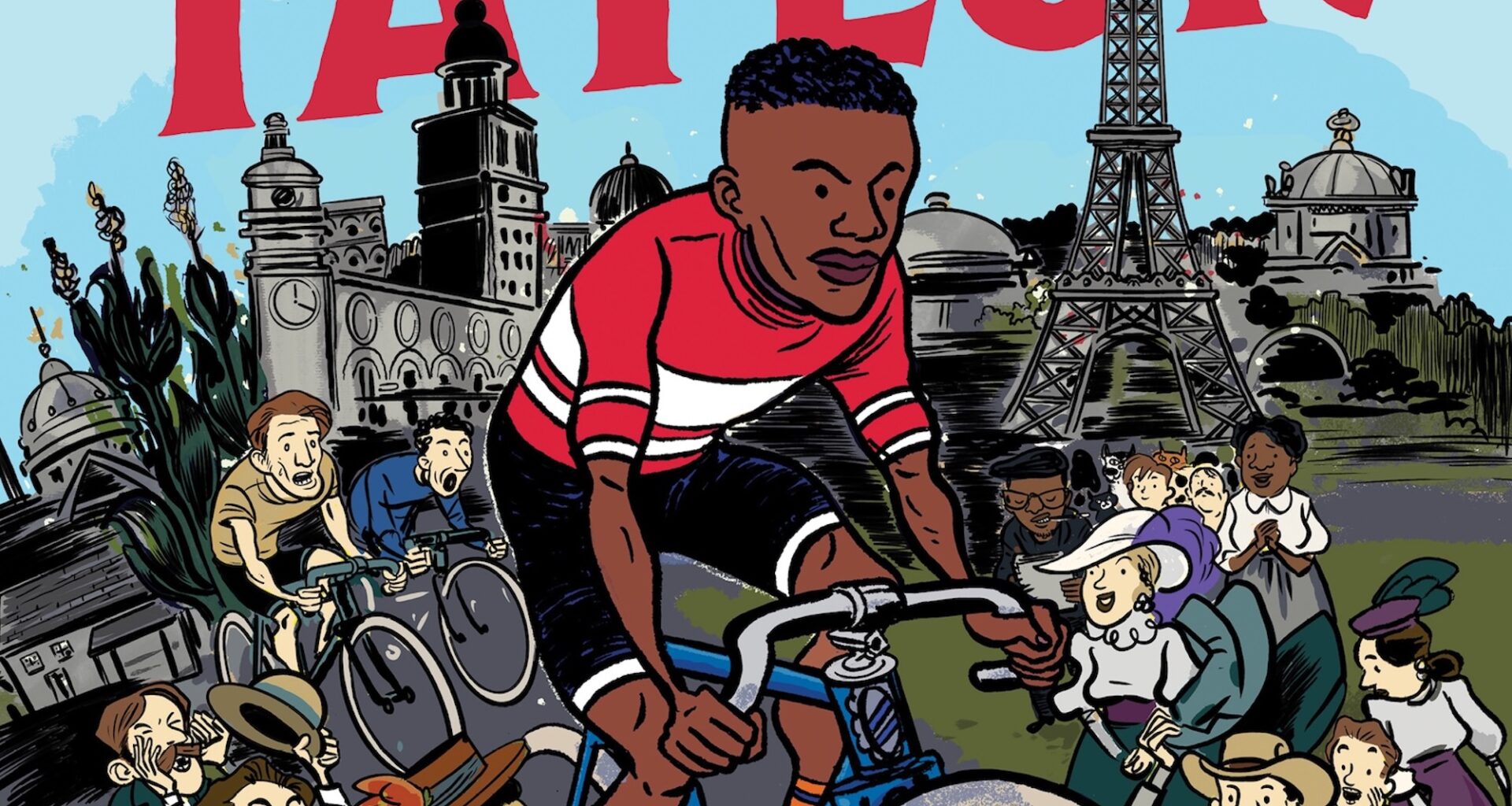
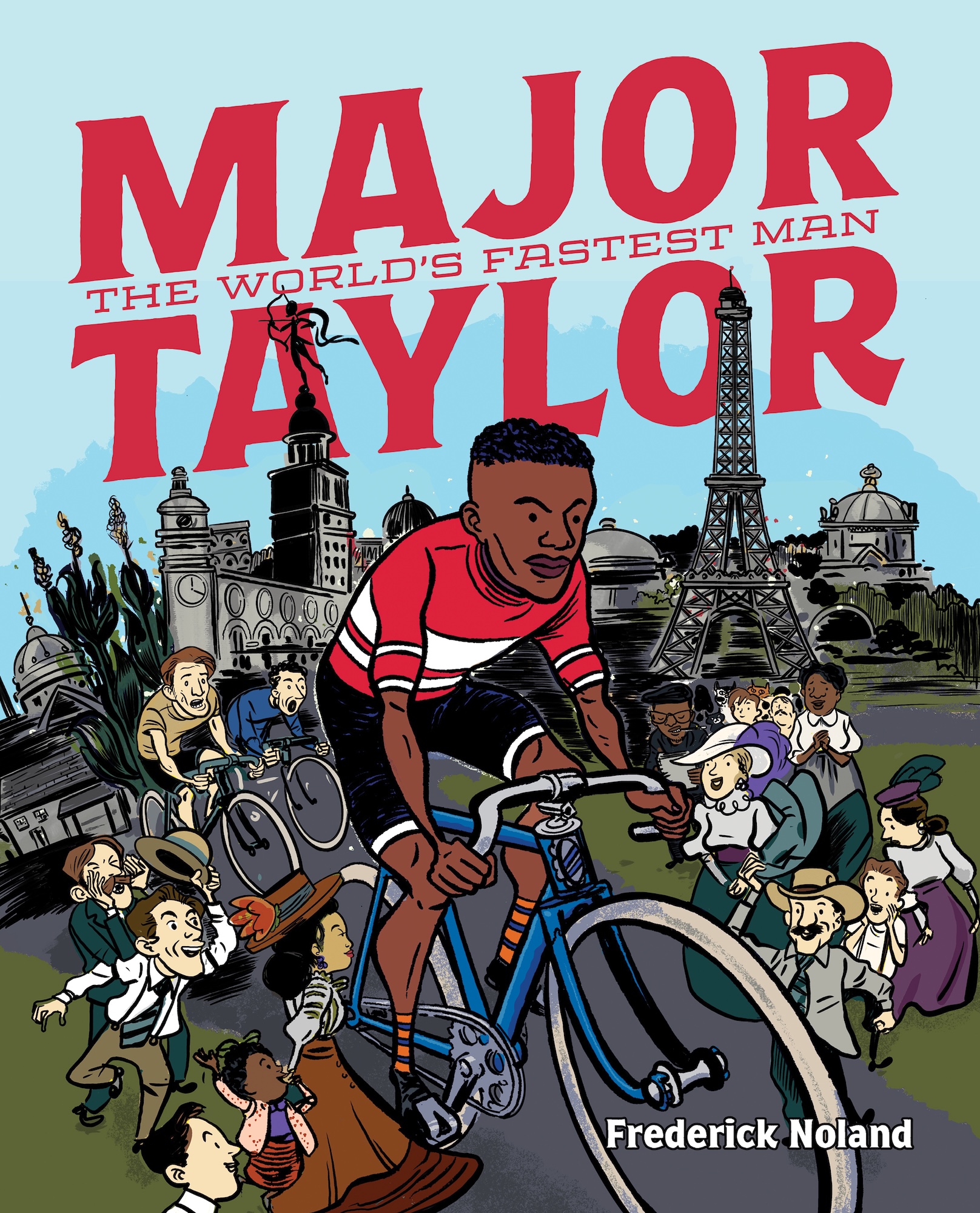
 ‘Major Taylor: The World’s Fastest Man’ by Frederick Noland.
You don’t have to be a bicycle aficionado to fall in love with Marshall “Major” Taylor. The groundbreaking Black cyclist smashed records in races around the world during competitive cycling’s — and his own — formative years at the turn of the 20th century. Taylor’s life story is lovingly rendered in a gripping new graphic biography Major Taylor: The World’s Fastest Man by Oakland-based cartoonist Frederick Noland.
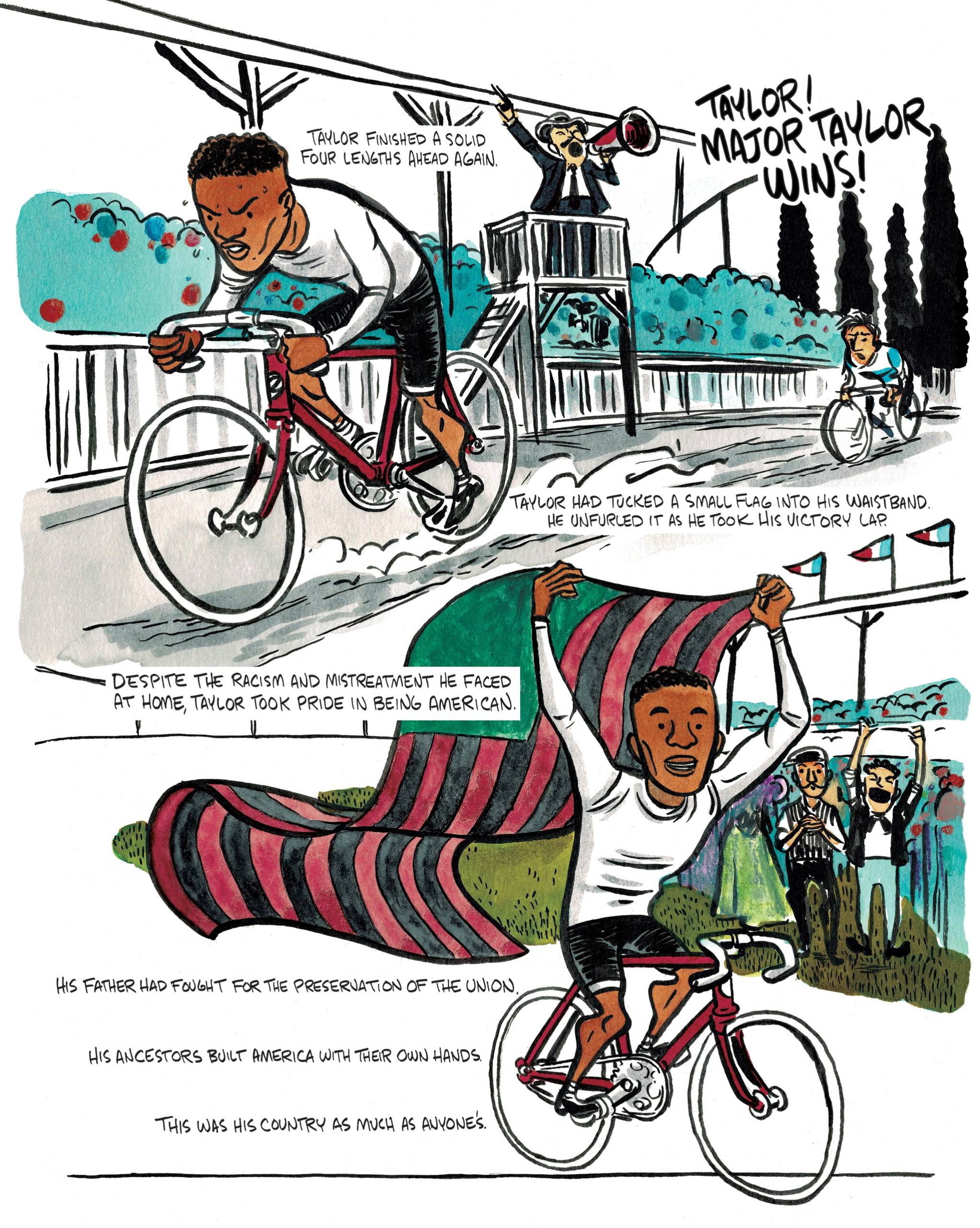 ‘Major Taylor: World’s Fastest Man’ by Frederick Noland tracks the champion cyclist’s adventures around the world — and the racism he faced at every turn.
Noland’s book does not flinch when it comes to emphasizing how much racism dominated American culture during the Victorian era, and how much more favorable the cyclist’s treatment was in Europe and Australia. (At one point, 85,000 fans turn out to see Taylor race in Paris.)
The Bay Area’s own racist policies are a depressing sight in these pages: before embarking on a trip to Australia in 1902, Taylor is refused service at hotels and restaurants across San Francisco. When he returns to the city with his wife Daisy, their treatment is just as awful, despite the fact that they have their newborn daughter in tow. One of Taylor’s most bigoted and relentless rivals, it’s worth noting, is Floyd MacFarland from San José.
Major Taylor: The World’s Fastest Man is thoroughly researched, with a pointed focus on Taylor’s grace, generosity and faith. The making of the book was clearly a labor of love and one that Noland sought to make enjoyable for as wide an audience as possible. Major Taylor starts, for example, with a fun history of the bicycle, tracing the earliest version all the way back to 1815 when a man named Baron Karl Drais came up with a two-wheeled contraption to facilitate faster travel — albeit without pedals or reliable steering.
Noland’s own reverence for the bicycle might assist readers in seeing this everyday conveyance in a whole new light too. According to the author, the earliest days of bicycle popularity, among other things, expanded the gene pool of French villages and became an effective means for suffragettes to organize and work.
By the end of Noland’s book, one can’t help but feel awe at Major Taylor’s perseverance in the face of so many obstacles. Major Taylor: The World’s Fastest Man serves to honor a groundbreaking cyclist, yes, but it does much more than that. This graphic novel is a history lesson, a source of sporting inspiration and a reminder of just what humans can accomplish if we learn to channel our frustrations into something constructive. Marshall “Major” Taylor should be a household name by now. Noland’s book finally brings him one lap closer to that.
Frederick Noland’s ‘Major Taylor: World’s Fastest Man’ is out Aug. 31, 2026 from Drawn & Quarterly. Noland will appear at Cape & Cowl Con (2501 Monarch St., Alameda) on Aug. 31; Pegasus Books (2349 Shattuck Ave., Berkeley) on Sept. 22; and Mission: Comics and Art (2250 Mission St., San Francisco) on Sept. 26.