
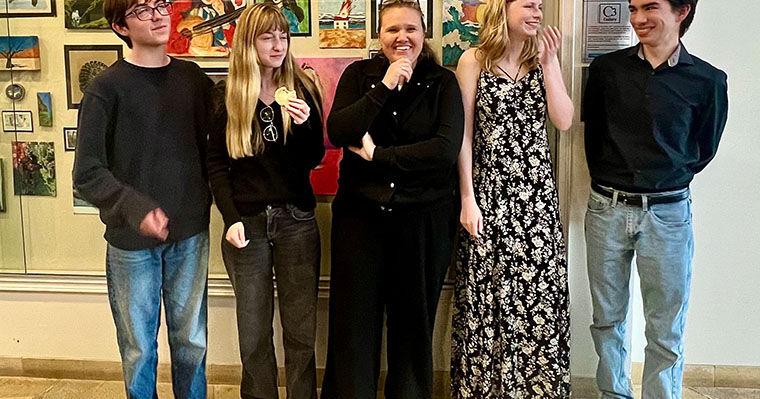
The Coronado Cultural Arts Commission works to support and empower Coronado’s Arts Partners, as well as maintain the City’s public art and facilitate visual arts collections and arts-related events throughout the year. Dawn Richards is the current Cultural Arts Commission Chair and is leading the way with the rest of the commission to reach for new goals in their overarching mission to support arts within the community.
In recent years, the commission was downsized in a vote by the Coronado City Council from seven members to five, and the commission currently has four active members. Richards has had to account for these and other changes since she took over as the chairperson for the group, and with feedback from the City and other partners, has a vision for how the commission can best meet their goals as they look to the future.
“What I would like to do is to make some very drastic changes, and my focus is on three things,” Richards said. “First, how can we best support our Arts Partners, which are nonprofits in the city that are arts and culture-related. That includes Safe Harbor, Emerald Keepers, as they hold some art-related fundraisers, the Community Foundation, and more. So it’s not just, say, the Coronado Island Film Festival, Coronado Promenade Concerts, the Jr. Arts League, etc. We have a huge component of Arts Partners, so how can we help them?” (A full list of Coronado’s Arts Partners can be viewed at https://www.coronado.ca.us/1060/Arts-Partners)
“I’d like to use some of our budget to have experts come in and lead workshops that can focus on things like board development, fundraising, and grant writing,” she told me. A good board can help groups maintain consistent goals, provide financial oversight, organize fundraisers, and course correct when needed. In the past, groups have had trouble maintaining boards consistently, so Richards sees this strategy as one avenue to offer the Arts Partners the groundwork for long-term support and stability.
“We had one [fundraising workshop] years ago, but I’d like to do a budget-intensive one,” she continued. “Finding grants that groups have a chance of getting and then holding either grant writing workshops or finding good grant-writers – which is hard because it’s a ton of work if you want to do a good job – to assist with that. So we’ll be looking at doing something like that.”
As a member of Californians for the Arts and San Diego Art Matters, Richards is also constantly on the lookout for what other cities with good arts programs are doing and opening dialogues with them. “I want to be able to find ways that our local artists can get grants, or find additional places for them to be able to exhibit their work,” she explained. “Our artists may not always realize all of the things they could be eligible for so I want to make all of that information available to them. I think that’s super important for us to have.”
As part of that goal, Richards is also working with City staff to maintain the Cultural Arts Commission section of the City’s website, now that their site has been incorporated into the City web page. “I’m working with them to have an ‘arts opportunities’ [section] where we can put all of these resources on there for artists to find and use. I want to support them by helping them to help themselves, and to be successful in what they do.”
Another area of focus for the Commission is on encouraging additional opportunities for collaboration. “[Our Arts Partners, artists, musicians, etc.] can save money on things like publicity and printing costs, and they can put on a better product when there are opportunities to collaborate,” Richards noted. “I always feel that many brains are better than just a few, and if they can cross-pollinate those ideas and help one another out, it also encourages stronger community ties.”
In a similar vein, the commission sees its role as a facilitator for more engagement between the arts community and the public, as well. “Another one of my goals is to do whatever I can to get top-quality videos to post better content when I attend arts events,” Richards mentioned. “I want to start a local art walk or art scene kind of thing, or use our public art piano more, where I can interview our arts partners, maybe talk to them before and after events they’re putting on, and just make these short, interesting reels that we can feature on our Arts Commission YouTube page and other social media channels.
“I’d like for us to create a presence so that people know we’re out there, get to know our artists, and know about what’s going on in the community. It would also give our Arts Partners and local artists and musicians a chance to say something and engage with the community a little more, with a more personal touch.
“So those are my main goals I’d like to focus on for our Arts Commission and I want to let our Arts Partners know that we’re not scaling back, but that we are revamping ourselves and will be offering lots more opportunities for them in the near future,” she added.
Additionally, Richards continues to keep in mind suggestions, feedback, and new ideas to incorporate within each of these elements. She mentioned a desire to reach out to additional demographics across the city to bring in additional artists and potential events. Another idea that she’s had many people ask her about in recent years is creating a new public chorale program that is simply geared towards the fun of getting together with people and singing popular music.
“We’ve had the Coronado Terrible Orchestra, which is for people who learned an instrument but haven’t played it in years, or know they’ll never be great but still enjoying playing. They hold concerts which are always sold out and have a waitlist, and so we want to consider a ‘Terrible Chorus’ for the people in the community who aren’t interested in learning how to read music or harmonize, but just want to get together and have fun singing,” Richards described. “So we’ll be looking for a place to hold a public meeting to gauge the possibility for a group like that and how it would function. I know there’s a need for something like that because so many people have asked us for it.”
In addition to those goals, the commission continues to maintain the facilitation of various areas of the arts, such as visual arts and public art. Part of the commission’s work is to review public art submissions that come in for the City, present those applications to the city council, survey each piece of public art across the city to assess their maintenance needs, and create a timeline for that maintenance schedule. “Public art is an area that could use some attention,” Richards mentioned, noting that they are also currently operating with only four commissioners.
The commission generally has ten regularly scheduled meetings a year, though commissioners may sometimes need to attend an additional working team meeting or a meeting to hold a vote on something that comes up outside of the regular meetings. “You can see our mission on the website, but everything we do is in support of all of our cultural arts partners and programs,” Richards added.
For those interested in applying for the Cultural Arts Commission to lend their time and skills towards the commission’s mission of supporting these various programs and goals, more information on the commission and how to apply can be found at https://www.coronado.ca.us/176/Cultural-Arts.
VOL. 116, NO. 33 – Aug. 19, 2026