

His family foundation had committed $9 million to the effort, nearly half the total, and the moment was indicative of the low profile that the venture capitalist — who has at times been a polarizing figure in city politics — has generally taken with his prolifically charitable Crankstart Foundation. The philanthropic nonprofit has given more than $500 million to San Francisco causes alone since 2020 and is among The City’s largest private foundations by assets.
Moritz, Crankstart’s chairman of the board, was not available for an interview. But Crankstart CEO Missy Narula heaped praise on Moritz and his wife, Harriet Heyman, for not seeking more recognition for their giving.
“It says so much about the way they view wealth, the way they view power,” Narula said.
“Michael and Harriet will say that all good things in their lives happened to them because they had the good fortune of moving to San Francisco,” she said. “I think they take that humility in the way they have approached their philanthropy.”


Venture capitalist Michael Moritz — seen wearing sunglasses to the left of Mayor Daniel Lurie — was present Oct. 29 for the announcement of a public-private partnership to pay for food benefits for 112,000 city residents, an initiative funded in large part by his Crankstart Foundation.
Patrick Hoge/The Examiner
Crankstart — founded in 2000 by Moritz, who became famous as a leader of Sequoia Capital, and Heyman, an artist — has assets of around $5 billion, said Eli Bildner, its vice president of operations. To date, the organization says it has distributed about $1.6 billion via 2,780 grants to 764 public and private entities. Moritz also funds The San Francisco Standard, an online news organization.
Under federal law, the foundation is required to distribute 5% of its assets every year — and with markets up in 2025, the foundation has so far contributed about $255 million, Narula said. About 60% of Crankstart’s donations typically go to Bay Area organizations, according to the organization, and the largest portion of that is distributed in The City, she said.
Crankstart’s money has supported a wide range of activities in program areas that include economic empowerment, education, promotion of democracy and voting rights, criminal-justice fairness, affordable housing and homelessness, environmental health and climate change, and medical science.
One notable Crankstart grant from this year for $500,000 went to an effort backed by Lurie that raised more than $2 million for nearly 80 groups that lost money when the nonprofit San Francisco Parks Alliance dissolved in June amid allegations of financial mismanagement.
A requirement that Crankstart made: The now-former directors of the defunct Parks Alliance also had to make contributions.
“Nonprofit board governance is very important,” Narula said.
Moritz was at the center of controversy last year as the major funder of TogetherSF Action, a group that tried unsuccessfully to get a November ballot measure passed that, among other things, would have radically restructured San Francisco’s sprawling commission system. Much derided by critics, TogetherSF Action merged this year with Neighbors for a Better San Francisco.
But Crankstart continued doling out money throughout.

Klarna CEO Sebastian Siemiatkowski, left and company Chairman Michael Moritz, center, meet with specialist Peter Giacchi, right, before their IPO begins trading on the floor of the New York Stock Exchange, Wednesday, Sept. 10, 2025.
Richard Drew/Associated Press
Crankstart has given $20 million to help develop The City’s new India Basin Waterfront Park. It has contributed to Downtown First Thursdays, the popular street party on 2nd Street south of Market Street; gave $7 million in April to a nonprofit housing cooperative in the Fillmore district; and provided a grant to Avenue Greenlight, a neighborhood-improvement initiative that launched a citywide sidewalk power-washing program in May.
Despite its extensive giving, Narula said, the Crankstart operation is lean, with only 15 employees. Given the scope of Crankstart’s activities, it would be reasonable to think the organization should have a staff of more than 100 people, she said.
In addition to leading the Crankstart Foundation, Narula is also CEO of Crankstart Management LLC, which manages Moritz and Heyman’s family-office investments and business activities.
Though Crankstart is headquartered in The City, it does not maintain its own offices, instead using WeWork space in Salesforce Tower at 415 Mission St. and in other parts of San Francisco.
“If you’re just sitting in a big building in San Francisco, you kind of miss the fabric of The City, and so it’s most important to be out and about,” Narula said. “That’s why we don’t have dedicated office space, because we try to make sure that the team members are incentivized to go where our community partners are and to do site visits as often as possible.”
Generally, Crankstart has served the function of funding other organizations. It did release a paper in April with recommendations about The City’s fractured response to homelessness, but Narula said that Crankstart does not claim expertise about homelessness. That publication was heralded in an unusually public event attended by Mayor Lurie at the Taube Atrium Theater in the War Memorial Veterans Building.
Crankstart produced the report with research conducted pro bono by McKinsey & Company in collaboration with Kunal Modi, then a partner at the consulting firm. Modi is now Lurie’s chief of health and human services.
In his current position, Modi worked recently with Crankstart to stand up the program to provide money for groceries to people with SNAP benefits affected by the shutdown of the federal government, Narula said. Crankstart and The City committed to paying out the money to some 82,000 households regardless of what the federal government does, with benefit letters to recipients going out in recent days, she said.
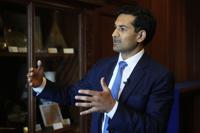
San Francisco Chief of Health, Homelessness and Family Services Kunal Modi produced a report alongside Crankstart prior to his current role, and he worked with the foundation on the private-public partnership to provide money to families who are without SNAP benefits amid the government shutdown.
Jeff Chiu/Associated Press

Retailer to pair with TMG Partners in effort to revamp huge department-store property

Other 25 vendors will gather at China Basin Park this weekend

Chamber of Commerce has, under Fong, focused on bolstering citywide recovery, advancing small business resilience and advocating for economic vitality
Trent Rhorer, executive director of The City’s Human Services Agency, which administers the food-benefits program in San Francisco, told the Board of Supervisors this week that the undertaking was complex and demanding.
“I do have to say that this was a Herculean effort,” he said.
Born and raised in Euclid, Ohio — a relatively low-income town — Narula said she is sensitized to families being in need.
“This isn’t an inconvenience for low-income people,” she said. “This is a crisis.”
Narula said her first employment was working at a McDonald’s, where she filled numerous positions, from griller to cashier.
“It has taught me to be grateful for sitting at a desk these days,” she said.
With financial aid, work-study jobs and belt-tightening by her parents, Narula was able to attend Yale University. She then worked in investment banking for two years to pay off debts before going to Harvard Business School, after which she worked for a decade for Boston Consulting Group and TPG Capital.
A mother of three children — now aged 13, 10 and 6 — Narula tried her hand at entrepreneurship for two years, launching a company that sought to help new parents easily navigate paid-leave rights and produced a patented phone holder designed to increase safety and parental comfort during diapering of toddlers.
“I was not a particularly good entrepreneur,” Narula said.
“It was a very, very humbling experience, to be honest,” she said. “You think you’re important, and you think that you know something, and people treat you with an enormous amount of respect. And then you’re an entrepreneur, and nobody answers your emails.”
In 2021, Narula joined Crankstart after a lawyer working for Moritz and Heyman — a “mom friend” — recommended her for the job, she said.
“It’s the best job,” Narula said. “I hope it’s my last job. I feel so lucky to work my butt off doing something that matters.”
“We remain committed to supporting people who are hungry,” she said. “We remain committed to supporting immigrants. We remain committed to supporting people who need a second chance after being released from the criminal-justice system.”

Working for Michael Moritz — seen at his San Francisco home in 2007 — at Crankstart has been Missy Narula’s “best job.” “I feel so lucky to work my butt off doing something that matters,” she said.
Jim Wilson © 2007 The New York Times Company
Moritz has a strong interest in immigration issues because he is an immigrant from Wales, where his parents made their home after fleeing from the Nazi Germany, Narula said.
Crankstart is currently working to assist immigrants — including the Bay Area’s thousands of residents with federal Deferred Action for Childhood Arrivals protection — to continue living and working in the country. It is also supporting efforts to reunite immigrants with family members in different countries.
Narula said Crankstart seeks to provide “catalytic capital.”
One example is the UCSF Career Pathways Initiative, which launched with a $14 million Crankstart grant in August 2024. It aims to train about 2,000 San Francisco residents over five years for possible positions at UCSF, including as medical-practice coordinators, medical assistants and radiology technologists. The Crankstart money was to cover 75% of the program’s costs.
Offered free of charge to trainees, the program works with community organizations to recruit city residents, including people who are unemployed or underemployed and transitional-aged youth. Narula said that serving students from low-income neighborhoods such as the Bayview is a priority.
Another Crankstart initiative that has yet to become public is an effort to get grocery stores into low-income neighborhoods that lack them, Narula said. The foundation is working with “a really community-oriented for-profit grocer to create an innovative model” in which Crankstart could cover costs such as rent or credit-card processing fees to incentivize the company to operate markets with healthy foods such as fresh produce.
A rare initiative that bears the Crankstart name is the Crankstart Scholarship program unveiled in April. It aims to provide 200 graduates of public high schools in The City with grants of between $1,500 and $15,000 per year for up to six years to cover college-related expenses such as tuition, housing, books and fees.
Crankstart has so far contributed $10 million million to the program, which takes students from Balboa, Burton, Galileo and Mission high schools — all large schools where many students who qualify are from lower-income households.
At the time, school-district Superintendent Maria Su said in a prepared statement that the Crankstart Scholarship program is “a powerful investment in equity, ensuring that our students facing the greatest economic challenges have a clear path to college and the opportunities that follow.”