
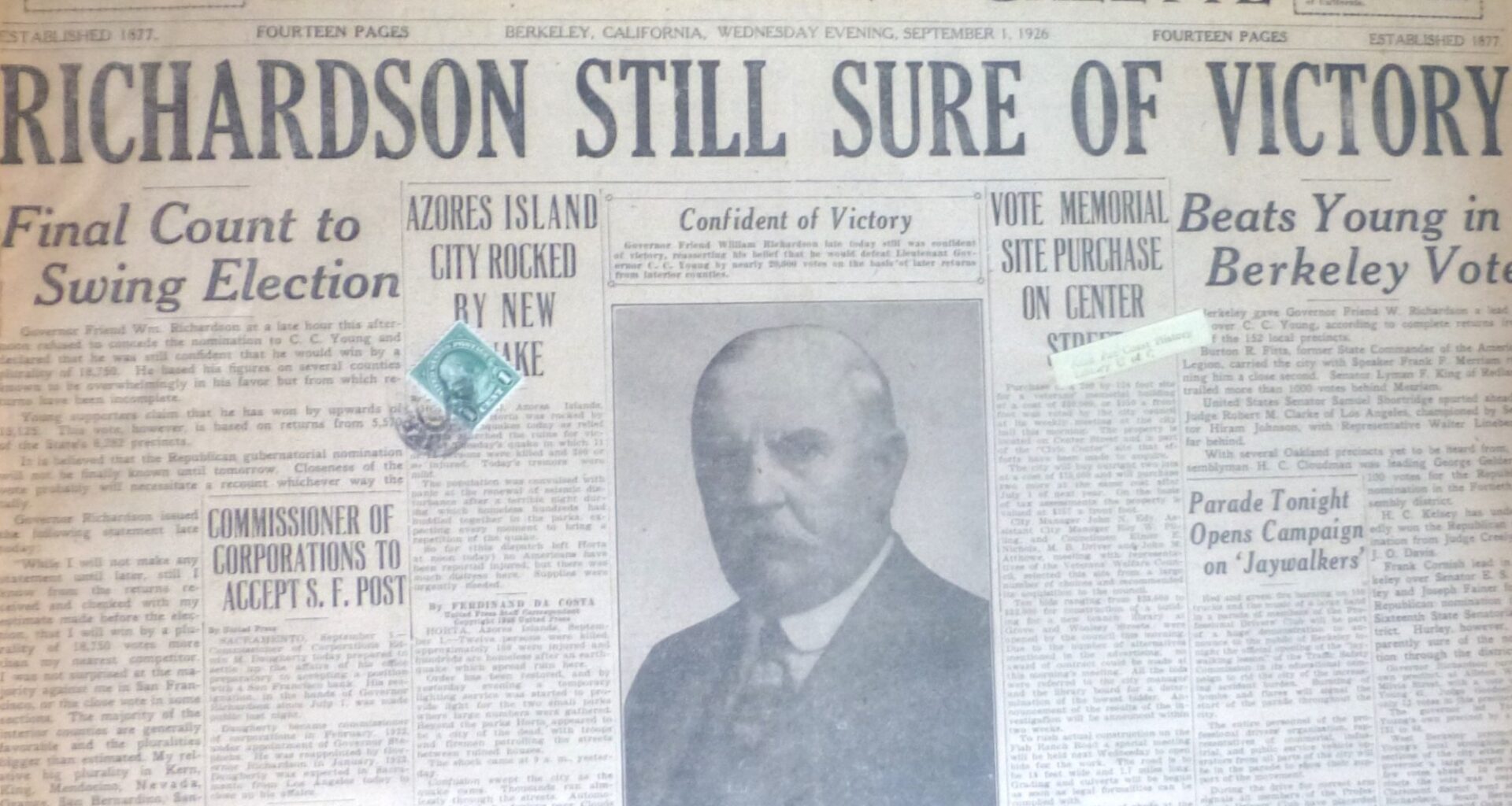
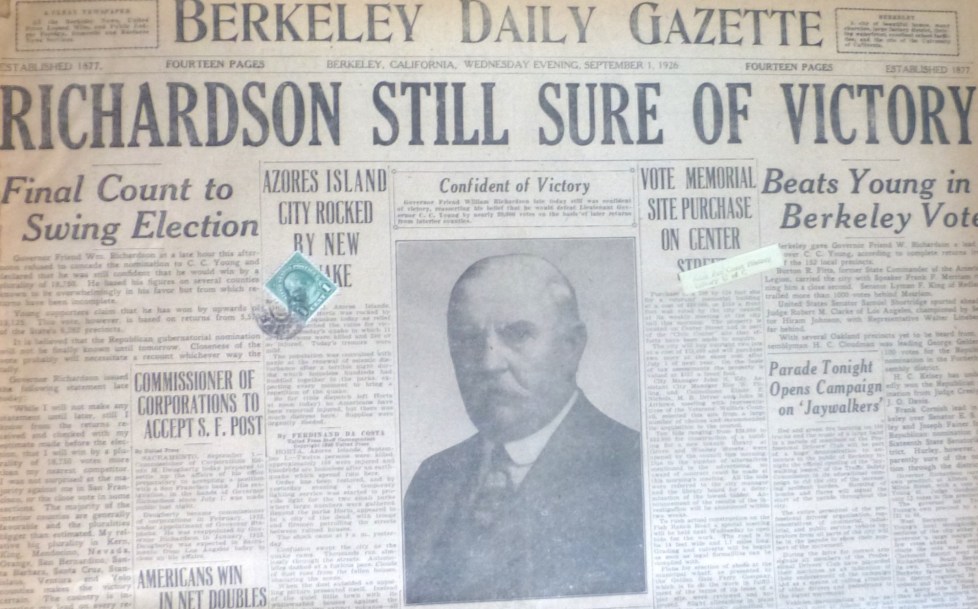
The Sept. 1, 1926, Berkeley Daily Gazette headlined that incumbent California Gov. Friend Richardson was “sure of victory,” but he later lost the Republican primary C.C. Young. Both men had close ties to Berkeley. (photo courtesy of the Berkeley Historical Society and Museum)
Berkeleyans and the rest of California’s voters went to the polls a century ago in a primary election. A key race on the ballot was to elect a Republican candidate for state governor that interestingly pitted two men with close Berkeley connections against each other.
One was California’s incumbent Gov. Friend Richardson, who published the Berkeley Daily Gazette and had long made his permanent home in Berkeley. The other was Lt. Gov. C.C. (Clement Calhoun) Young, who had earned his degrees from UC Berkeley, represented the city in the state Legislature and had also established his permanent home in Berkeley when he wasn’t in Sacramento.
So this election was an unprecedented “local” event. The governor, his main opponent (the lieutenant governor) and the state Supreme Court’s Chief Justice were all on the ballot, all Berkeley residents and all well known locally. On Aug. 30, 1926, the Berkeley Daily Gazette unsurprisingly ran a full two-page spread of advertising for Richardson, including a list of the names of one thousand Berkeley citizens who endorsed him.
The ad also attacked C.C. Young’s policies and programs, asserting that Young favored “Socialistic State Insurance,” government regulation of “almost every act of man and function of property” and that he favored clemency for murderers, rapists and child abusers. Young, the ad alleged, had support from not only “every political boss and political machine in California” but also “almost every prominent radical” in the state.
Richardson, on the other hand, was characterized as the candidate for government efficiency, less regulation and fiscal restraint. “Economy and efficiency” had been his successful 1922 campaign slogan. In a nail-biter finish, Richardson ran far ahead in the Berkeley vote count, but Young edged him out statewide by about 15,000 votes out of 767,000 cast.
Civic places: On Aug. 31, 1926, the Gazette noted that “preliminary arrangements were completed last night for sale of property on Allston Way belonging to the Board of Education and used as a site for administrative offices … .” The lot, on Allston between Shattuck and Oxford, was 194-by-147 feet and had been the site of the Kellogg School, Berkeley’s first high school. A later occupant was the California College of Arts and Crafts.
Also on Aug. 31, a City Council committee made a consequential recommendation that the city pursue purchasing land on Center Street “as a site for a war veterans’ memorial.” This was intended to help foster the creation of an as-yet theoretical civic center east of Berkeley’s City Hall and north of Berkeley High School.
Within a few years, Berkeley would have that Veterans’ Memorial Building centrally fronting onto a block that would eventually be fully acquired by the city and, in the early 1940s, turned into today’s Civic Center Park. On Sept. 1, 1926, the City Council opened bids for construction of a south Berkeley library, and on Sept. 2 the new “West End post office” on University Avenue at at Ninth Street was dedicated.
Police shooting: On Aug. 29, 1926, Officer C.I. Howell, a “champion pistol shot of the Berkeley Police Department” shot three apparent robbers in Emeryville. Howell was sitting in a car with undercover agents when they were approached by the three men. Howell shot two of them, both of whom ended up in the county hospital, while the third one, believed to be wounded, escaped.
Street accident: On Aug. 27, 1926, a Berkeley streetcar on Dwight Way at San Pablo Avenue was hit by an alleged drunk driver in an automobile, “with such force that it (the streetcar) was thrown 10 feet off its tracks.”
Bay Area native and Berkeley community historian Steven Finacom holds this column’s copyright.