
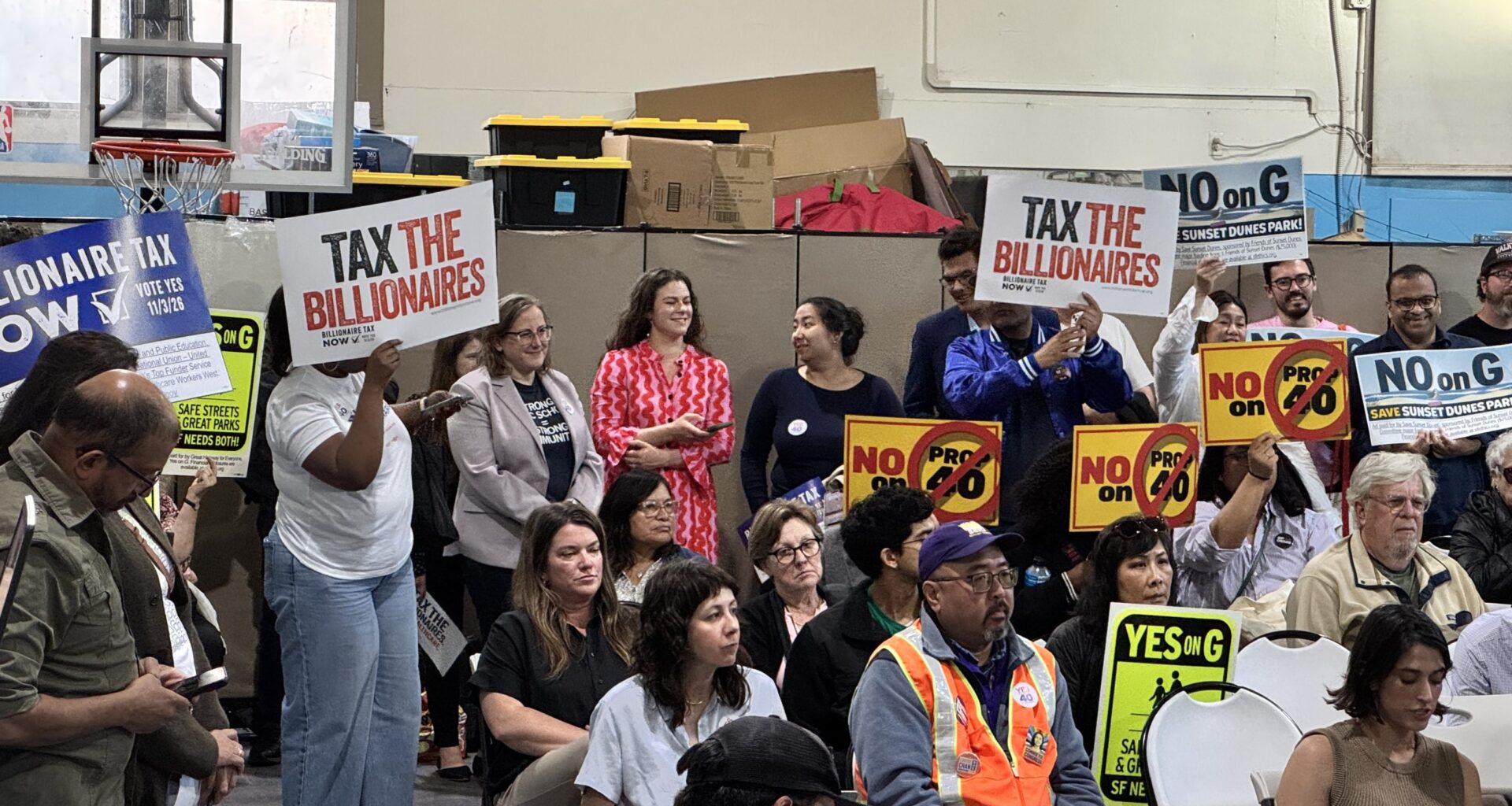
The San Francisco Democratic Party, as predicted, voted 17-4 on Wednesday evening to oppose the upcoming California billionaire tax — and in so doing made the rare choice to buck the state Democratic Party, which had narrowly endorsed the proposition in early August.
The vote was expected and fell along a neat progressive/moderate divide. The local chapter took the step two months ago to alter its bylaws to allow itself to diverge from the state party’s endorsement on California ballot measures. Previously, the local chapter’s convention was to follow the state party on statewide ballot measures and candidates.
Prop. 40, or the billionaire tax, would levy a one-time 5 percent tax on some 200 billionaires who lived in California on Jan. 1, 2026. Most of the money would be spent on health care, patching up a $30 billion hole in Medi-Cal due to federal cuts after President Donald Trump’s “Big Beautiful Bill.” The rest would go to education and food assistance.
Members of the Democratic County Central Committee, the local party chapter, said California would suffer from billionaires fleeing the state.
“[My union is] particularly disturbed because we feel it sets up an uneven playing field for California,” said Patrick Boileau, a DCCC member and the political director of the Operating Engineers Local 3. “The billionaires that are going to be taxed with this measure also have the ability to vote with their feet and move out of California.”
Supervisor Matt Dorsey put it bluntly: “This is terrible public policy.”
Lanier Coles, a DCCC member who was diagnosed with a chronic neurological disorder at 28 and had trouble getting healthcare coverage, said she opposed Prop. 40 because it is not “a long-term viable solution to provide affordable healthcare.”
When Democrats win Congress this fall and the White House in 2028, she said, they will “pass enduring legislation” to fund and expand the Affordable Care Act and tackle federal tax reform to address inequalities.
“That is how we will get to a place where more Americans, more working-class people will have access to healthcare for the long term,” she said.
“They’ll be dead,” quipped a Prop. 40 supporter in the audience.
“That’s why you lost to Trump twice,” added another.
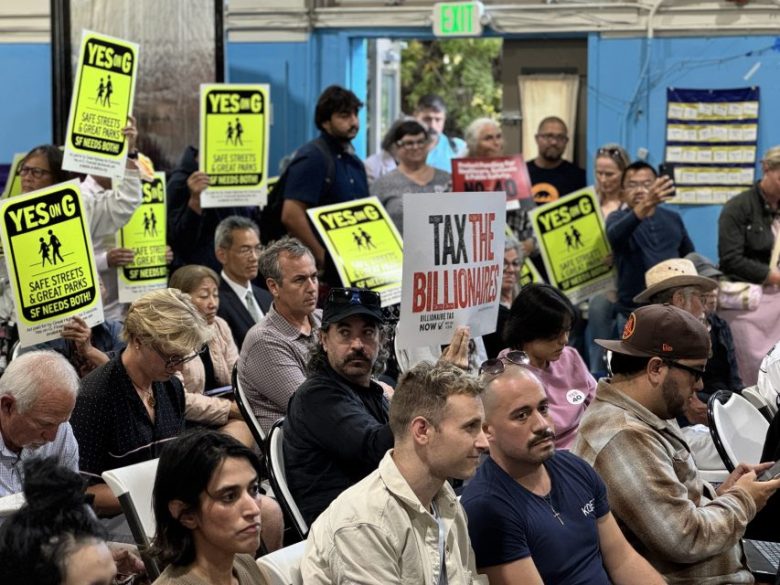 A man holds a “tax the billionaires” sign in the audience, among supporters of reopening the Great Highway, at the San Francisco Democratic County Central Committee’s endorsement meeting on Aug. 26, 2026. Photo by Junyao Yang.
But for the minority of supporters of the billionaire tax on the body, the tax cannot wait.
“California needs this money now,” said Michael Nguyen, a progressive DCCC member. “There are reasonable questions here around implementation, long-term revenue projections, but those questions cannot become an excuse for doing nothing.”
Gordon Mar, another member, agreed. “The bottom line is Prop. 40 is the only proposal before voters and on the table, more generally, that approaches the scale of this crisis.”
The state ballot measure, pushed by the health care labor union SEIU-UHW, was endorsed by the California Democratic Party and the California Federation of Labor Unions. But it has faced formidable opposition from Gov. Gavin Newsom; his likely successor, Xavier Becerra; Planned Parenthood; and several labor unions.
While the tax is estimated to bolster state revenue by tens of billions of dollars, according to the nonpartisan California Legislative Analyst’s Office, it could also lead to “ongoing” deficits of less than $1 billion per year.
Opposing the billionaire tax could be a boon for the DCCC: It may benefit from heavy spending by tech billionaires already pouring millions into defeating the measure.
The campaign fighting the tax could pump money into the DCCC that the body would then use to put out slate cards — which would promote other candidates and measures the San Francisco Democratic Party has endorsed, unrelated to the tax.
“After tonight we will be moving into full-blown campaigning mode for our endorsed candidates and campaigns,” said Nancy Tung, the chair of the San Francisco Democratic Party.
The DCCC, in a symbolic vote, then went on to unanimously pass a non-binding resolution for a “national wealth tax.”
“This is something that we can actually do that will make an impact on income inequality in this country,” said Eric Kingsbury, who introduced the measure with Emma Hare. “I ask that all of you join me in pushing for this tax that would be actually workable, viable, and not something that would hurt the economy of one city or county or state.”
Others called it performative politics.
“It is a resolution. It doesn’t have to go anywhere,” said Hene Kelly, 84, the regional director of the California Democratic Party. “We’ll work on it for years and years and years. I would like to have something before my 85th birthday and this won’t do it for me.”
“Let’s just be honest with ourselves: The resolution is just basically shouting into the void and may or may not go anywhere,” Nguyen said. “Prop. 40 will be at the voters in November.”
The local chapter also voted to:
Endorse Manny Yekutiel in District 8 supervisor race despite sexual assault allegation against him;
Support Prop. B, the measure to create a public bank;
Oppose Prop. G, the measure to reopen the Upper Great Highway to cars;
Oppose Prop. I, the measure to dedicate transfer tax revenue to affordable housing.