
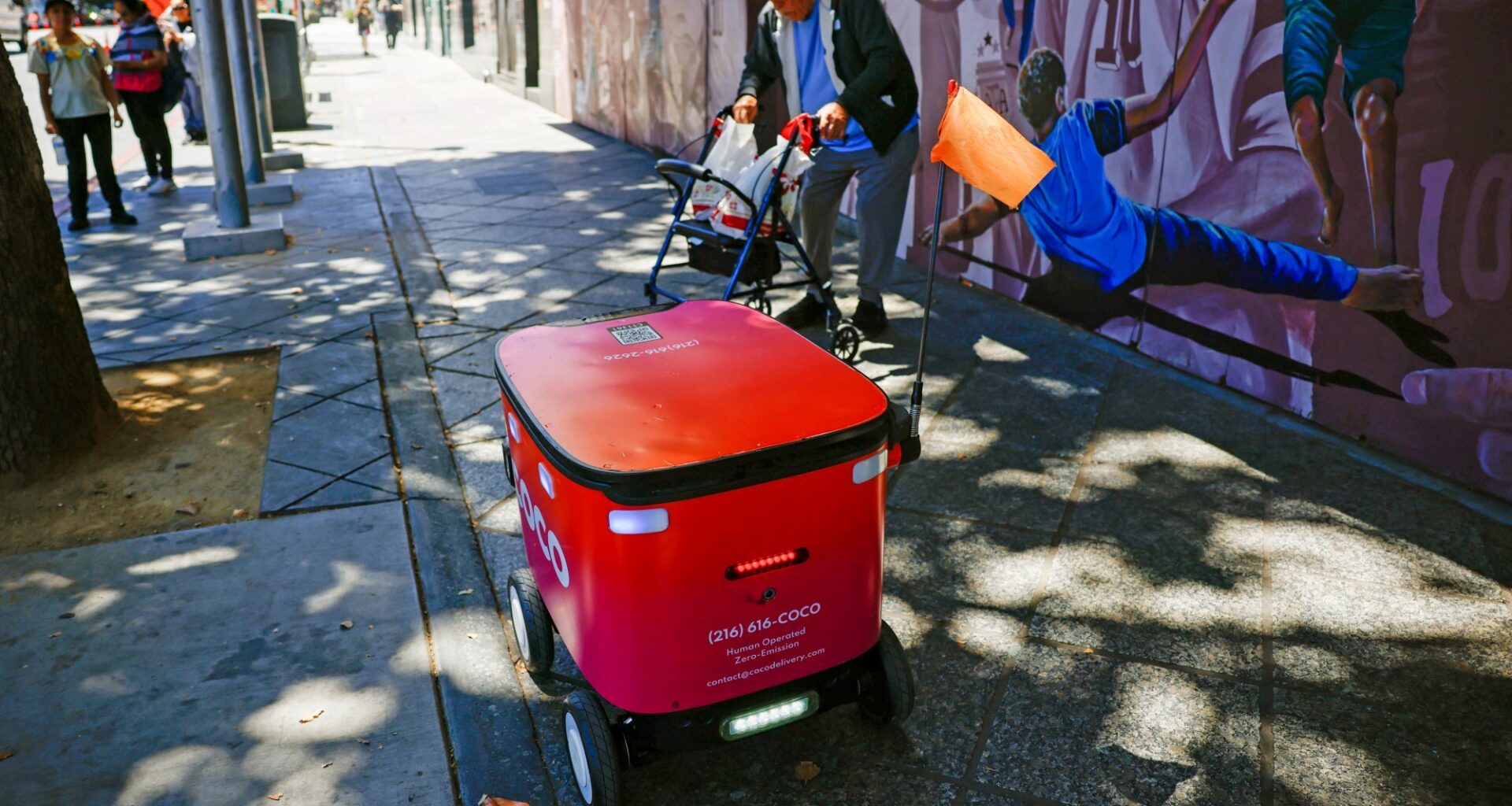
It looks like a pink-and-red beer cooler on wheels as it silently rolls up to a downtown San Jose intersection, pauses for the light to change, then crosses with the crowd, ferrying a hot meal in its security-coded storage compartment to a waiting diner.
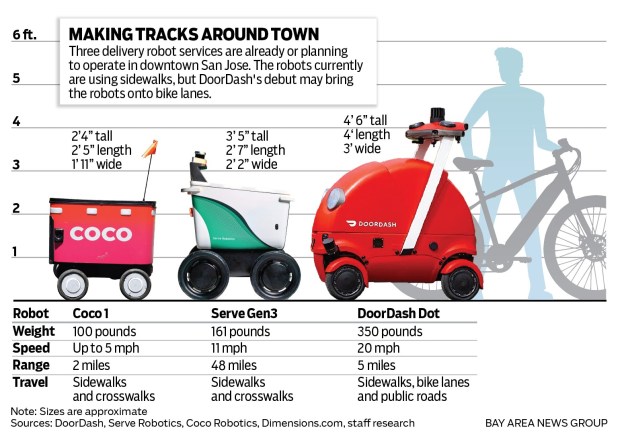
A much larger version could soon enter city bike lanes.
But the rules governing how many robots can operate, where they can travel and what happens if a 100-pound machine blocks a wheelchair user or knocks someone down are still being written. San Jose has informal operating understandings with two robot companies, while permits and regulations intended to protect public safety and sidewalk access won’t come until the City Council acts, likely this fall.
“This is the heart of the innovation economy, here in San Jose,” said Ramses Madou, a San Jose Department of Transportation manager overseeing the delivery-robot rollout. “The direction we’ve gotten from city leadership is to be open to new entrants and new technologies.”
The city has no formal, written agreement with Coco Robotics, whose 20 robots are delivering restaurant meals around downtown, or Serve Robotics, which recently launched a similar service in the same area. Both companies deliver orders for Uber Eats and DoorDash.
City staff approved the deployments under City Council policies aimed at reducing greenhouse gas emissions and single-occupancy vehicle trips and improving public safety, city transportation officials said.
“This is a learning period for us to gain insight into public perception, operational impacts, etc., to inform the proposed regulations,” Laura Stuchinsky of the city’s transportation department said in an email.
The regulations would require companies to obtain permits, provide proof of insurance and agree to cover the city’s legal costs or damages arising from robot operations, Stuchinsky said.
Even without such an agreement, state law provides cities with significant protection from lawsuits and leaves most of the legal risk with the companies operating the robots, Santa Clara University law professor Nicholas Emanuel said.
The kind of dispute those protections are intended to address has already emerged elsewhere.
Arizona resident Trudy Perez has sued Starship Technologies, alleging one of its delivery robots knocked her down at an Arizona State University parking garage in Tempe and caused a spinal fracture. The 2023 encounter was captured by cameras and documented in a police report.
In court filings, Starship denied liability and argued that Perez’s injuries resulted from her own negligence, preexisting conditions or a third party. The San Francisco company, which previously tested robots in several Bay Area cities but no longer operates in the region, declined to comment.
Back in San Jose, the delivery-robot experiment is poised to move beyond sidewalks. DoorDash plans to deploy 350-pound robots in city bike lanes, likely as soon as this fall.
Coco’s sidewalk robots are 2 to 3 feet tall, about 2 1/2 feet long and 2 feet wide, and can travel up to 2 miles to make deliveries. DoorDash’s “Dot” bike-lane robots, described by the company as a tenth the size of a car, can deliver up to 5 miles away, Madou said.
Coco robots weigh 100 pounds empty, while Serve robots weigh 161 pounds. At 350 pounds, Dots would weigh more than twice as much as either, according to city officials.
A benefit or a barrier?
Sheri Burns, an advocate for people with disabilities and former executive director of the Silicon Valley Independent Living Center, said her primary concern is the robots’ potential effect on people using wheelchairs, walkers and other mobility devices.
But Burns also said the technology could be a “game changer” by expanding grocery-delivery options for residents with limited mobility.
She supports Coco’s partnership with BlindSquare, which maps sidewalk conditions such as raised pavement and hazardous cracks and relays that data to municipal leaders.
City staff have reached out to groups representing people who are blind or have low vision and “will encourage them and other people with disabilities to keep providing feedback as more devices are deployed in more neighborhoods,” Stuchinsky said.
So far, San Jose residents have greeted the high-tech delivery devices with a mix of curiosity, excitement and concern.
Arturo Litvin of San Jose, who works in venture capital, was surprised late last month when his Uber Eats app told him his order from Sixth Street Burger downtown would arrive by robot.
“It was kind of at my neighbor’s house, but close enough,” Litvin said.
He had included a tip on the app, but Uber Eats refunded it because a robot made the delivery, Litvin said.
“I don’t know how good it bodes for the delivery people,” Litvin said. “I’d be annoyed if there was a ton of them on the sidewalk and you’re trying to walk.”
A DoorDash spokesperson declined to say how many human deliveries its robots could replace or how much the company saves by using them. Uber Eats did not respond to questions.
On a recent weekday evening, as the dinner rush slowed at Punjab Cafe on East Santa Clara Street, owner Bobby Saini received a DoorDash order. Waiting outside was a pink-and-red Coco robot.
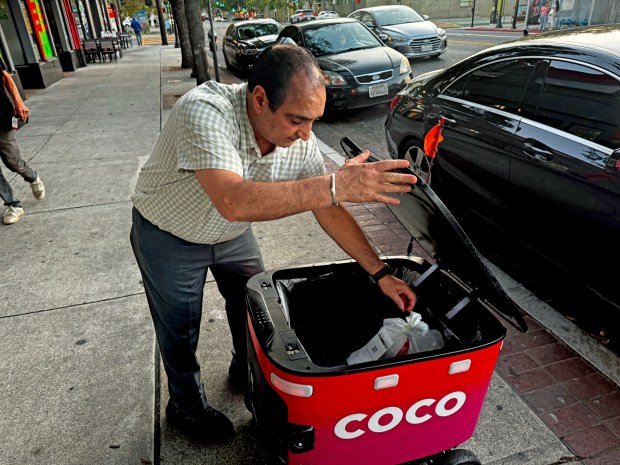 Bobby Saini, owner of Punjab Cafe on E Santa Clara Street, places an order of butter chicken and spicy garlic naan in a Coco delivery robot on Tuesday Aug. 11, around dinnertime. He says the robots showed up to pick up orders a couple of months ago, sometimes picking up four to five deliveries a day, “sometimes more on weekends.” (Ryan Macasero/Bay Area News Group)
Saini checked his tablet, opened the robot’s compartment and loaded a hot order of butter chicken and garlic naan inside. The exchange has become an ordinary part of his workday.
“They’re here about five times a day, even more on weekends,” he said.
At nearby La Victoria Taqueria, cashier Marta Alejandre said the robots have not always received such a warm welcome. About a month ago, workers found a Coco robot outside the restaurant flipped onto its back, its wheels in the air.
“Some people,” Alejandre said, “they don’t like it — they don’t like the robot.”
Rules coming after the robots
Until the City Council passes regulations, San Jose has no robot-specific system for penalizing companies if their devices obstruct curb ramps, pedestrian pathways, driveways, bus boarding zones, bikeways or other public rights of way, Stuchinsky said.
The city could still levy fines if the robots violate existing administrative regulations, which mandate compliance with city, state and federal laws, she said. Police could also ticket companies if their robots break traffic laws.
“Technically the city can say no to these operations — it’s up to council to make that choice,” Madou said.
The regulations expected this fall would establish a permit system, cap the number of robots and companies if their operations substantially interfere with other sidewalk or bike-lane users, and allow the city to issue fines or revoke permits for violations, officials said.
Companies would pay annual fees of $200 to $250 per robot. Their permits could be revoked if the devices block or interfere with public access to sidewalks, crosswalks or streets, Madou said.
The companies have assured city officials that their teams respond quickly when robots cause access problems. If they do not, “the city can remove the device from the public right-of-way as with any other obstruction,” Stuchinsky said.
Each robot displays a phone number and identification number people can use to report a malfunction or obstruction. Company representatives said field technicians would respond within 30 minutes. City staff can also observe the robots in real time and address problems, Madou said.
“A bot being immobilized in the sidewalk would be very unusual, and it would be very unusual for it to be there for very long,” said Carl Hansen, Coco’s head of government relations.
Robots are not to exceed 5 mph on sidewalks under the city’s informal understanding with the companies. They also are not allowed on pathways such as the Guadalupe River Trail.
Although Madou described 5 mph as roughly the average human walking speed, journalists from this news organization had to jog to keep up while following Coco robots down San Jose sidewalks. Harvard Medical School in 2018 cited research putting a typical moderate-to-brisk walking speed at about 2.7 mph.
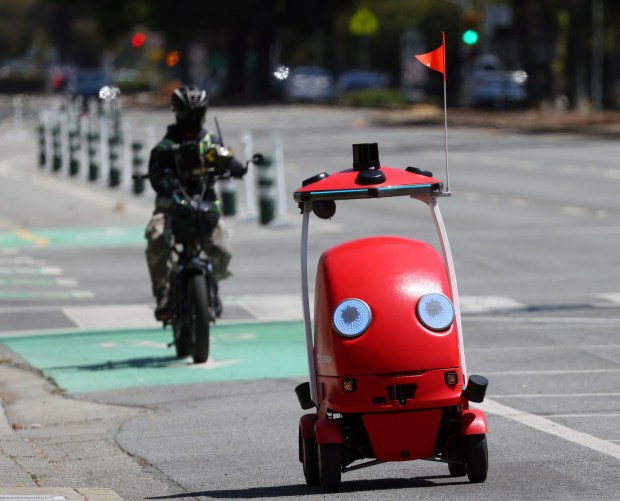 An autonomous delivery robot from DoorDash moves along Fremont Boulevard while followed bay a human supervisor riding a bicycle on Wednesday, Aug. 12, 2026, in Fremont, Calif. (Aric Crabb/Bay Area News Group)
A 350-pound robot in the bike lane
DoorDash’s Dot robots can reach 20 mph, though they will typically travel more slowly, a company representative said during an online city presentation last month.
Jordan Mesch, a DoorDash product manager, said during the presentation that the robots “should not try to pass the cyclist.” When cyclists want to pass, the robot is supposed to pull to the side and make space, he said.
Callers raised concerns about robots blocking sidewalks, curb cuts and bike lanes and potentially endangering pedestrians and cyclists.
Amie Ashton, former board chair of the Silicon Valley Bicycle Coalition, said robots using bike lanes could boost public support for the lanes and push the city to maintain and protect them.
But she worries about collisions and the risk of cyclists getting stuck behind a slow or malfunctioning robot in narrow, barrier-protected lanes where passing is impossible.
“I can see this going very well or very poorly,” Ashton said.
She questioned why cyclists, rather than drivers, should have to cede “our crowded space” to the devices.
“Why not put them in car lanes?” she said.
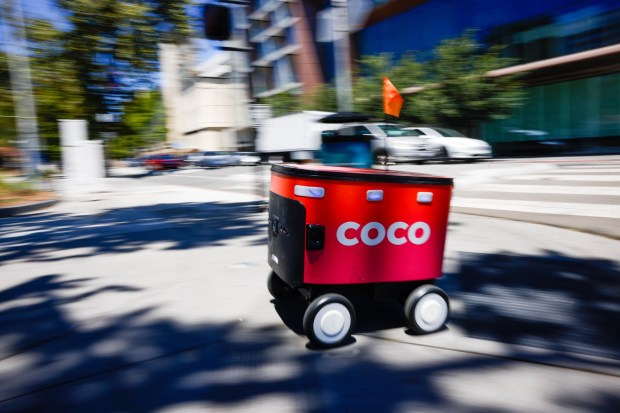 A Coco delivery robot travels along the sidewalk in downtown San Jose, Calif., on Thursday, July 30, 2026. (Shae Hammond/Bay Area News Group)
City staff determined that the Dot robots’ 20 mph maximum speed was too slow for traffic lanes. The regulations are expected to include requirements intended to ensure the robots can operate safely in bike lanes and on certain road shoulders, Stuchinsky said.
Madou said he expected DoorDash to deploy the robots after the City Council adopts the regulations.
The companies make their case
Coco CEO Zach Rash said his company plans to “keep expanding across San Jose” and “would like to keep expanding this across the Bay Area.”
By replacing some car trips and sending cities data about sidewalk problems, the robots can make city life safer for people on foot, Rash said. Eighteen Coco robots can fit in a single parking space, he added.
City officials also say the electric robots could reduce traffic and pollution, though Madou said those potential benefits must be weighed against the risks to people using sidewalks and bike lanes.
“We don’t want the robots to trip people up, whether they’re biking or walking,” Madou said.
Representatives from DoorDash and Coco said customers notified that their orders will be delivered by robots can opt out and request conventional delivery.
Rash said using a Coco robot instead of a human driver provides delivery platforms with substantial savings that could be passed along to consumers through lower fees.
“It is fundamentally the cheapest way to move goods around the city,” Rash said.
DoorDash declined to say whether it planned to pass any savings along to consumers. Uber Eats did not respond.
The robots use cameras to navigate, and the companies said they would provide video and location information to law enforcement in response to warrants and subpoenas. Serve said its systems automatically blur license plates and people’s faces and that police would receive video with that information obscured.
Serve and Coco representatives said their robots are designed to slow, stop and yield when pedestrians approach. Hansen said Coco is interested in expanding into San Jose’s Willow Glen neighborhood “in the near future.”
Coco’s next-generation robot will be slightly larger and operate on low-speed roads and in bike lanes, Rash said.
Different cities, different approaches
DoorDash expects to begin Dot deliveries in Fremont in September, city spokesperson Geneva Bosques said.
The robots, built by Sonic Manufacturing Technologies in Fremont, will operate under an encroachment permit valid through March. The city can revoke the permit if DoorDash violates its conditions or if safety problems or significant public concerns arise.
The permit imposes a 16 mph speed limit in bike lanes and requires DoorDash to conduct outreach to organizations representing cyclists and people with disabilities, Fremont spokesperson Cheryl Golden said. The company must also provide proof of up to $1 million in insurance.
“The robots will be treated as a bicyclist using the roadway, and DoorDash will be legally responsible for the operations of the robot,” Golden said. “The city will have the power to revoke the encroachment permit should the robot pose a safety or operational issue.”
In San Francisco, a city known for technological innovation, delivery robots remain a rare sight.
Amid concerns about a hasty rollout and sidewalk access, the Board of Supervisors enacted strict regulations in 2017, limiting the number of robots, restricting testing to specific industrial areas and capping speeds at 3 mph. The restrictions came years before autonomous Waymo taxis became ubiquitous on the city’s streets.
Asked about potential limits on robot speeds and operating areas, San Jose officials cited the proposed 5 mph sidewalk limit. They said rules for bike-lane robots would likely include restrictions based on the speeds of cyclists traveling in front of and behind them.
Delivery-robot representatives have been upfront about using public sidewalks and streets as testing grounds.
Responding during the San Jose presentation to a question about potential effects on people with disabilities, Coco’s Hansen said, “We’re always learning.”
Kelly Jones, government affairs manager for San Carlos-based Serve, described “an iterative process” as the company expands from city to city.
“We’ve been learning along the way,” she said, “market to market.”
On a recent afternoon, real estate agent Joseph Bedodo warily watched a Coco robot make its way in herky-jerky fashion down East Santa Clara Street. He was less enthusiastic about the industry’s work-it-out-as-it-goes approach.
“I’m getting to the point where I want to go live among Amish people,” Bedodo said. “In tech, they design stuff, build stuff, and throw it out on the street when it’s only 70% done. The defense industry won’t do that. The medical industry won’t do that. But the tech industry does.”