
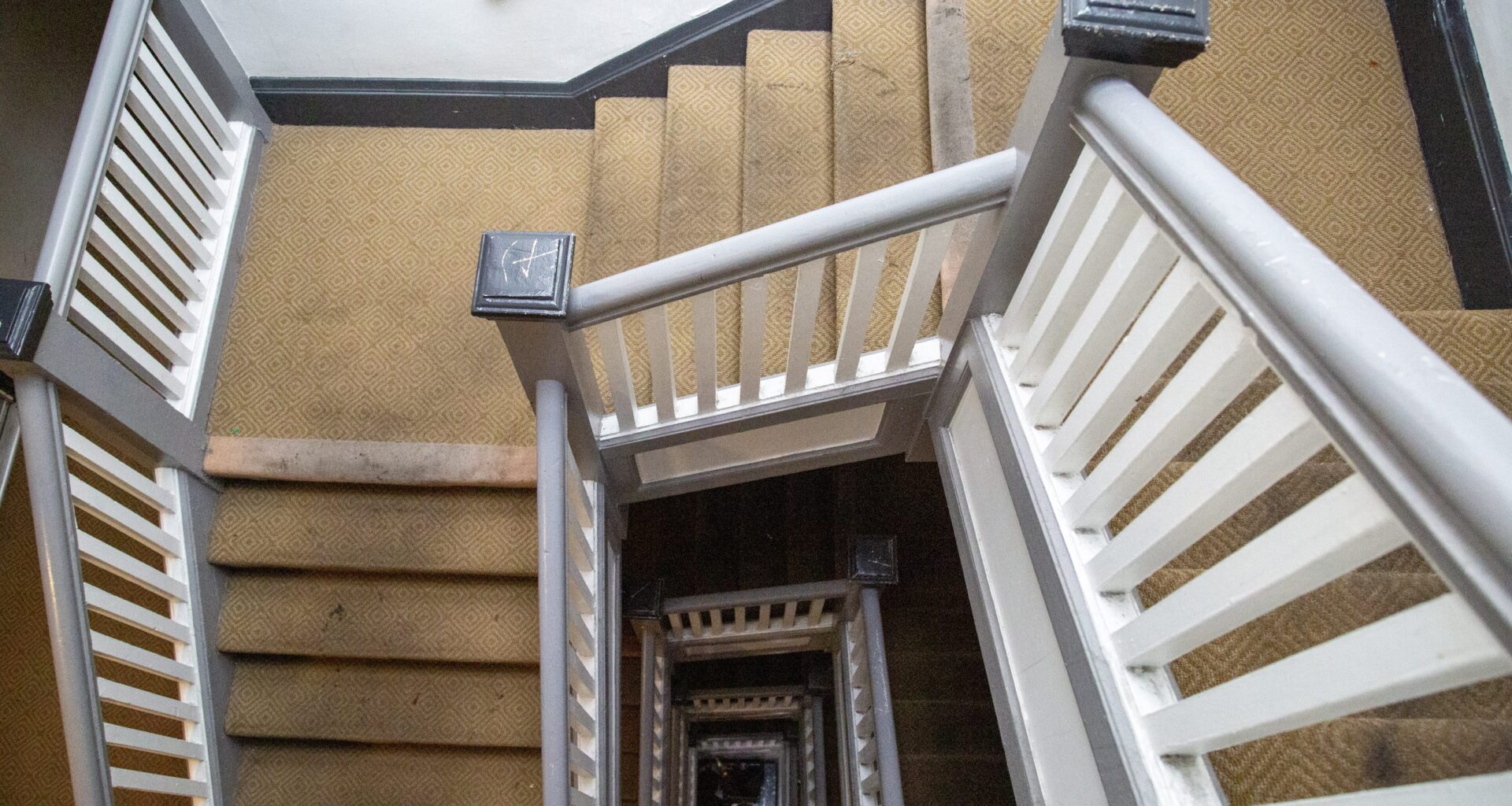
Raymond Levy, 77, lives on the fourth floor of his building at 57 Taylor St. in the Tenderloin. His knees are swollen from 10 years of arthritis, making it impossible for him to take the stairs.
In April, the only elevator in his five-story building went out for several weeks, forcing him to hibernate in his apartment, which is really a 7-by-7-foot room with one window. Other elevator breakdowns have resulted in his staying inside, aside from jaunts into the corridors, for several months.
“It’s called being in prison. It totally interrupts your life,” he said.
Levy had a heart attack in 2024, and said not having an elevator forced him to miss “countless” appointments with his cardiologist, most recently in May. The elevator wasn’t working when he had the heart attack, either. He said two employees from Royal Ambulance had to carry him up the stairs.
Levy’s building has just the one elevator. That’s common: Of the 5,400 or so San Francisco addresses with elevators registered with the state, half — about 2,800 buildings — have just one, according to public records obtained by Mission Local. There are no backup passenger elevators when one breaks in these buildings.
Mission Local has documented the effects of elevator outages before, including at former public housing complexes where seniors and disabled residents have expressed frustration that broken elevators are an ongoing issue.
No one knows for sure how many elevators in San Francisco are out at any one time. What we do know is that many have not been inspected for several years, and there are not enough technicians to quickly bring them into compliance.
Part of the problem is also legal, not just mechanical. City law requires landlords of buildings higher than 50 feet — generally four to five stories — to maintain at least one working elevator, but sets no deadline for fixing one when it breaks.
A landlord can leave a building’s sole elevator down for weeks, or months, without violating the letter of the law. That could change. Supervisor Danny Sauter announced drafting legislation in late July that would mandate elevator repairs within 24 hours, and require landlords to pay for the relocation of seniors, disabled tenants, and families with young children when repairs take longer.
Inspections and the backlog
While there is no record of how many elevators are out, there is good data on the length of time since an elevator’s last recorded inspection.
California law generally requires elevators to be inspected every year, except those covered by a full maintenance contract with a licensed elevator service company. Those can qualify for a two-year permit.
Among San Francisco’s nearly 2,800 single-elevator buildings, records show more than a third haven’t had a recorded inspection in more than three years, and nearly 20 percent haven’t been inspected in more than five years.
Levy’s building is one of them: The elevator he depends on has a permit that expired on April 10, 2026 — the same month the elevator went out. Since then, it has worked intermittently.
California’s Department of Industrial Relations, the state division responsible for licensing and inspecting elevators, says it cannot confirm with certainty what shape the elevators are actually in “due to how the information is managed.” In other words, the agency tasked with overseeing the safety of the city’s elevators cannot say, from its own records, which ones are safe to ride in.
A spokesperson for the department said it first inspects the elevators that have been out of compliance the longest, but that doesn’t happen quickly. Records show nearly 1,200 San Francisco passenger elevators, including in buildings with more than one elevator, haven’t been inspected in more than five years, some for more than a decade.
“I think everyone you’ll talk to, there’s no one who’s going to say that there’s not a shortage of inspectors,” said Greg Hardmann, 44, the business secretary of IUEC Local 8, San Francisco’s elevator technician union. “San Francisco seems to be the hardest place for the state of California to keep or bring on inspectors just because of the cost of living.”
An aging building stock
After New York, San Francisco has the biggest elevator industry in the country, in part because of the age of its buildings, Hardmann says.
State records back him up. Of the roughly 8,200 San Francisco passenger elevators with a valid installation date, the median age is about 27 years old, and about one in four are more than half-a-century old.
Some are pushing a century. The oldest elevators still in service date to 1927, including elevators in the Russ Building on Montgomery Street and the Alta Apartments on Mason Street.
Getting replacement parts for them isn’t easy. The only company that made custom parts for many of the city’s old elevators, Oak Iron Works, shut its doors in 1982. “They sold their building and retired. No one took over the business,” Hardmann said.
As a result, older elevators have to source used parts from New York and abroad. “And those secondhand suppliers charge a premium, to say the least,” Hardmann said.
Landlord neglect
Hayle Meyerhoff, the lead organizer against corporate landlords at the Housing Rights Committee of San Francisco, said she often deals with malfunctioning elevators around the city. She said tenants in 545 O’Farrell St., one of the buildings she organizes in, hasn’t had a working elevator for more than three years.
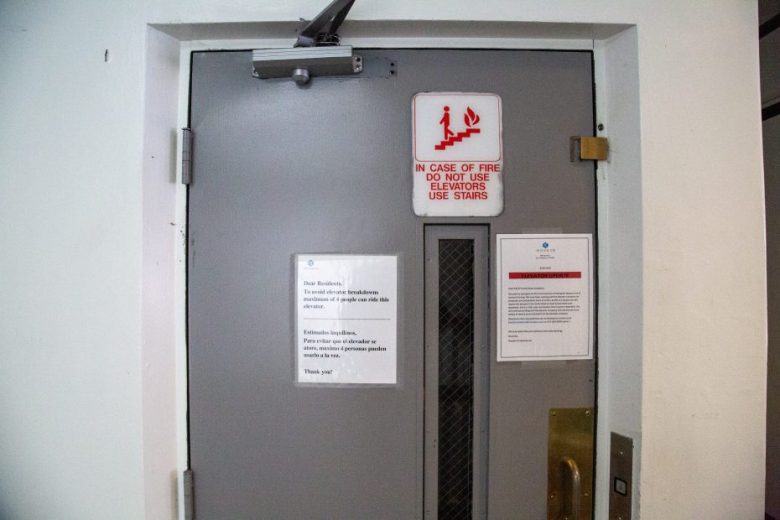 Elevator update notice for residents of 545 O’Farrell St. Taken on June 27, 2026. Photo by Hamza Fahmy.
The building doesn’t appear anywhere in the state’s elevator permit database. It’s not listed as active, and not listed as expired; it’s simply absent.
Olga, 81, has lived on the top floor of 545 O’Farrell St. for more than 21 years. She has to climb 10 flights of stairs several times a day.
 Olga, 81, hasn’t had a working elevator in her building for over three years. Taken on June 27, 2026. Photo by Hamza Fahmy.
About a year and a half ago, Olga was walking down from the third floor at night to reach a nearby corner store when she missed a few steps in the dark.
“I didn’t see three steps and fell all the way down to the second level,” she said. She hit her head, right arm and leg, and now goes to physical therapy three times a week for the pain.
The corporate landlords Meyerhoff has been dealing with often include Mosser, which owns 545 O’Farrell St. as well as hundreds of other properties around the city, and Veritas, which owns Levy’s building Levy on 57 Taylor St.
“These are multi-billion-dollar companies, and the idea that they’re not able to fix elevators or come up with a solution to get elevators fixed just isn’t really acceptable when their CEOs are making so much money in comparison to what they’re actually spending on the buildings,” Meyerhoff said.
Mission Local has reached out to Mosser and Veritas for comment on the 545 O’Farrell St. and 57 Taylor St. properties, but did not hear back. An elevator update notice from August 2025 apologized to residents of 545 O’Farrell St., saying in part “This is a 100+ year old elevator that’s beyond repairable.”
A non-working elevator can lead to other problems. Levy said his rent-stabilized building has also struggled with multiple bedbug infestations throughout the years, which forces him to rely on bedbug spray.
When the elevator is out, he isn’t able to spray his space because he can’t leave the apartment. He now sleeps on three plastic air mattresses that are stacked on top of each other, and lays out cinnamon sticks across the entrance of his apartment in hopes of preventing them from entering.
“At least I think it prevents them. That’s what Google says,” he said. (Actually, a search found no evidence of cinnamon sticks as a deterrent.)