
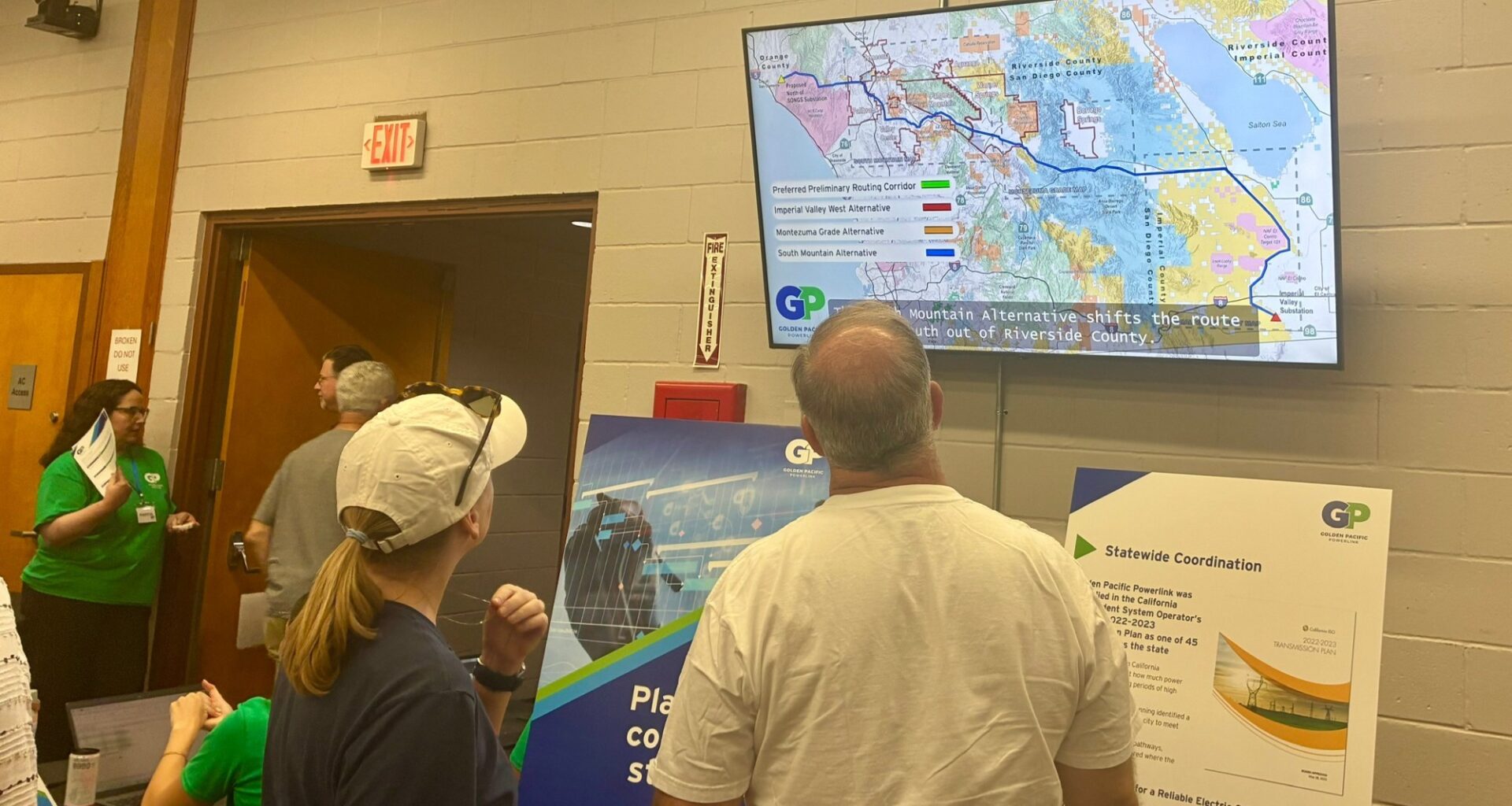
About 250 people showed up Tuesday evening in Fallbrook for the first of four open houses that San Diego Gas & Electric will host to address questions and concerns about a proposed high-voltage transmission line that would span about 145 miles through multiple counties in Southern California.
One of the attendees, Kathy Wehe, said she is dead set against the Golden Pacific Powerlink.
“That line is going right through my backyard,” said Wehe, who has lived in Fallbrook for 43 years. “For the first time in 25 years, we have mule deer on our road again. We have pumas coming up and down our street, which is fine because I live in the middle of nowhere and we want them there. That’s going to go away once they start this crazy construction.”
With an estimated price tag of $1.62 billion, the Golden Pacific Powerlink would serve as an electricity corridor, connecting SDG&E’s existing Imperial Valley substation to a still-to-be-constructed substation where San Diego and Orange counties meet.
Ultimately, the California Public Utilities Commission, or CPUC, will have the final say on where the 500-kilovolt line will go — or whether it even gets built.
Public feedback, critiques and suggestions gathered from the open houses, SDG&E officials say, will help inform the CPUC’s decision. SDG&E plans to formally file paperwork for the project with the utilities commission later this year.
The project has already generated opposition from residents and politicians stretching from the Anza-Borrego Desert to Temecula.
The open houses are one of the early steps of what figures to be a years-long process that includes public hearings, environmental impact reviews and regulatory proceedings on the local, state and federal levels.
“We all need reliable electricity and our lives increasingly depend on the electrical grid,” Erica Martin, SDG&E’s director of project development, said. “And that is why the state has identified a robust, formalized state transmission planning process to determine the state’s needs, to identify the projects that are necessary.”
The project stems from a 180-page transmission plan for 2022 and 2023 issued by the California Independent System Operator, which manages the electric grid for about 80% of the state. The plan found the need for 45 transmission projects around the state, including what was eventually dubbed the Golden State Powerlink.
The plan cited assumptions that the power system needs to add more than 40 gigawatts of new resources over the next 10 years to keep the electric system reliable and resilient — and meet California’s clean energy mandates.
The state aims to derive 100% of its power from carbon-free sources by 2045. Policymakers also intend to transition from buildings and homes using natural gas to electricity, not to mention converting California’s transportation sector from gasoline to electric vehicles.
The system operator, also known as the CAISO, has requested the transmission corridor go into service in mid-2032 or, at the latest, 2034.
SDG&E recently released a map of one route the utility prefers the transmission line to traverse, as well as three alternative routes.
Each of the suggested routes would go through Fallbrook.
“It’s going to devastate this community,” said Stephani Baxter, “and all the communities that it’s proposed to go through on many levels, not only environmental, but fire risk, insurability risk, our scenic views and vistas and property values.”
Baxter is a member of Save Fallbrook, which is opposed to the Golden State Powerlink. The group set up a table outside SDG&E’s open house.
“So many in the community are irate” about the visual impact of transmission towers as high as 200 feet carrying the power lines, Jamie Phillips said.
A conservationist who has lived in Fallbrook since 1980, Phillips worries about the project’s impact on the local environment. “I want to see alternatives to this” transmission line, he said.
Doug Schweizer of Rancho Bernardo said one of the alternate routes for the transmission line would run through property he owns in Ocotillo Wells.
“Would you want a power tower in your backyard?” he asked.
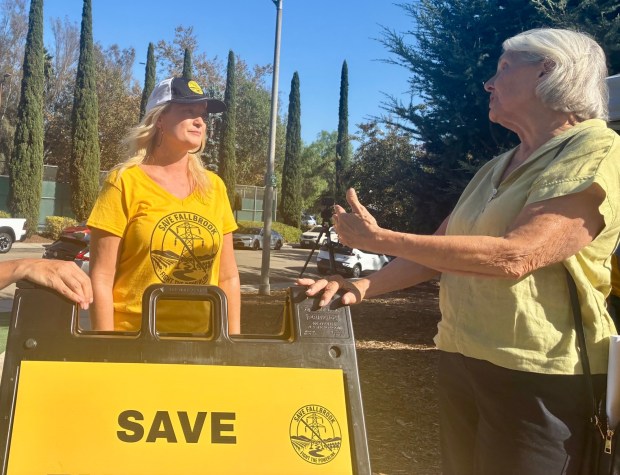 Stephani Baxter, left, of the Save Fallbrook group that is opposed to the Golden Pacific Powerlink, listens to Fallbrook resident Kathy Wehe outside the Fallbrook Community Center on Tuesday. (Rob Nikolewski/The San Diego Union-Tribune)
Rather than a formal presentation followed by audience Q&A, the open house featured tables with displays of maps of the line’s proposed routes and other details, with staffers and engineers stationed nearby to field questions on topics such as wildfire risk and electric and magnetic fields from power lines.
A representative from the CAISO who was in attendance said transmission projects such as the Golden Pacific Powerlink can help the state’s grid run more efficiently.
“We anticipate that congestion will continue to worsen as new power generation projects in the Southwest come online and we wanted to get in front of that by looking for solutions,” said Jayme Ackemann, CAISO’s director of communications. “This was one of them.”
Asked if placing the transmission line in the Fallbrook area underground was an option, Martin of SDG&E said, “There’s significant technical challenges associated with that,” as well as steeper expenses. But she reiterated the CPUC makes the final determination whether “that’s something that the ratepayers should bear the cost of.”
If the transmission line wins approval, the project’s $1.62 million tab will be spread among all ratepayers served by the CAISO. Of that, SDG&E customers will shoulder 9% of the financial burden.
SDG&E will host another open house Wednesday from 4 to 7 p.m. at the Embassy Suites in Temecula.
Two more open houses will be held in October — at the El Centro Community Center on Oct. 13 and the Borrego Springs Resort on Oct. 14. Each session will run from 4 to 7 p.m.