
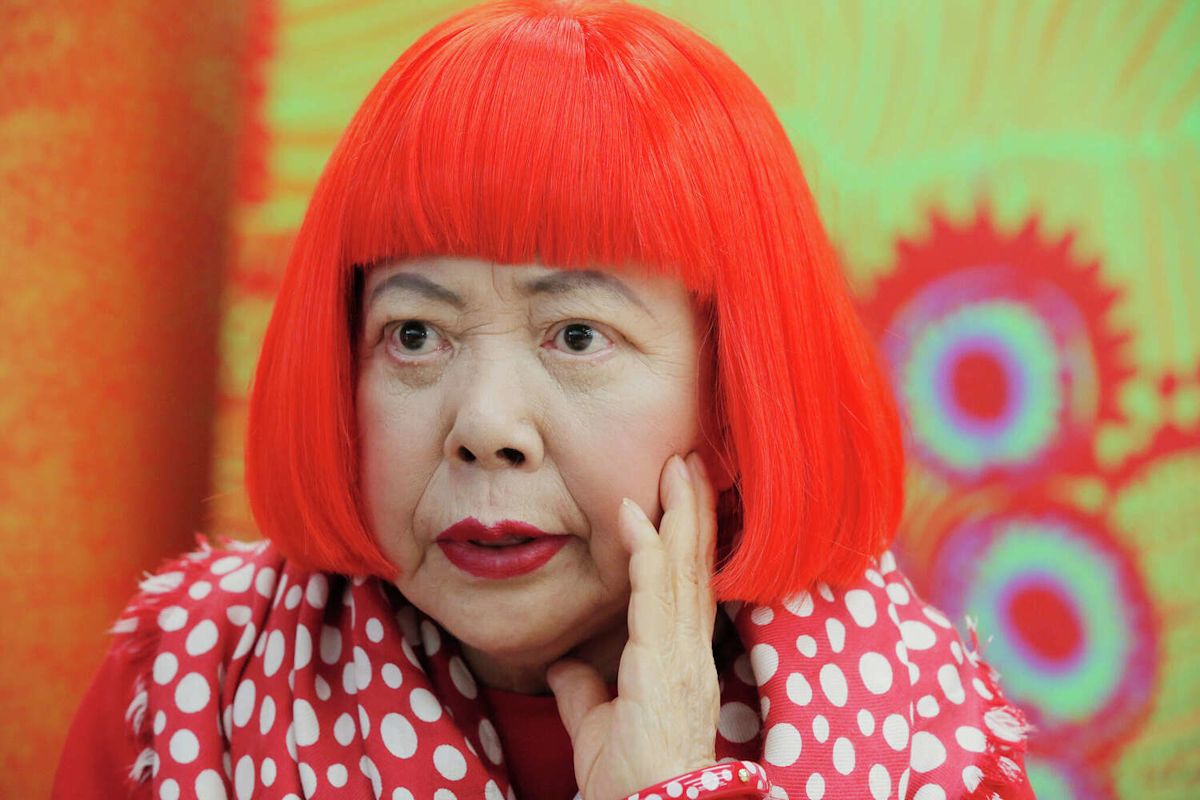
For many Bay Area museumgoers, Yayoi Kusama’s first solo Northern California exhibition at the San Francisco Museum of Modern Art in 2023 became the backdrop for selfies and Instagram reels.
Now, with news of Kusama’s death in Tokyo at 97 on Aug. 14, confirmed by the Yayoi Kusama Studio this week, the controversy that shadowed that SFMOMA show is inseparable from her local legacy.
“Yayoi Kusama: Infinite Love” brought more than 170,000 visitors to the downtown museum during its six-month run. But the show also ignited questions over racist language in Kusama’s writings spanning several decades, placing the Japanese artist at the center of a predicament many arts institutions across the country were grappling with over how to present the work of acclaimed artists with problematic pasts.
In the wake of those works resurfacing, former Chronicle staff writer Soleil Ho criticized SFMOMA’s choice to feature Kusama.
Kusama responded to the controversy in a public comment obtained only by the Chronicle.
“I deeply regret using hurtful and offensive language in my book,” she told the Chronicle at the time. “My message has always been one of love, hope, compassion, and respect for all people. My lifelong intention has been to lift up humanity through my art. I apologize for the pain I have caused.”
SFMOMA also didn’t retreat. Director Christopher Bedford declared “SFMOMA stands firmly against these and all anti-Black sentiments” and characterized it as “a tremendous leadership opportunity for SFMOMA … to become leaders in the field and thinking about the relationship between authorial complexity and artistic expression.”
During the run of the show, the institution eventually acquired the Infinity Mirror Room, “Dreaming of Earth’s Sphericity, I Would Offer My Love” (2023).

A party guest stands near Yayoi Kusama’s Aspiring to Pumpkin’s Love, the Love in My Heart during the Art Bash fundraiser for SF MOMA in San Francisco, on Wednesday, April 23, 2025. The evening features activities, performances and art installations throughout the museum (Carlos Avila Gonzalez/S.F. Chronicle)
This was Kusama at a major career pinnacle.
Famed for her polka dot motifs, giant pumpkin sculptures and “Infinity Mirror Room” installations, Kusama was considered among the most famous and successful artists in the world. She was a pioneering female superstar who began her career in the 1960s, when few women had reached that acclaim, and beame renowned for working across media including painting, installation, sculpture, performance art, film and poetry.
Dubbed the “Princess of Polka Dots,” she also cut a distinctive figure in pop culture with her orange-red bobbed hair and self-designed polka dot ensembles. Her persona itself was as famous as her artistic output, inspiring dolls in her likeness and children’s books.
Kusama also embraced collaborations beyond the art world that ranged from creating a special Louis Vuitton collection with Marc Jacobs in 2012 to designing a hot air balloon for the 2019 Macy’s Thanksgiving Day Parade.
Her international acclaim, which included representing Japan in the 1993 Venice Biennale, was seen as a unique triumph in light of her well-documented struggles with her mental health. Since 1977, she had lived in the Seiwa Hospital for the Mentally Ill in Tokyo.
But for all her success, she could not tamp down the simmering controversy that came to a boil in San Francisco on the cusp of “Yayoi Kusama: Infinite Love” at SFMOMA in October 2023.

Pumpkin, by Yayoi Kusama, sits in a pool near the main building at the Donum Estate Winery in Sonoma, Calif., on Saturday June 23, 2018. (Michael Short/Special to The Chronicle)
Earlier that year, writer Dexter Thomas published a story in the online arts magazine Hyperallergic with extensive examples of derogatory writings and characterizations of Black people as both hypersexualized and primitive in Kusama’s work.
Among the examples highlighted in Thomas’ story and subsequent reports was Kusama’s 1971 play “Tokyo Lee,” in which she describes its only Black character as a “WILD-looking, hairy, coal-black savage.”
Kusama’s 1984 novel, “The Hustler’s Grotto of Christopher Street,” Thomas claimed, also contains highly sexualized descriptions of Black characters, while white characters in the novel were not fetishized in this way.
Even in the 21st century, Kusama’s 2002 autobiography, “Infinity Net,” included a passage in the Japanese edition where she stated her former New York neighborhood, Greenwich Village, had transformed into a “slum” due to “black people shooting each other out front, and homeless people sleeping there.” (The sentence was omitted from the English translation of the book.)
After Kusama’s apology, Bedford described the gesture as more than a response to criticism, saying it offered museums a chance to confront harder questions about artistic expression and authorial complexity.
“We can use this moment as a catalyst for a broader interrogation of what it means to present artists in our galleries,” he said at the time.
For her part, Kusama “continued to paint until her final days, never setting aside her brush, and continued exploration of forever love and eternal soul,” her studio said in a statement released Thursday, Aug. 27.
Upon her death, Bedford once again reflected on Kusama’s impact on SFMOMA.
“Yayoi Kusama was a legendary artist, whose more than 70-year career challenged the ways we think of and experience art, and the world around us,” Bedford said in a statement to the Chronicle. “Her multidisciplinary practice and relentless creativity defied categorization while it delighted and inspired visitors of all ages and backgrounds.”
Subscribe
There’s more to San Francisco with the Chronicle. Subscribe today for just 25¢.
This article originally published at How Yayoi Kusama’s San Francisco triumph became an SFMOMA reckoning.