
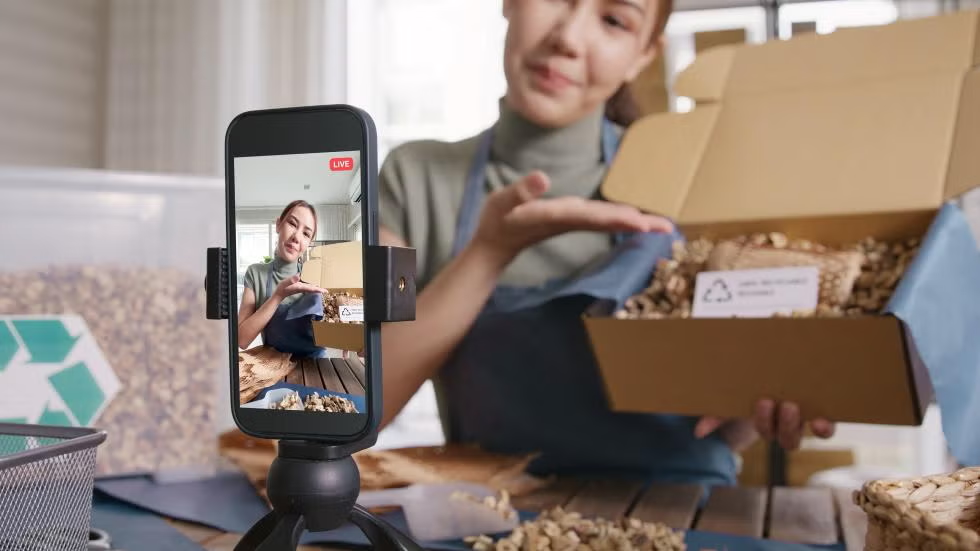
As you scroll through social
media on your phone, the signals should be easy to spot. They are
often small: a paid partnership label, a hashtag such as #ad, a
brand tag, a caption, a bit of onscreen copy. Under federal
guidelines, those clues are supposed to make commercial
relationships clear. They are meant to be the recognizable signs
of sponsored content.
Elk Grove-based Britney
Chiu (21.6K followers on Instagram @britneychiu04)
knows those signs well. The 22-year-old professional tennis
player’s profile on Collabstr, an influencer marketing platform,
offers paid packages for Instagram content, UGC (user-generated
content) and YouTube videos. She says her early gifted campaigns
evolved into negotiated brand work.
Chiu uses paid partnership labels
and hashtags when a post involves a brand relationship. But when
asked how familiar she was with the Federal Trade Commission
guidelines behind those disclosures, she was candid.
“Not that much, to be honest,”
she says. “I’ve only heard about it a few times these past few
weeks. I had someone ask me, what do you do about the FTC and all
that stuff? And I was like, I’m not too sure what that means, so
I had to do a bit of research myself.”
She’s more familiar with
disclosure practices than with the acronym. “I disclose that if
I’m doing a partnership, it’s a paid partnership or it’s an ad,”
she says. “I know that’s pretty required on those platforms,
whether it’s putting a paid partnership label or I do #partner,
#ad.”
Traditional journalists are
expected to avoid conflicts of interest by refusing gifts and
free travel. Influencer marketing works differently: Creators may
be paid, hosted or given products, as long as the commercial
relationship is clear to the audience when they recommend or
feature the brand. That distinction is one reason the FTC, which
regulates advertising and endorsement practices, including on
social media, has focused on improving transparency for online
influencers. Under FTC guidance, a material connection can
include money, free products, discounted products, hosted
experiences, affiliate commissions or other perks.
As sponsored content becomes a
routine part of social media, Sacramento-area influencers are
managing the practical rules of disclosure. That means figuring
out how to label paid, gifted and hosted partnerships, how much
guidance to rely on and how to balance transparency with content
that still feels authentic to their audiences.
The rules behind paid
influencer partnerships
While many creators begin as
passionate amateurs, they are not just people posting
recommendations. They sell packages, negotiate deliverables, work
with management companies and help businesses reach customers
through content that looks native to the platform. For creators,
that makes disclosure a practical part of the job, not simply a
formality.
Sacramento-based fashion
influencer Meghan Korte (760K followers on Instagram @the_other_mk)
remembers when creator disclosures felt looser and less
structured.
“There were none for a really
long time, or they were very loose,” she says of disclosure
guidance for creators. “In 2021, there was a huge backlash
because a lot of influencers were hiding the tags, shrinking
them, putting them in the top corner so you couldn’t see them.”
The platforms vary, but the basic question stays the same: can
the audience recognize the commercial relationship behind an
Instagram Reel, TikTok video or YouTube post?
No one hands creators a
beginner’s manual. “There’s not like a, ‘congratulations on your
small business of being an influencer, here’s a book or a
pamphlet,’” Korte says. But influencer marketing and content
creation are now established enough to appear in university
extension programs.
UC San Diego Extended
Studies offers an
influencer marketing course that covers ethical and compliance
issues such as disclosure, transparency and audience
trust.
UCLA Extension
offers a course on employing
influencers that warns marketers about the risk of violating
federal regulations.
“Even if you are sent something
and you’re posting content about it and then you go to make money
off of it, you are supposed to provide that it was gifted or sent
to you in some capacity,” Korte says. “The whole point is that
the audience should not be surprised that it was an ad.”
That creates one of the central
tensions of influencer marketing: sponsored content must reveal
the relationship while still feeling authentic to the
audience.
The challenge of
authenticity
As Sacramento-focused lifestyle
and travel content creator Maddy Edmunds (103K followers on
Instagram @maddyjedmunds)
says, “I never want my content to feel like an ad.” Edmunds, who
has worked with Visit California, Old Sacramento and the
California Lottery among other partners, says disclosure is built
into how she handles various partnerships. “If anything is paid,
or even if it’s a trade or if I’m hosted somewhere, I will still
post that paid collaboration disclosure on Instagram and on
TikTok,” she says.
The work often starts
with deliverables and budget. A campaign might call for a Reel, a
TikTok post or another piece of platform-specific content. “Once
we agree on that, then we do talk about if there is some sort of
creative brief, or if there is a certain campaign or talking
points that they would like me to hit,” she says.
Edmunds’ recent collaboration
with the California Lottery to promote a new scratcher shows that
tension in practice. Lottery promotions come with additional
guardrails: California law prohibits lottery ticket sales and
prize payments to anyone under 18. The California Lottery also
says its advertising should not target minors and should include
responsible-play and 18-and-older messaging as
appropriate.
“There were clear expectations
and clear talking points that I had to hit, and also specific
hashtags that I had to use in that content, in the stories, to
let the audience know that this is for 18 and up,” she says. She
received a creative brief, examples from past influencer
campaigns and guidelines for formatting official hashtags.
Although the resulting post includes disclosure signals like
onscreen captions and #ad hashtags, it feels more like a smartly
edited slice-of-life than a commercial.
Even as paid creator work becomes
more structured with management companies, creative briefs and
approval processes, creators still have to decide whether a
promotion fits their own brand. “Now that I have a management
company, they’re pretty good at finding things that align with my
brand,” Edmunds says. “I definitely have no problem letting them
know up front if this does not align with my brand or my
values.”
That question of fit and
brand identity is especially important for Gina Ragland, also
known as Sactown Supermom (18.1K followers on Instagram @sactownsupermom),
who spotlights kid-friendly local events, attractions and day
trips. Ragland is selective about the sponsorships she accepts
because anything she shares must be useful to the families who
follow her. She says she started the account to help busy parents
find family activities without searching across dozens of
sites.
“A lot of times I’m just off
doing stuff and trying to share fun things that me and my family
do,” she says. “I pay out of pocket for a lot of the
stuff.”
Ragland’s background in social
media and digital marketing helped her understand the importance
of disclosure and audience trust. “If I am paid, it is always
labeled for me with a paid partnership label,” she says. “I want
to make sure that my followers can trust me. If you have five
followers versus five million, everyone should be following the
same protocol.”
–
Never miss a story: Get Comstock’s weekly newsletter delivered to your
inbox.